

Australians are rightly concerned with violent abuses of powerless people far away in the Middle East. Yet next door, similar evils thrive. Duncan Graham reports from Indonesia.
The Indonesian military’s interference in high school and university education is threatening the next generation’s knowledge of the world and how issues affecting their lives are being erased.
The documentary Pesta Babi (Pig Feast) has been banned by civic authorities and soldiers from three locations: the public Mataram University (Lombok Island, alongside Bali), North Maluku, and Yogyakarta in Central Java.
Intimidating discussions of the film are pushing students away from inquiry, the core of all learning. They’re turning into sheep.
The Indonesian producers say their film “chronicles the struggle of indigenous Papuans to defend their ancestral lands and forests from the threat of food security projects or food estates. “The documentary also exposes the involvement of business circles, palm oil conglomerates and the Indonesian Military in government-backed national strategic projects.”
A news account of the Mataram Uni banning read: “Efforts at negotiations between the committee and several student organisation officials yielded no results, and an argument ensued. The campus authorities were unwilling to compromise and remained firm.
The event was then forcibly broken up without any justification.
Last month, another screening of the film by the Alliance of Independent Journalists (AJI) and the Society of Indonesian Environmental Journalists in Ternate City, North Maluku, was closed by Lieutenant Colonel Jani Setiadi, claiming social media rejections of Pesta Babi.
(Ternate is 1,660 km northeast of Mataram. West Papua is a further 500 km east of Ternate, a volcanic island in the Maluku group. There are about 17,500 islands in the Indonesian archipelago.)
“There’s been a lot of opposition to this film screening on social media because many people think it’s provocative,” Jani reportedly said. He was formerly a deputy commander of an infantry battalion.
“… the joint screening [should] not go ahead considering that issues of ethnicity, religion, race and intergroup relations issues in North Maluku are highly sensitive and easily politicised.”
AJI Ternate Chairperson Yunita Kaunar alleged Jani’s orders were “an act of intimidation against legitimate civilian activities.
“If every critical work is considered a threat and then silenced, then democracy is in a dangerous situation. The state must not be afraid of discussions and documentaries.”
In late April in Yogyakarta, a scheduled showing at a Catholic venue was cancelled without reason. The Central Java city is Indonesia’s cultural HQ.
Army influence
These episodes amplify concerns that Indonesia is being run by the army,
freed from the barracks by their boss, disgraced former general now President Prabowo Subianto.
Now he’s back in the top job and militarising the Republic of 285 million – that’s 11 to one Aussie. There are just three other nations with more people – India, China and the US.
Though trained to kill, be-medalled officers in the Tentara (military) Nasional Indonesia have been taking over the jobs of peaceful civilian bureaucrats. No appropriate experience or qualifications? No worries, it’s the discipline that’s needed.
Now the men in khaki have turned censors, shutting down screenings of the 57-minute Pesta Babi.
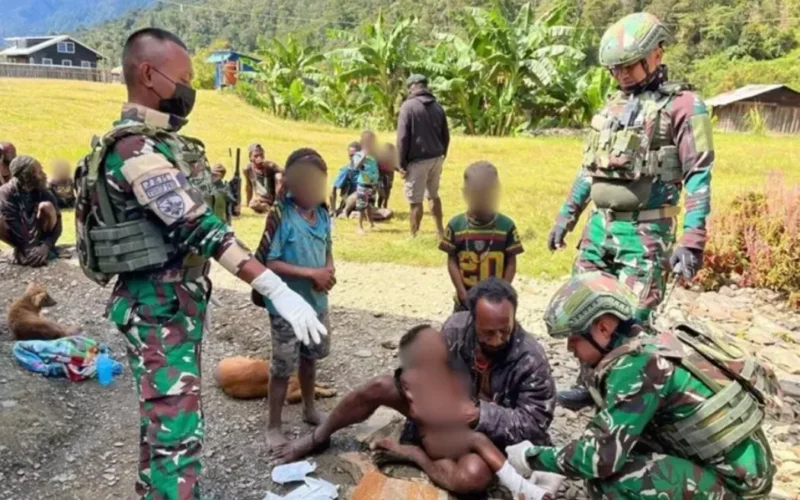
The soldiers from Java watching out for spears and jungle-track ambushes in West Papua tend to be Muslims; pig products are haram (forbidden), so meals aren’t shared with the Christian locals.
That ensures convivial sit-downs to talk peace are rare.
West Papua suppression
West Papua has been shut to foreign journalists for decades. Twelve years ago, activists in London claimed:
“Dozens of demonstrators dressed in black gathered outside the Indonesian Embassy today to lead the global protest against West Papua’s 50-year-long isolation. The demonstration was organised by TAPOL (an international organisation for Indonesian political prisoners) and Survival International, supported by Amnesty UK and the Free West Papua Campaign.
“The rally was one of 22 protests around the world calling for free and open access to Indonesia’s most secretive region.”
More than 83,000 soldiers on rotation and carrying modern weapons have been trying to put down bow-and-arrow guerrillas protesting possession of West Papua and its enormous mineral riches.
The Grasberg mine has one of the world’s largest reserves of gold and copper. It’s a joint venture among the governments of Indonesia, Central Papua, and the US company Freeport-McMoRan.
In colonial times West Papua was the Netherlands New Guinea. It was taken over by Indonesia in 1969 after a referendum of 1,025 hand-picked ‘leaders’ claimed they wanted Jakarta’s control. It was called the Act of Free Choice, retitled by cynics as the Act Free of Choice.
The population is now an estimated 5.6 million. About two-thirds are Christian.
Pig Feast
Scenes in the Pesta Babi film show villagers opposing the destruction of the jungle, erecting large crucifixes. The most impactful vision has a colossal barge laden with scores of new yellow front-end loaders crawling off the deck, rolling onto land and bashing into the green bush.
Indonesian journalist Made Supriatma, a Visiting Fellow at Singapore’s Institute of Southeast Asian Studies, was due to comment:
“Once a Papuan speaks, even through film, it’s banned. And this ban occurs in a place owned by the Catholic Church … that should give those silenced by the authorities a chance to speak.”
Antipodean support for the Papuans has mainly come from NZ where activism thrives, though there are some supporters across the Ditch. Parramatta’s Catholic Outlook newsletter commented:
“The Papuan Church, which has long been dominated by Indonesian clergy, has done little to protest the state’s exploitation of this resource-rich region’s forests and minerals, disregarding the fundamental rights of Papuans to live on their land.”
In early May, seven young Papuans in the Central Highlands were injured – one seriously – when police allegedly opened fire on a parade of school graduates displaying the banned West Papuan nationalist Morning Star flag.
The National Indigenous Times reported a government spokesman claiming, “Local authorities in close relations with civic groups, including church authorities and traditional leaders, are currently trying to conduct a thorough investigation regarding the incident.”
Observers of the 60-year conflict between indigenous tribesmen and imported troops estimate more than 100,000 West Papuans have been killed since the Indonesian takeover.
Indonesian researchers have been “mapping the violence that has occurred, in part inspired by the massacre mapping project of Indigenous people in Australia by the Guardian and the University of Newcastle.”
No sign yet that Jakarta sees the ongoing hate and anger as needing attention. That will require so many deaths the world starts to notice. Whether that would include the Australian government is questionable.
Indo-Oz treaty. Pandering to Prabowo, ignoring unrest, West Papua

Duncan Graham has a Walkley Award, two Human Rights Commission awards and other prizes for his radio, TV and print journalism in Australia. He now lives in Indonesia.