
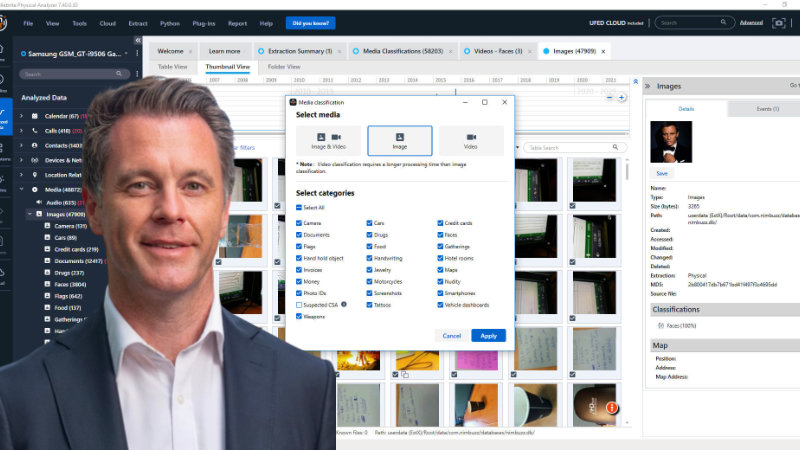
Legislation before NSW Parliament will allow police to extract mobile phone data without a warrant, using technology developed by Israel Defence Force veterans. Michael Sainsbury reports.
On Friday, the NSW Minns government introduced legislation that would give police effectively unfettered powers, including on roadside stops, to use military-grade Israeli-built mobile phone spyware known as Universal Forensic Extraction Devices (UFED), widely used by ICE and border security agents in the United States.
The move is the latest expansion in the use of technology built by NASDAQ-listed Israeli firm Cellebrite across Australian state and the Commonwealth and mimics similar powers available to police in Victoria and Queensland..
Cellebrite, currently valued at $US3.9B, is one of a group of technology surveillance companies to emerge from the Israeli Defence Force signals unit that also include Paragon Solutions, Cognate and Verint.
Cellebrite has won Australian government contracts worth tens of millions of dollars since 2017 for its UFED, software and military style equipent from more than two dozen agencies or departments, including police in Victoria, Queensland, Western Australia, South Australia, the ACT and Northern Territory.
Federally, Cellebrite technology is used by the Department of Defence, Australian Taxation Office, the Australian Federal Police, ASIO, the Border Security Force, the Australian Criminal Intelligence Commission and Services Australia and many more.
Unwarranted seizure and rising jail terms
The legislation will allow police to compel access to citizens’ phones during arrests, roadside stops and other lawful detentions.
They will also be able to take unredacted images from toll road cameras and add NSW driver licence photographs to the national facial recognition ($) database. It also doubles penalties for refusing to answer NSW Crime Commission questions to 10 years’ jail.
The Bill expands the digital evidence access order (DEAO) regime created by the Law Enforcement (Powers and Responsibilities) Amendment (Digital Evidence Access Orders) Act 2022, which inserted Division 4A into Part 5 of the Law Enforcement (Powers and Responsibilities) Act 2002 and commenced on Febuary 1, 2023.
Until now, an order could only be sought where a device was seized under a search or crime scene warrant. Refusal to comply will now be an offence that
expressly overrides the common law protection against self-incrimination.
“Most people in NSW would be alarmed to know that the NSW police, using data from an Israeli corporation … can access any message they have ever sent, any photo they have ever taken, their location at any moment, everything they have ever searched and biometric data about who they are,” NSW Greens upper house member Sue Higginson, a lawyer, told MWM.
“Barely a week has gone by since Labor’s Chris Minns came to power where we haven’t had some knee-jerk law and order measures introduced that have punished the community, bolstered the Police Force, and secured the Premier more personal power,”
“These changes are a matter of concern for every single person that lives in NSW, while couched as targeting organised crime, they will apply to everyone. The face of every single person with a licence in NSW will be up for sale to the highest bidder on the dark web if these laws pass,”
“They are part of the continuing trend towards personal privacy being diminished in favour of extensive and opaque police powers and a State that will soon have the right to permanently store your entire digital history as a result of relatively minor infringements,”
The government has promoted the new legislation as targeted at organised crime, the government’s media release stating, “The NSW Government is today introducing new laws into Parliament to modernise the fight against organised crime, giving the NSW Police Force and NSW Crime Commission stronger powers to investigate sophisticated criminal networks, disrupt their operations and hold offenders to account.”
Minns’ government record
The Minns government has form here. In April 2024 the government created a stricter bail test for 14 to 17 year-olds with a 12-month sunset, then extended it three years to 2028.
In November 2025, it made it easier for prosecutors to rebut doli incapax, which presumes children aged 10 to 13 lack capacity to be criminally responsible. In February this year, councils were given power to cut water and electricity to unlawful places of worship. In June, organised crime laws lifted the maximum for recruiting a child into crime and extended asset forfeiture from one year to five.
The Court of Appeal has twice set a limit on what the state can do to a crowd. Each measure was implemented as an often knee-jerk response to a specific event.
“Unconstitutional”. Court strikes down Minns’ draconian anti-protest laws
But as Higginson noted, the police shackles will effectively be off if the legislation is passed – and it’s hard to see the Coalition, under law-and-order hardliner Kelly Sloane, knocking it back.
She noted that there is no published policy that governs how extracted data is stored, shared or destroyed, and none is destroyed when a matter finishes. So the data is retained indefinitely with no requirement to destroy it, which is how material from the Brittany Higgins criminal investigation later surfaced in defamation proceedings.
There are no reporting requirements for any government agency on Cellebrite use, Higginson said.
Cellebrite and human rights
Cellebrite has sold products to governments known for significant human rights violations such as China, Saudi Arabia, Turkey, Russia, Belarus, Serbia, Nigeria, Botswana, Uganda and Venezuela.
“Cellebrite has been at the centre of numerous accusations and reports on its connections to human rights abuses including the torture of a dissident in Bahrain,” according to US Member of Congress Malinowski (2021). “Cellebrite’s devices have been linked to [a] military crackdown in Myanmar that has resulted in the deaths of over 750 people’, while the technology was presented as central to the 2018 trial of two Reuters reporters who uncovered evidence of a Rohingya massacre the year before”, a November 2025 paper by academics at Deakin University and Canada’s Ontario University said.
An investigation by MWM has shown tracking Cellebrite contracts is difficult as a number of states, including NSW, Western Australia and South Australia, have said police technology contracts are confidential, and it uses a range of local resellers, including Faxtech.
Federally, Cellebrite has won at least 178 tenders for 28 contracts totalling $7.6m, according to AusTender. Victorian Police have inked two consecutive contracts with Cellebrite from 2017-2027 with a combined $19.1m.
Freedom of Information documents lodged on the NSW Police Force website show that 160 Cellebrite kits have been deployed throughout NSW police locations, as at June 30, 2025. The number of phones that have been scanned during FY22-23 was 13,897, FY23-24 was 7,765, and FY24-25 was 9,132.
NSW residents remain in the dark
In response to questions on notice by Higginson, answered in March, NSW Police and Counter-Terrorism Yasmin Catley said: “The NSW Police Force does not, nor has it ever, engaged Cellebrite to facilitate digital surveillance”.
Yet it does just that. The NSWPF utilises Cellebrite; contracts are commercial-in-confidence. The NSW Crime Commission does not have a contract with Cellebrite. The expenditure on Cellebrite products cannot be disclosed because it is commercial in confidence. The expenditure has been allocated through NSW Government funds.”
A wall of silence, just like any good police state.
Chris Minns’ stormtroopers. Guns for graffiti, silence for the dead

Michael Sainsbury is a former China correspondent who has lived and worked across North, Southeast and South Asia for 11 years. Now based in regional Australia, he has more than 25 years’ experience writing about business, politics and human rights in Australia and the Indo-Pacific. He has worked for News Corp, Fairfax, Nikkei and a range of independent media outlets and has won multiple awards in Australia and Asia for his reporting. He is a fierce believer in the importance of independent media.