

A month after a 37-year-old jazz festival was cancelled over superannuation paperwork, no agency has produced a document showing anyone worked out what Payday Super would do to musicians. The union covering them says it was never asked either. Josh Barnett reports.
“Musicians have been legally entitled to superannuation since July 1, 1992. Almost none of them ever got it.” We broke this story last month. The public response to the billion-dollar black hole for performers – 82%of musicians have never seen a cent of their super in three decades – was strong. The regulatory response not so much.
On 13 July, a Freedom of Information request was lodged with the Australian Taxation Office. It asked for internal analysis of what Payday Super does to performers and the creative sector, how many hospitality and live music venues the ATO has audited for super guarantee, and correspondence between the ATO and the Media, Entertainment and Arts Alliance (MEAA).
The reply came on 29 July, from a senior lawyer in the ATO’s Office of General Counsel.
“I have ascertained that there is limited information/documents to provide in response to your request,” he wrote. In its place he offered something else. The Superannuation and Employer Obligations business line would like to arrange an interview, to explain what the ATO is doing in the super guarantee space, how payday super operates generally and in relation to performers, and the updates being made to online materials for taxpayers.”
Would I be agreeable, he asked, to withdrawing the FOI request in exchange? An answer was needed by close of business on Monday 3 August.
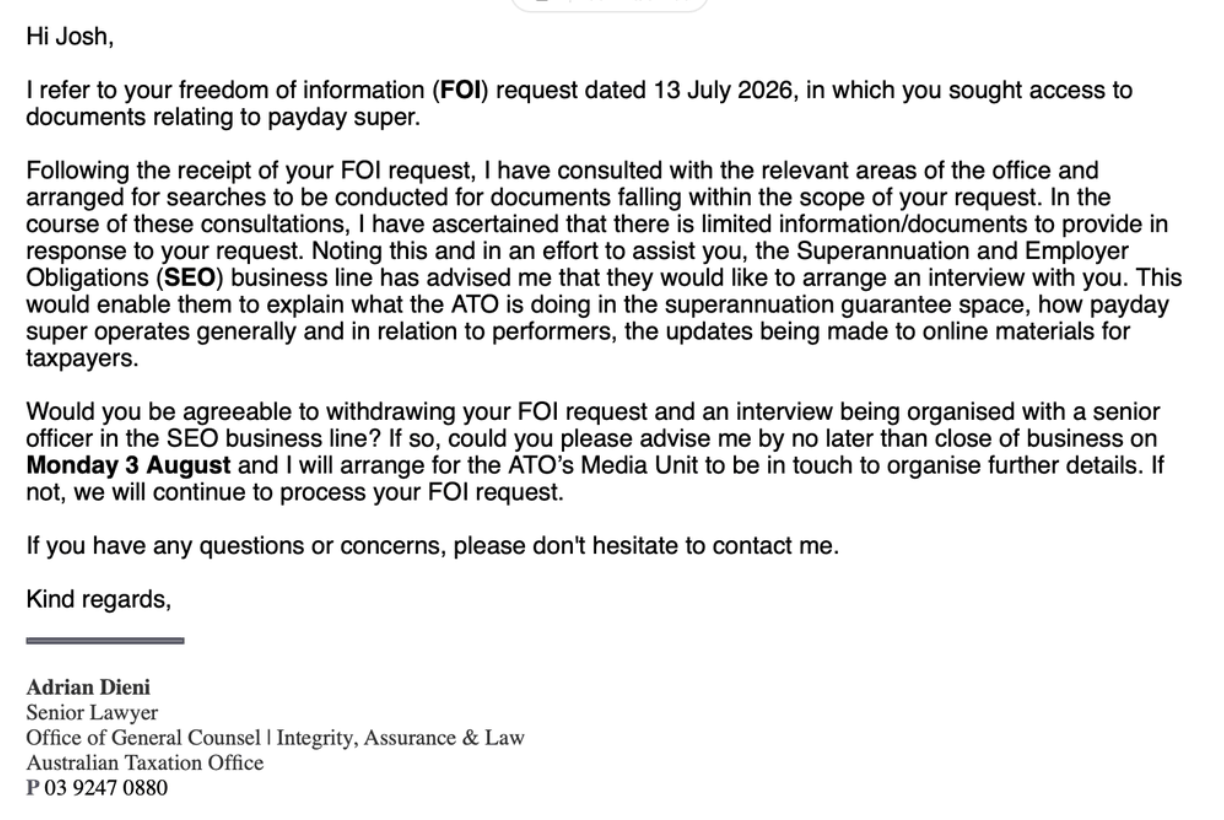
The ATO’s response to the FOI request, 29 July 2026.
Offering an interview in place of documents is not improper, and agencies do it routinely. It is also not the same thing. An interview produces quotes. A document shows whether the work was done. I declined to withdraw. The request is still being processed.
The same questions, one state down
On 22 July I put five questions to Create NSW, the state’s arts funding agency, through the Department of Creative Industries, Tourism, Hospitality and Sport. Two of them were simple. Has Create NSW made representations to Treasury or the ATO about what this law does to the NSW creative sector? And was Create NSW itself consulted while the law was being designed, including the exposure draft roundtables held between 14 March and 11 April 2025?
The Department’s media team answered that afternoon: “We’ve noted your enquiry and will aim to come back by your deadline.”
The Department’s reply, 22 July 2026. Nothing has followed it.
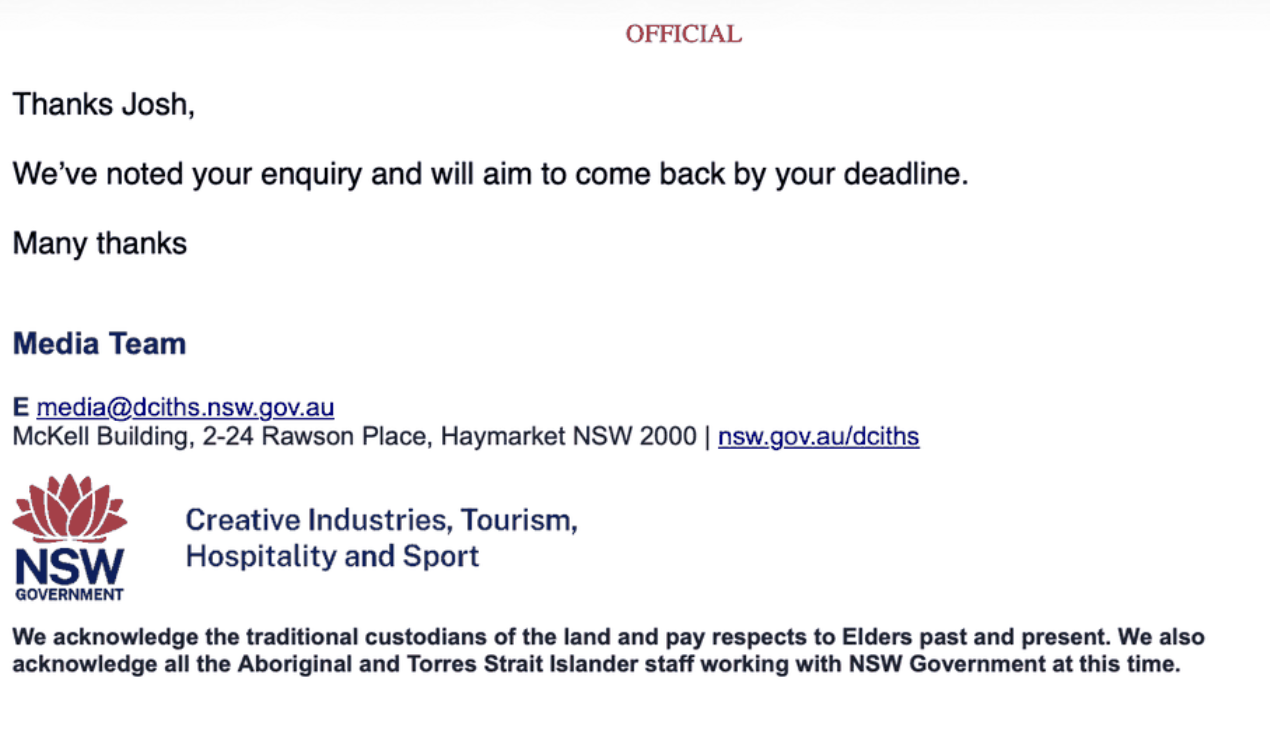 The deadline was 1 pm the following day.
The same questions went to Sound NSW, the state government’s dedicated music office, on the same morning. Its mailbox sent an automatic acknowledgment. Nothing has followed that either.
The Union wasn’t asked either
The Media, Entertainment and Arts Alliance has now come back to us. When we first put the liability question to the union, it redirected to its campaign for a $250 minimum performance fee. Days after that story ran, MEAA published a Payday Super explainer for members. Which still has the same gaps and holes the original ATO advice gave.
Its response to our questions, attributable to Paul Davies, MEAA Director, Musicians:
“We recognise that volunteer-run organisations and community festivals may face different administrative and resourcing challenges from commercial operators. However, unless musicians (and other workers) have explicitly decided to volunteer their services, which is often the case in community not for profit and fund-raising events, they must receive their lawful entitlements, including superannuation.”
“While the responsibility for ensuring superannuation is paid could differ depending on the contracting arrangement, the reality is that in more cases than not, musicians are currently not receiving superannuation when they play gigs.”
One line in that answer goes further than the rest. “We were not consulted by the ATO on recent advice and draft rulings, but we have informed ourselves about them,” MEAA says.
Treasury’s own ministerial submission on the law, obtained under FOI 4112, listed everyone consulted before Payday Super was designed: large and small business employers, digital service providers, unions, super fund trustees, clearing houses, onboarding services. Across 31 pages, no mention of musicians, performers, the arts or entertainment.
The regulator then wrote the guidance that decides when a musician gets super, and the union representing musicians says it wasn’t asked about that either.
Some paying, others cutting back
None of this is new law for musicians. Super has been owed on gig work since the Superannuation Guarantee (Administration) Act commenced on 1 July 1992.
What changed on 1 July this year is the deadline, not the debt. Three decades of an obligation nobody enforced has landed on venues and volunteer committees at once, and the responses are splitting in two directions. Sydney Agency Launch Squad has told its followers it is paying super on top of performance fees.
The Alley Entertainment Centre has told its audience it is cutting back live music. Same rule, same month, opposite outcomes for the musicians who play there.
The Australian Live Music Business Council was collecting submissions from artists on how the rules work in practice, ahead of a meeting with the ATO this. It is asking musicians to describe their own booking arrangements, on the argument that the spread of real situations shows the guidance does not match how the industry books work.
On 28 July, Sydney’s MoshPit Bar announced it will close permanently on 28 November after nine years of booking emerging heavy and punk acts, citing “ever-increasing operating costs, combined with declining revenues.”
Its operators did not name superannuation as a factor, which is worth stating plainly: the point is not that Payday Super closed MoshPit, it is that small venues are absorbing a new per-payday obligation in a year they are already losing.
That is the state of it a month in. Musicians are being asked to explain their own industry to the regulator, because nobody in government appears to have done it for them.
The Newcastle and Hunter Jazz Club meets on 30 August, the weekend its festival would have run, to decide whether the club continues.
So far the only thing anyone has offered to put on the record is a conversation.
If you know of another venue, club or festival caught in the same trap, contact us at MWM.
Three decades unpaid. 82% of musicians have never seen a cent of their super

Josh is a journalist, musician and cameraman who is working with Michael West Media to develop The West Report and other visual content across major social media channels, as well as researching and writing articles.