
Australians lost almost a quarter of a billion dollars in the first three months of 2026, with online cons driving the largest losses.
Scammers cheated Aussies out of $248.3 million in the period, according to 60,657 reports received by Scamwatch and ReportCyber.
However, the number of scam reports and losses fell by roughly a sixth compared to the same three months in 2025, in a sign that efforts by governments, regulators, industry, and police are working.
“That said, we caution against drawing too much from one quarter of data as reports and losses typically move around somewhat,” the consumer watchdog, which oversees Scamwatch, said in a statement.
“We will continue to monitor closely to see whether this quarter’s data represents the beginning of a trend.”
Investment scams accounted for the highest reported losses to Scamwatch in the first quarter, amounting to $45.5 million.
Relationship scam losses rose to $7.5 million, while phishing scams remained one of the most commonly reported grifts, with more than 13,400 reported over the period.
Email remains the most common method scammers use to snare victims.
Australians lost $2.2 billion to scams in 2025, down from a peak of $3.1 billion in 2022.
Showing the scale of the problem, the Australian Competition and Consumer Commission’s National Anti-Scam Centre disrupted thousands of scam operations over the quarter.
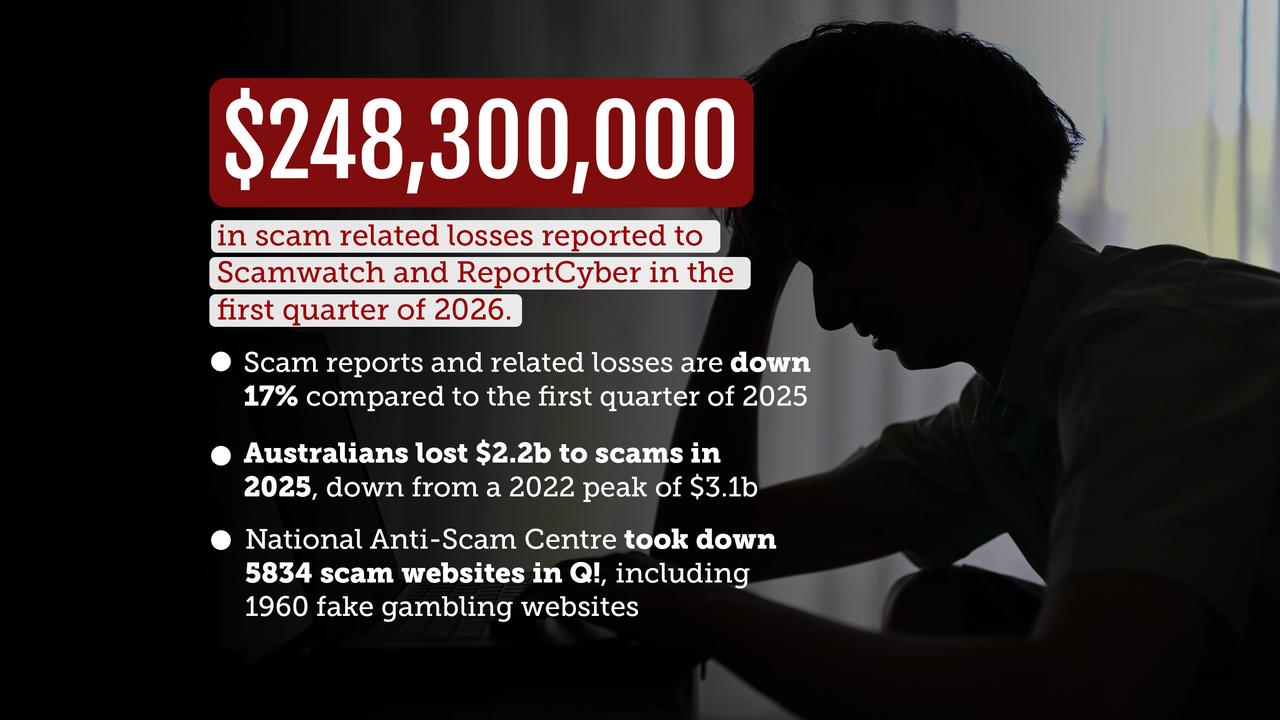
They took down almost 5,900 scam sites, including 1,960 fake online gambling – or scambling – websites.
”Online platforms give scammers the ability to reach large numbers of people quickly, cheaply and convincingly,” commission deputy chair Catriona Lowe said.
”Disrupting scam websites is one of the ways we can make it harder for criminals to reach Australians online.”
The Anti-Scam Centre also referred 511 advertisements, profiles and groups on Fecebook to platform-owner Meta for investigation.
Scammers are increasingly using polished and professional-looking content to appear legitimate.
”Consumers should be cautious if a website or advertisement creates urgency, promises high returns or asks for payment or personal information up-front,” Ms Lowe said.
People should always pause before sharing personal information and be wary of high-pressure situations.
“Say no, hang up, or delete suspicious messages,” the watchdog said.

“Contact the person or organisation directly using phone numbers or email addresses you find on their official website or app.”
People should contact their bank immediately if they think they’ve lost money or shared financial details.
WHAT TO DO IF YOU GET SCAMMED
* Contact IDCARE (www.idcare.org or call 1800 595 160) if you want support to recover – they can help you create a plan to mitigate the damage
* Report to Scamwatch (www.scamwatch.gov.au) to help protect others
* Report to police (www.cyber.gov.au)
* Change passwords and security details if you think they’ve been compromised
* Monitor your bank statements and credit reports for unusual activity
* Report the scam to the impersonated organisation and platform where the scam is happening
Lifeline 13 11 14
beyondblue 1300 22 4636

Australian Associated Press is the beating heart of Australian news. AAP is Australia’s only independent national newswire and has been delivering accurate, reliable and fast news content to the media industry, government and corporate sector for 85 years. We keep Australia informed.