
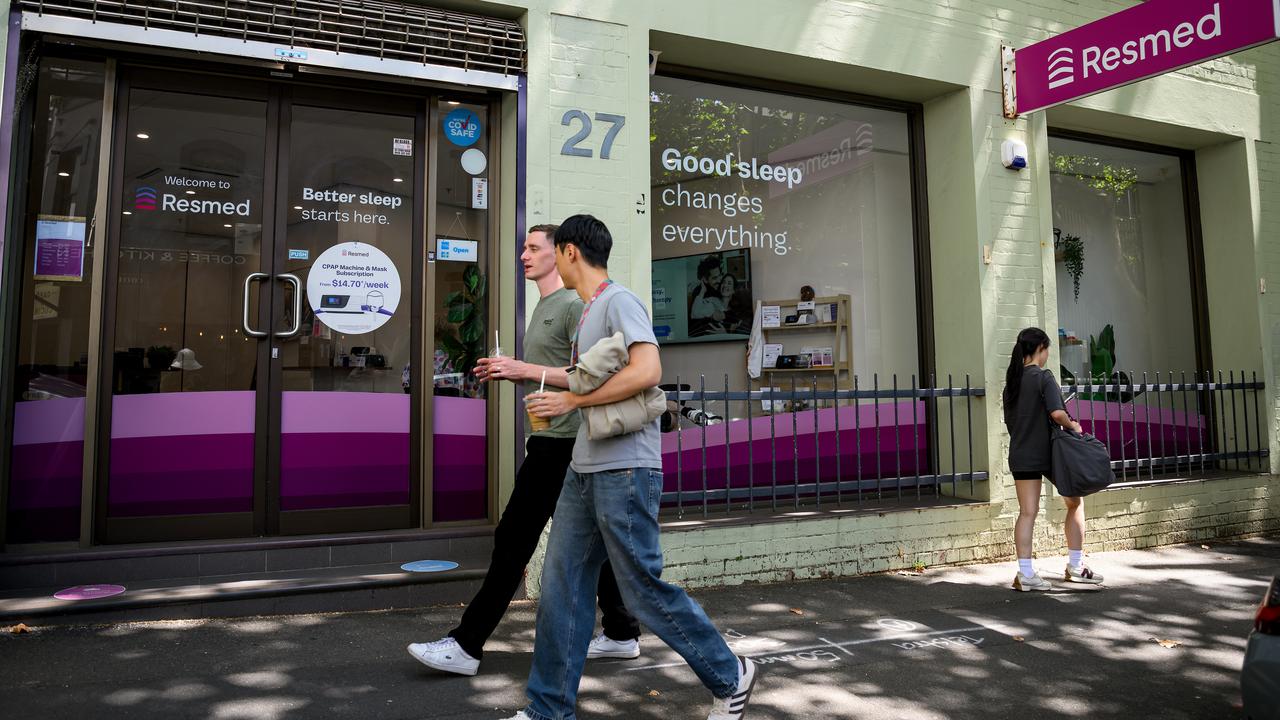
An Australian-American medical giant leading the world in products to treat sleep apnoea is branching out into another major sleep disorder – restless leg syndrome.
Resmed has bought Noctrix Health, a California-based company that makes a wearable device to treat Will-Ekbom Disease for $US360 million ($500 million).
The syndrome is the third-biggest sleep disorder, affecting as many as seven per cent of the adult US population, Resmed boss Mick Farrell told AAP on Friday.
“Their legs will pivot and kick, and it’s very bad for the bed partner, obviously,” he said.
“It can be treated by drugs, but they have awful side effects, so many people don’t; they just go without treatment, and have this awful thing all their lives.”
Noctrix’s newly launched Nidra device has cuffs that wrap around a patient’s leg and provide electro-stimulation to stop the twitching.
Noctrix is much smaller than Resmed, currently generating about $US24 million ($A33 million) a year in revenue, compared to about $US5.5 billion ($A7.7 billion) for its new parent.
Mr Farrell said Resmed had been eyeing the company for years and decided now was the time to buy.
“They’re growing faster than us, and their gross margin’s higher than us, and we can scale them nationally and beyond,” he said.
The Nidra product is similar to Resmed’s continuous positive airway pressure (CPAP) machines used to mitigate sleep apnoea, including snoring and breathing interruptions.
Both are non-invasive devices and available via prescription from sleep doctors, Mr Farrell said.
The US and Australia-listed Resmed also has some digital products for patients who suffer from insomnia.
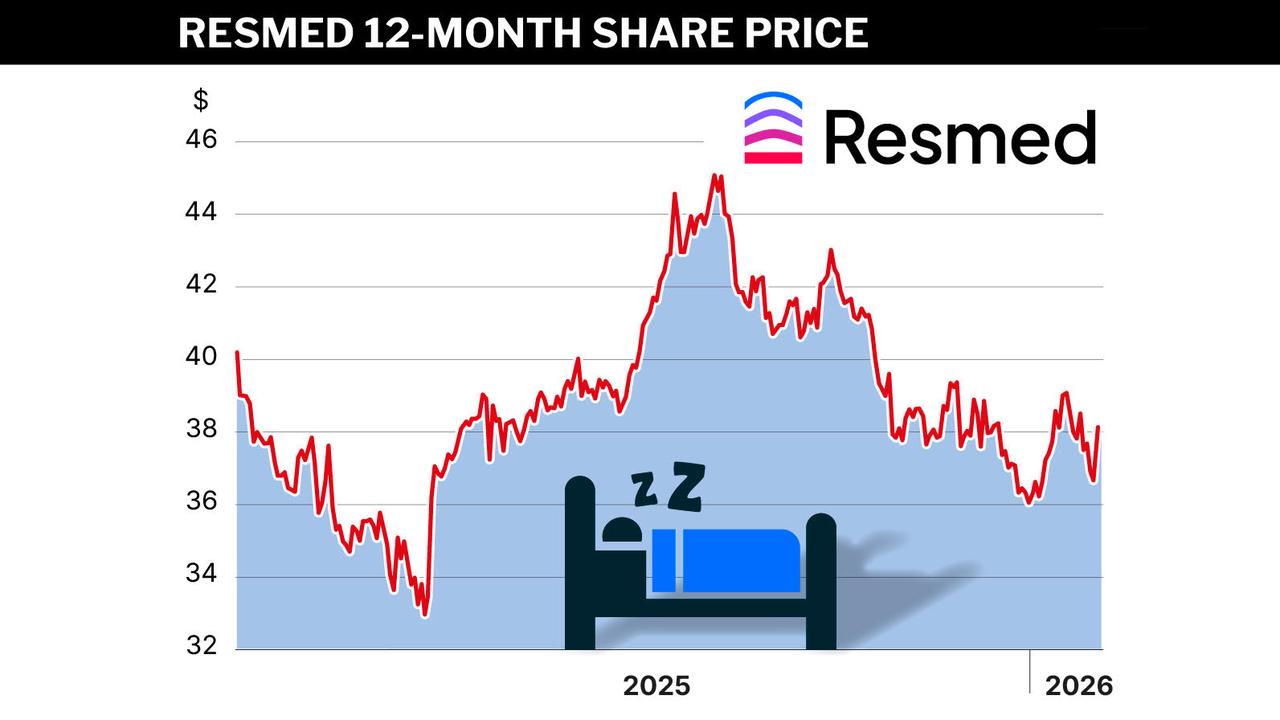
On Friday, Resmed announced revenue for the third quarter rose 11 per cent to $US1.4 billion ($A2 billion), while gross margin climbed by 2.9 percentage points.
During the quarter, Resmed accumulated more evidence Ozempic-style GLP-1 drugs will be a tailwind for Resmed, rather than a headwind, Mr Farrell said.
Since sleep apnoea is closely linked to obesity, investors initially thought the opposite, prompting a big sell-off in Resmed shares in late 2023 and early 2024.
Resmed tracking of 1.7 million patients who were using a CPAP machine and then prescribed a GLP-1 drug showed they were five per cent more likely to be using a CPAP machine two years later.
That compared to patients who hadn’t been prescribed a GLP-1 drug.
“I have the correlation. I don’t know the causality or the root cause of it. We’ve got a lot of hypotheses,” Mr Farrell said.
Weight loss may lower the pressure needed to keep a patient’s tongue off their uvula, making CPAP machines more comfortable to use, he said.
RBC Capital Markets analyst Craig Wong-Pan said Resmed’s results were slightly above consensus.
Its Australian shares dropped 4.3 per cent to $28.51 in afternoon trading.
Investors might have been concerned by the retirement of the company’s chief financial officer of the past 20 years, Brett Sandercock.
He’ll be replaced by Aaron Bloomer, who recently served a similar role at cancer diagnostics company Exact Sciences.

Australian Associated Press is the beating heart of Australian news. AAP is Australia’s only independent national newswire and has been delivering accurate, reliable and fast news content to the media industry, government and corporate sector for 85 years. We keep Australia informed.