

The much-heralded ‘News Media Bargaining Code’ only served to line the shallow pockets of mainstream media. The revised scheme is designed to change that, but will it? Kim Wingerei asks.
When introduced in 2021, the News Media Bargaining Code was meant to help Australian media companies “level the power imbalance” between the social media and search behemoths and “support quality journalism. It’s being replaced by ”The ‘News Media Bargaining Incentive’ (NBI), its proponents touting the same lofty goals.
The only thing the Code achieved was redirecting around $250m of Facebook’s and Google’s advertising revenue to another global behemoth, News Corp, plus Nine Entertainment, ABC, and a few other media companies, who did individual deals with the two internet giants
No stipulation was made that the money would support journalism, and there is
little evidence that it did anything but prop up the declining profits of the recipients,
with the exception of ABC, which did spend the money for its intended purpose.
Stealing content really?
Importantly, like the old Code, the new Incentive is based on the premise that the social media giants are “stealing” content, when in reality it’s the media companies who benefit from freely placing their content on those platforms to attract visitors to their own sites, thereby boosting their advertising and subscription revenue.
(The same applies to MWM; we freely place our content on social media and optimise our site for Google to find us, in order to boost traffic to our website. The only difference, we don’t carry any advertising, and all our content is free to read.)
Fake news or no news? The folly of the News Media Bargaining Code
From ‘Code’ to ‘Incentive’
Prompted in part by Meta declaring that they would not renew any of the deals it made with publishers, the Labor Government decided to take a different tack. Rather than forcing Meta, Google et al to the negotiating table by using a stick, this time it’s the carrot.
They will instead be ‘hit’ by a levy of up to 2.25% of their revenue, unless they enter into an agreement for revenue share with local media companies.
The incentive is that the internet giants will be able to offset up to 170% of whatever they pay as a result of those agreements as a reduction of their levy liability. In other words, a good incentive to do deals.
Google and Meta are already complaining about this, of course,
decrying the “unfair transfer of wealth.”
Given the tech giants’ proclivity to minimise the revenue (and profit) they report from Australian activities, their tax accountants would already be hard at work working out how to reduce it even more.
Meta reported $1.8B in advertising revenue last year, but only $239m in “net revenue” as the bulk is paid to its overseas parent entity. Google reported local revenue of $1.9B – a curious number given the search advertising market in Australia is reported to be worth $7.6B, and Google has an estimated search market share of 94%.
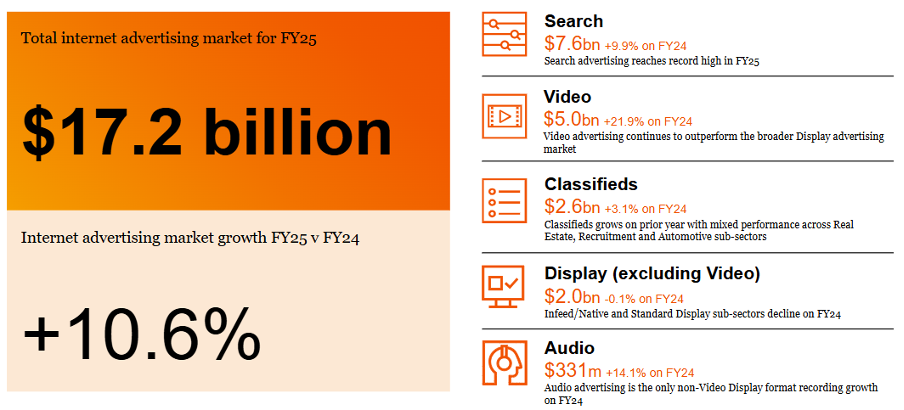
Australian internet advertising market FY 2025. Source: IAB Australia.
Using the reported local revenue from Meta and Google as the base of the levy, and adding a bit for others that may be included, the levy could, in theory, rise $450m (2.25% of $2B). However, the government’s estimate is $200 – $250m.
‘Others’ refers to social media companies with more than $250 million in revenue. That would include TikTok, with reported revenue of $679m in FY 2025, but YouTube is not included, and Elon Musk’s X reported $3.4m in Australian revenue in 2024. LinkedIn’s revenue is swallowed up by Microsoft, as is Bing, which shares in the crumbs of search engine revenue left to others by Google.
AI companies are also excluded from the levy at this stage.
Incentive distribution
This week, Treasury issued a ‘Consultation Paper‘, outlining how the levy is to be distributed.
The Government has been at pains to stress that it’s not a tax, and that 100% of monies raised will be distributed to media companies under the auspices of the Australian Communications and Media Authority (ACMA).
This time, it wants the benefits to flow to actual journalism, but it will only achieve that for whatever portion of the levy that it distributes, not for whatever direct agreements Meta and Google may enter into (which offsets the levy they pay).
The proposal is that whatever levy monies are left to distribute by ACMA will go to support journalism for publishers with more than $150,000 in annual revenue. The suggested formula for distribution will be based on the number of Full Time Equivalent journalists (FTEs).
 Loading...

 Reload document
  Open in new tab
 The Consulting Paper also raises the spectre of a disproportionately higher share being given to regional publishers, as well as to publishers focused on First Nations and other marginalised groups.
Claire Stuchberry, Executive Director of the Local and Independent News Association (LINA), told MWM, “The revenue test eligibility requirement excludes about 35% of LINA members from engaging with the Code.” LINA represents 180 newsrooms Australia-wide.
While the principle of a levy may be sound, it remains anybody’s guess what proportion will actually go to strengthen independent media after the mainstream has taken its share.
The early indication is maybe not a lot, judging by a joint statement of support by recipients of the bulk of the earlier Code’s largesse, ABC, Australian Community Media, 10, News Corp, Nine, SBS, SCA-Seven West and Guardian Australia:
“The government’s news bargaining incentive (NBI) draft legislation is a critical step toward securing the future of Australian news. By prioritising commercial deals, this legislation protects our democratic way of life.”
Here at MWM, we will still rely heavily on the generosity of our readers as our incentive.
Google Australia pays pittance in tax, pays media moguls instead

Kim Wingerei is a businessman turned writer and commentator. He is passionate about free speech, human rights, democracy and the politics of change. Originally from Norway, Kim first came to Australia in 1989. Author of ‘Why Democracy is Broken – A Blueprint for Change’.