
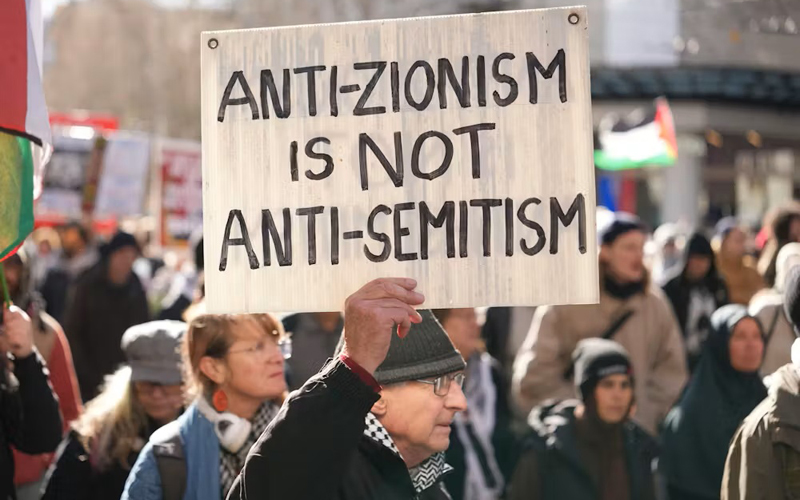
Not content with one antisemitism envoy, the Federal Government appointed a university antisemitism watchdog in a questionable process. Andrew Gardiner reports.
There are red flags aplenty around university anti-Semitism watchdog Greg Craven, an academic with many links to staff at the office that chose him.
A rushed selection process – with careful written submissions giving way to brazen backing for one candidate – isn’t how you’d think high-profile appointments happen in Australia. But when the issue at stake is antisemitism, and there’s a need to placate powerful pressure groups, checks and balances fly out the window.
FOI documents seen by MWM reveal just such haste in the appointment of Craven as leader of the controversial University Report Card Project (URC), part of the government’s crackdown on antisemitism following the October 7 attacks.
Craven – a retired Catholic academic who once accused universities of “moral complicity” in the spread of antisemitism – is now in charge of monitoring those very same seats of learning.
How did officialdom arrive at this point?
Flawed selection process
MWM approached the relevant parties, Home Affairs (DHA) and the office of the Special Envoy to Combat Anti-Semitism (ASECA), about the rush to appoint Craven. We queried the apparent absence of ‘business plan’ documents backing his candidacy and – importantly – the conflict-of-interest for at least two of ASECA’s six staff members.
Neither office responded to our questions, but here’s what we’ve learned so far under Freedom of Information (FOI):
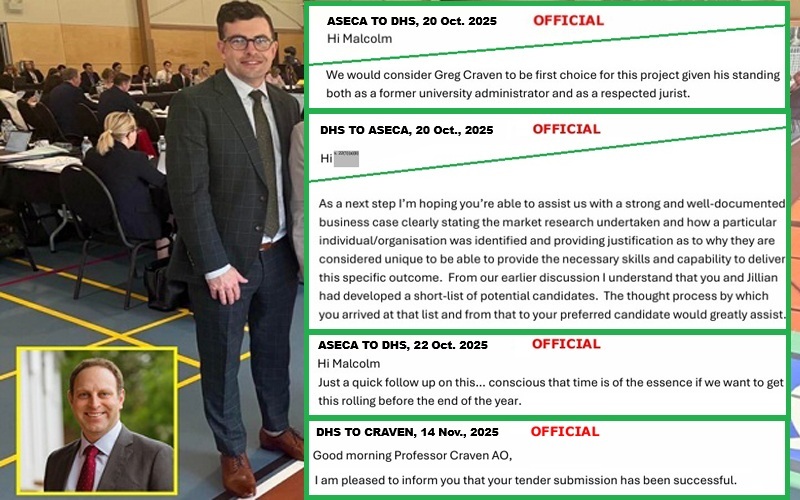
- After an open market tender for the position brought no bids, DHA went to a “limited tender” process on October 20 last year. ASECA picked five “eminent individuals” and declared a strong preference for “working our way down the list”, one by one, until they found a taker;
- At the top of that list was Craven, a clear ASECA favourite for the job, “given his standing both as a former university administrator and as a respected jurist”.
- once the former Australian Catholic University (ACU) Vice Chancellor showed an interest, he was pretty much assured of the job, with no evidence on hand ASECA even spoke with the other four names on its list;
- As part of the limited tender process, DHA had asked for “a strong and well-documented business case” in support of Craven. It seems that never happened, ASECA instead telling DHA “time is of the essence … to get this rolling before the end of the year”;
- On November 14, Craven got the job. It seems nobody else came under serious ASECA consideration.
Did ASECA thumb its bureaucratic nose at integrity rules by greasing the rails for ‘their guy’? Adding urgency to that question are revelations at least two ASECA staff members enjoyed collaborative working relationships with Craven at ACU.
ASECA’s Damien Freeman (a legal academic) had close professional ties with his former Vice Chancellor, working with Craven on such issues as Indigenous constitutional recognition during the Voice referendum (2023). “Greg Craven and I argue along similar lines (on the Voice) in a paper we wrote this year”, Freeman told Quarterly Essay.
Another ASECA staffer, Ashley Midalia, isn’t an academic, so any affinity with Craven isn’t documented in quarterly journals. But a man in his position (director of Government, Policy and Strategy at ACU during Craven’s tenure) was expected to work closely with his Vice-Chancellor in areas like high-level external relations, lobbying, policy advocacy and strategic advice.
Did these ASECA staffers declare apparent conflicts-of-interest, removing themselves from any and all decision-making around Craven’s appointment? Given that they represent one-third of anti-Semitism envoy Jillian Segal’s six-strong staff, such recusal may have been impractical.
Source: FOI
Business case missing
Was DHA’s request for a “strong and well-documented business case” for Craven (surely a central element in any limited tender process) simply ignored? Finally, and most importantly, could other agencies simply skate around some of the fundamental requirements for integrity in government?
With Canberra under siege from Zionist and other pro-Israel groups since the October 7 attacks, it appears exceptions can be made.
What are Australian taxpayers getting for the more than $265,000 per annum they pay Craven? Through the URC mechanism, he’ll be monitoring universities on their performance in three specific areas:
- how well they train their staff in combating anti-Semitism and hate speech;
- how fair and accessible their complaint processes are;
- how effectively they respond to pro-Palestinian demonstrators occupying buildings and open spaces (encampments) – pastimes ASECA says “may incite discrimination”.
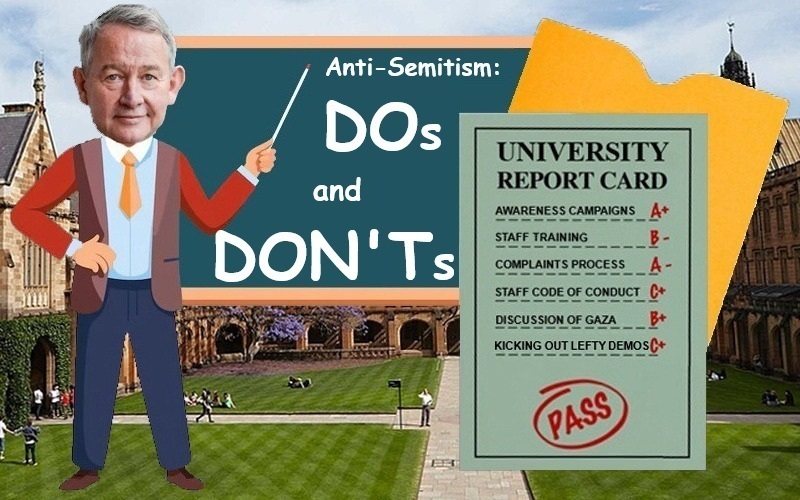
Image collage by Andrew Gardiner
If the third of these measurables triggers alarming memories of what happened at last month’s anti-Herzog rallies, you’re not alone. Deploying police to quell protests against what the International Criminal Court calls genocide (which universities would have to do to meet URC targets) seems both counterintuitive and draconian to many.
“Pressuring universities to crack down on peaceful protest and criticism of the state of Israel has nothing to do with combatting hatred, and everything to do with stifling criticism of Israel’s genocide. This is a Trumpian attack”, Students for Palestine co-convener Bella Beiraghi said.
“Agents of intolerance”
Re-casting students as agents of intolerance takes the kind of imagination you’ll find in the International Holocaust Remembrance Alliance (IHRA) definition of anti-Semitism, which critics argue conflates hatred of Jews with criticism of Israel or Zionism.
Yet 39 universities across Australia, the Joint Parliamentary Committee on Human Rights and ASECA itself have adopted criteria for anti-Semitism which jibe closely with those of the IHRA, as has the the Bondi Royal Commission.
Amnesty International calls it “a direct attack on fundamental freedoms, stifling freedom of speech, expression, assembly, academic debate, and protest”. Further, it “omits one compelling fact: the recent upsurge (in both anti-Semitism and anti-Zionism) is likely linked to Israel’s war on Gaza”, as UNSW’s Louise Chappell points out.
Questionable tender process
Thanks to a questionable tendering process, much of the enforcement of these new rules (which govern what you can and can’t say or do on the campuses of a free country) falls to a man who harbours deep suspicions of many academics and the universities they work for. “A large majority of academic staff and students have sympathies with the left (and will) find it very hard to confront the large parts of the left (which) are anti-Semitic”, Craven told News Corp.
Not stamping out anti-Semitism on campus was, he added:
one of the greatest failures of Australian universities in their history
“Every time you see a chanting, vicious protest on a university campus (and) nothing is done about it, that’s telling (students) it’s not wrong”.
Observers say the appointment of Craven or someone like him was inevitable the moment Segal (a woman with conservative ties and conflicts of her own) got the ASECA job. “You cannot be the face of a national strategy against hate while your own family trust donates $50,000 to Advance Australia, a far-right lobby group which itself fuels other forms of racism and bigotry”, the Lebanese Muslim Association’s Gamel Kheir said.
Sarah Schwartz of the more progressive Jewish Council of Australia (JCA) sees the power of Zionist pressure groups (and Canberra’s acquiescence in the face of it) at the root of a crackdown which has robbed Australians of some of their right to free expression. “We urge the PM to reject voices less interested in addressing anti-Semitism than in fulfilling a pro-Israel wish-list.”

An Adelaide-based graduate in Media Studies, with a Masters in Social Policy, I was an editor who covered current affairs, local government and sports for various publications before deciding on a change-of-vocation in 2002.