
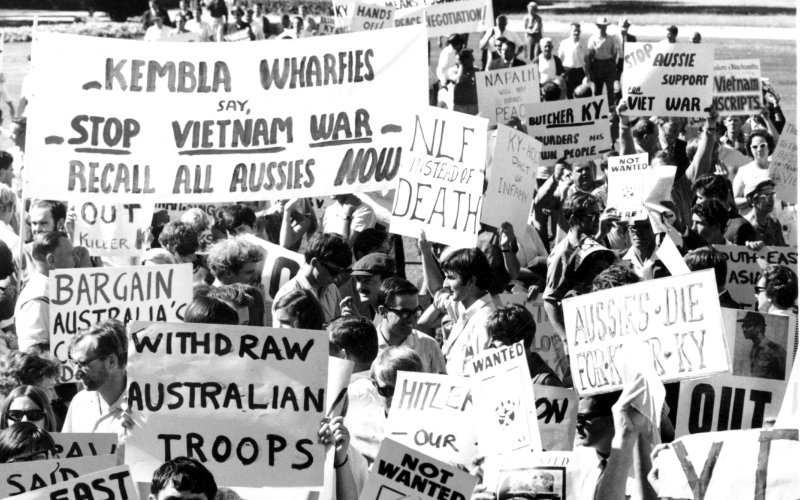

Sixty years on from the Vietnam War marches, Australian union bosses are mostly MIA when it comes to protesting Israel’s genocide in Gaza. Andrew Gardiner reports.
The genocide in Gaza, and moves to muzzle talking about it in universities and schools, have rank-and-file unionists up in arms. But union officials have barely lifted a finger on Gaza’s humanitarian catastrophe, or on schemes to stop us talking about it. Instead, we’re seeing a timid, tepid response from union bosses.
Spearheaded by Israel backers Jillian Segal and David Gonski, moves by the Anti-Semitism Education Taskforce threaten to “chill” Middle East debate in our seats of learning and elsewhere. To the dismay of rank-and-file members, many union execs seem ambivalent.
The union bosses appear to be in lockstep with the Albanese Labor Government, which announced last Thursday that the Tertiary Education Quality and Standards Agency (TEQSA) would have new powers to compel compliance on a broad swathe of what our PM calls “the evil scourge of anti-Semitism”.
Deference to this new regime is to be gauged via measures like a university “report card” system, put forward by Segal herself and, in NSW, a new code of conduct for school staff. Yet what looks like an assault on our educational sovereignty by a pair of high flyers closely tied to groups with allegiance to Israel, not Australia, has elicited nothing in the way of meaningful resistance from either vice chancellors or union heavyweights.
Antisemitism Task Force
With full backing from Canberra, the coercive power of Segal and Gonski’s new task force is such that journalist and activist Meg Bourne predicts “entire staff-rooms will self-censor in order to avoid reprisals”. Yet officials from the union representing independent school teachers in NSW and Canberra fell right into line, welcoming the changes which, they said, “ensure all schools are free from hate speech”.
Critics of education union bosses’ often-muted response to the Segal-Gonski moves say they’ve abandoned their duty to protect academic freedom and – in one case at least – gaslit rank-and-file members by claiming the moves were “unremarkable” and there was “a need to recognise changes to the law”.
The NSW Teachers Federation is accused of sending out Member Alerts that understated the significance of changes to the code of conduct, while the NSW/ACT branch of the Independent Education Union (IEU), representing private and religious school teachers, has been attacked for openly supporting the new code of conduct.
Meanwhile, officials at the National Tertiary Education Union (NTEU) and the Australian Education Union (Vic.) seem to be dithering amid a slow-walking of moves – approved by rank-and-file members – to divest the superannuation funds of members from companies directly aiding the Gaza genocide.
Where are the unions?
A largely muted, movement-wide response to the genocide in Gaza has many questioning: “Where are the unions”? Their peak body, the ACTU, seems to have gone to ground since May last year, when secretary Sally McManus joined president Michele O’Neil to condemn starvation tactics in Gaza. McManus was spotted at the protest against Israeli President Isaac Herzog’s visit earlier this month, but has been otherwise quiet in public on Israel and Gaza for the past nine months.
Some unions have bucked the trend, most notably the Australian Services Union (ASU), which succeeded in divesting superannuation funds from companies supporting the Israeli war machine, and the Maritime Union of Australia (MUA), a vocal participant at rallies. “(Israel is) an oppressive regime responsible for genocide and the forced displacement of millions of Palestinians”, the MUA’s Dave Ball told anti-Herzog protestors in Melbourne.
The NSW Teachers Federation have been in attendance at the pro-Palestinian rallies since the genocide began, as have other unions.
Some honourable exceptions aside – and despite support from the protest movement from the rank and file of many unions – the inaction of union officials stands in stark contrast to the 1970s, when unions halted the mining and export of uranium, and ‘Green Bans’ protected parks, historic buildings and low-income housing. With the Transport Workers Union spurning the chance to “do a Sinatra” on Herzog by refusing to fuel his flight home, perhaps the most effective remaining option for unions is the aforementioned divestment.
Union superfunds silent
Australian Super, whose board includes the ACTU’s O’Neil and the AWU’s Paul Farrow, is heavily invested in at least six such companies: Elbit Systems (drones), ICL Group (white phosphorus), Caterpillar (demolition of Gazan homes and public facilities), Palantir (AI/software for weapons systems) and Lockheed Martin (aerial attacks on Gaza). A successful divestment resolution would, theoretically, hit Israel where it hurts.
But when the rubber meets the road, this option often goes begging. Aside from the ASU’s success with Vision Super and a member-driven partial divestment by HESTA, union officials have ignored, slow-walked or outright
blocked efforts to stop funding the suppliers of Israel’s war machine.
Farrow might sit on the Australian Super board, but his union appears to be one of the least inclined to help the Palestinian cause, as is the Shop Distributive and Allied Employees’ Association (SDA), whose assistant secretary is on the board of Rest Super.
“We’ve seen the most willingness to act (on divestment) from ordinary members. Union leadership says they’re eager to do the right thing, but we’ll have to wait and see”, Molly Coburn, campaigns lead at the Australia Palestine Advocacy Network, told MWM.
The biggest divestment debacle belongs to the NTEU, whose National Council of members passed a “Boycott, Divestment and Sanctions” resolution in 2024, only to see union execs not prevail on their fund, UniSuper, to act. The gap – in deed if not word – between rank-and-file members and head office is beginning to look like a chasm.
Social change outsourced to ALP?
Why are today’s unions so timid when compared to their 1970s forebears? A part of it is their co-dependency with the ALP, in which union bosses (not ordinary members) can aspire to pre-selection for Parliament and other assorted perks in exchange for “throwing money (and said members) into getting Labor elected”.
“The union bureaucrats have placed an ever-greater emphasis on getting Labor elected over mobilising workers’ power,” activist Ian Rintoul explained. In other words,
union execs have outsourced their social change mandate to the ALP,
a party of neoliberal acolytes whose commitment to the people of Gaza amounts to little more than “whispering, mumbling clichés and banalities”.
It gets worse. Not content with tossing sumptuous junkets at politicians and reporters, the Tel Aviv lobby offers the same and more to union officials through its Australia-Israel Labour Dialogue, a group laser-focused on stopping, you got it, divestments.
Following one such junket as a young activist, former ACTU president and PM Bob Hawke was so smitten with Israel that he lauded the country as “a working class building its own nation through its own physical and intellectual labor”.
These trips, and the other activities, “have only one objective and that’s to see that no matter what Israel does, it will never be criticised by Canberra”, former Foreign Minister Bob Carr said.
But perhaps the biggest reason lies, again, in the divergent priorities of rank-and-file members and union executives. Not only do the latter seem indifferent to causes like Gaza, but in some cases, they’ve worked against unaffiliated rank-and-file groups who are the heartbeat of activism, like Unionists for Palestine (U4P).
For four straight days in early 2024, U4P pulled off a successful, 1000-strong “community picket” of Israeli-owned ZIM Ganges, suspected by activists of being a conduit for arms shipments to Israel. Members allege that within weeks of the Port Melbourne picket, efforts were underway to undermine and divide the group by infiltrating meetings and using assorted nefarious tactics.
“Is there a group of Trade Unions for Sudan (or) Trade Unions for Afghanistan? As I understand it, 750,000 people have been killed in Sudan”, said Health Services Union president Gerard Hayes, clearly unimpressed with all this grassroots activism.
“U4P came under attack from ALP-aligned union members and officials, including the Victorian Trades Hall, because we were seen as a threat to union structures and to the ALP”, the group’s Monica Campo told MWM. The attraction among some of these officials to “power for its own sake” leaves a growing number of rank-and-file activists wondering if there’s a better way.
Albo bows to media, Israel pressure, moves on antisemitism, free speech

An Adelaide-based graduate in Media Studies, with a Masters in Social Policy, I was an editor who covered current affairs, local government and sports for various publications before deciding on a change-of-vocation in 2002.