
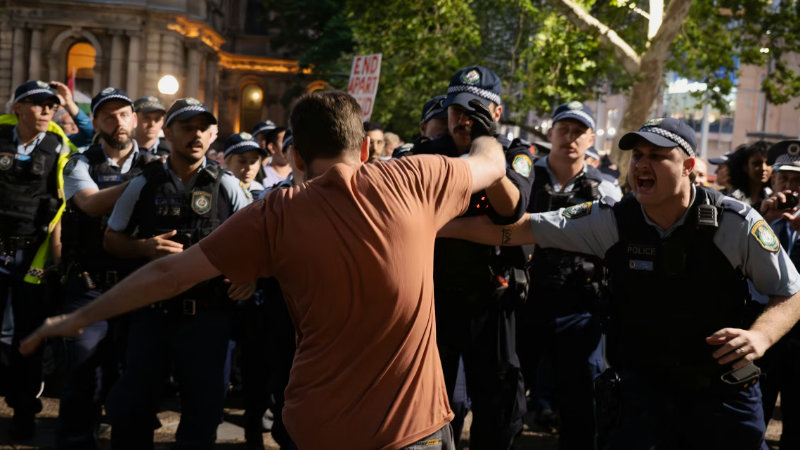
Monday’s police actions against anti-genocide protestors in Sydney represent a significant escalation of unwarranted violence. Stephanie Tran and V Y Franco-Klothos report.
Editor’s note: An earlier version included unconfirmed claims that the police used tear gas (in addition to pepper spray, which was used).
NSW Police are on the defensive. Following the spate of attacks on pro-Palestine protestors on Monday night, and amid rising criticism of their brutality, the Police are refusing to answer questions as to the number of people arrested, the number charged, and the nature of the charges.
According to the ABC yesterday, 27 people were arrested and 9 have since been charged. That was yesterday. Today, they were not responding, apart from a motherhood statement unrelating to those arrested.
From the outset of the protest against the visit of Israeli President Isaac Herzog, police had set up clear lines around every exit from the Town Hall area to contain the protest within Town Hall Square.
Police were seen giving contradictory instructions to protestors – both instructing them to disperse from the square and demanding that they stop attempting to leave the square.
Aerial video clearly shows NSW police kettling protesters and causing a crowd crush.
Incontrovertible evidence of the police hemming in protesters, preventing them from leaving(kettling) and attacking them.
They started this from before the speeches had even ended. The police commissioner is proud of this. He needs to resign with Minns. pic.twitter.com/ERU7K3Tn9f
— The Longford Slasher (@Longfordslasher) February 10, 2026
Aggressive police behaviour
Activist Larissa Payne was near a group of Muslim demonstrators who had begun evening prayers in a corner of Town Hall Square. Payne, her family members and other members of the public linked arms to form a barrier between the praying group and riot police.
“It was a deliberate expression of non-violence, it was an expression of love and solidarity,” Payne said.
Footage of the scene shows officers moving in and violently grabbing members of the prayer group.
Payne was restrained using a wrist hold and dragged down steps, leaving her with sprained wrists.
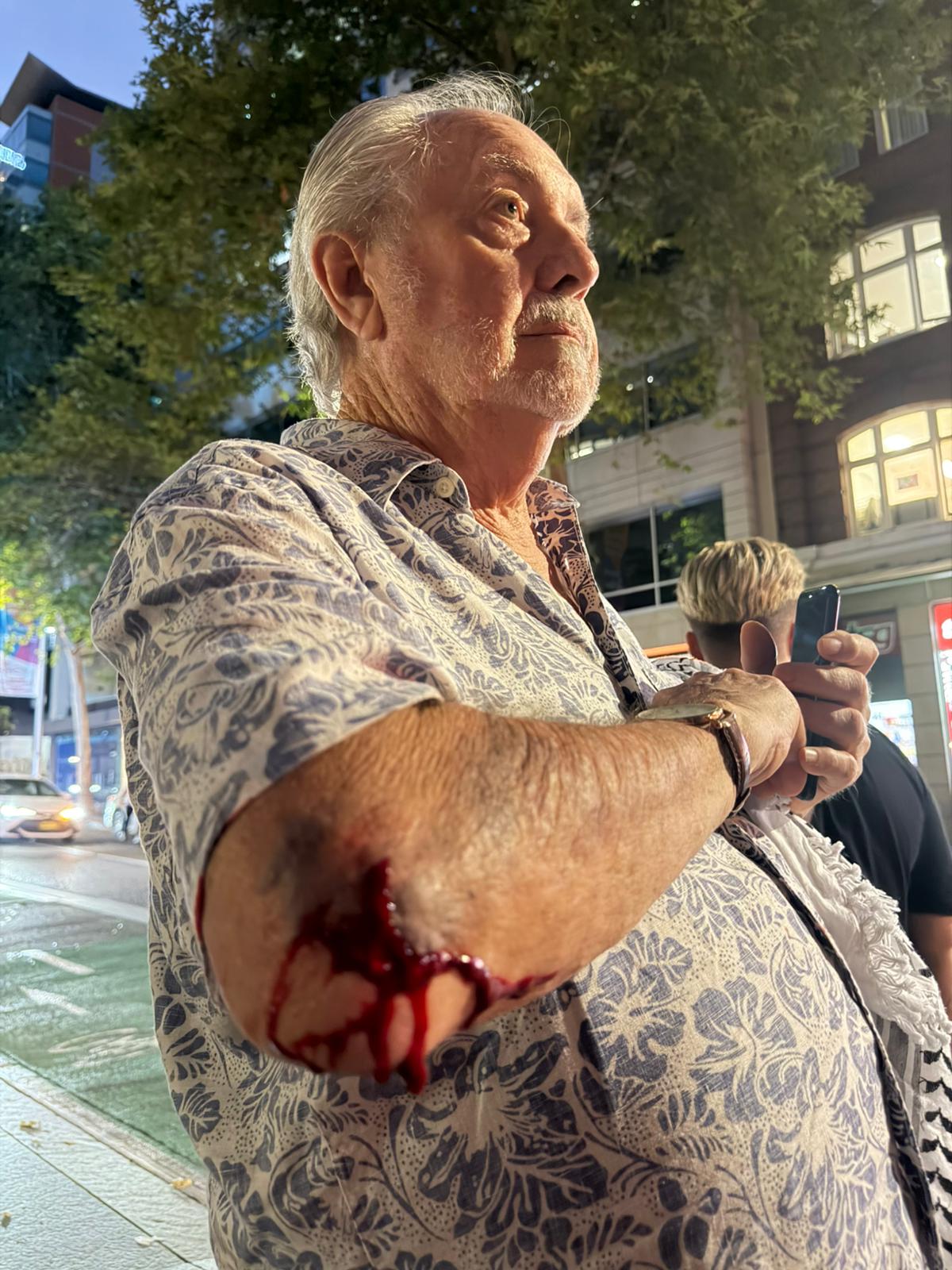
Ian Payne
Payne’s 78-year-old father, Ian Payne was with her. When he put his arm out to protect her, police forced his arm behind his back, causing a deep wound to his elbow.
“When he instinctively put his arm out to protect me, they grabbed his arm and put it right up behind his back. They tore open his elbow so he had skin and blood hanging everywhere. It was just awful.”
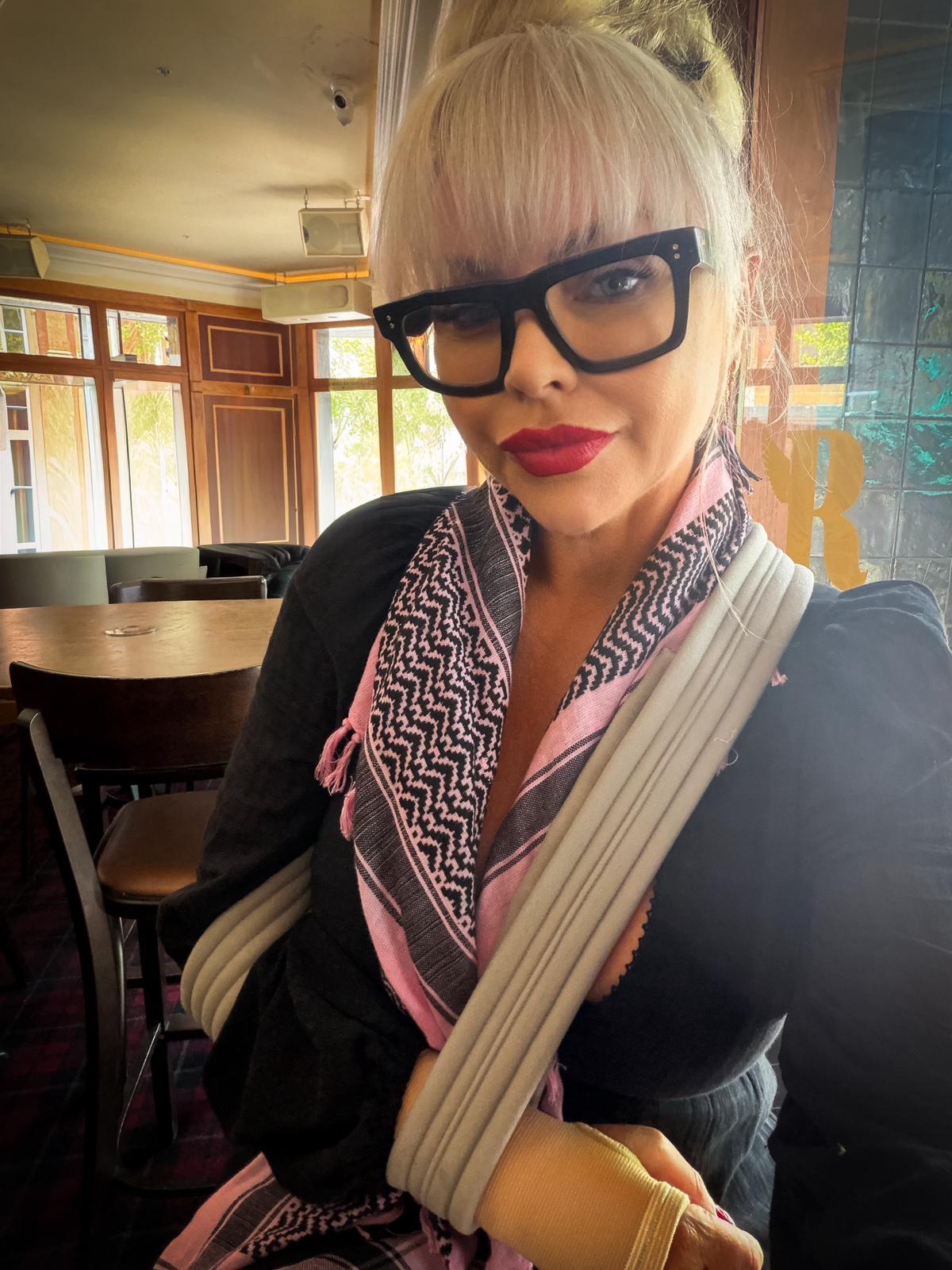
Larissa Payne
Payne’s partner, former Senator Scott Ludlam, was knocked to the ground, leaving him with a possible fractured rib. He was handcuffed and arrested before being released.
Payne said a lack of accountability for the police brutality on Monday would lead to police impunity becoming “normalised”, telling MWM:
If we don’t do something collectively to hold them to account, if the police get impunity, this violence is going to become normalised.
“The police violence is a symptom of something larger. If you look at the global context, we’re moving towards more extreme right wing politics. The fact that this was done under the leadership of a Labor Premier speaks to how Labor is being dragged to the right,” Payne said.
Another protester, Ali Al-lami says he was pushed to the ground and called a “brown c*nt”. Police proceeded to punch Al-lami and handcuff him while pressing his head to the ground.
“It was like how an IDF soldier would put a Palestinian to the ground and brutalise them. That’s exactly what they did to me,” Al-lami said. He was arrested but subsequently released without charge.
“They released me without any charges because they know what they did was wrong. They didn’t have any legal basis to arrest me. I did nothing wrong, I wasn’t resisting, I didn’t attack anyone,” he said.
Medics under attack
Volunteer street medics, who operate independently of PAG, were in attendance on Monday evening and treated dozens of protestors who had been indiscriminately attacked with pepper spray.
Omaim Al-Baghdadi was one of the medics at the scene. She told MWM that police officers attacked and pepper-sprayed medics who were assisting injured protesters.
“We were in the middle of treating people. We told them we were medics, but it didn’t matter to them. They grabbed us and shoved us and told us to move on.”
Many families and elderly people were caught in the crowd as tear gas* was deployed by police.
Another volunteer medic, who asked not to be named, was caught in the middle of the crowd as police simultaneously crushed, pepper-sprayed and tear-gassed* families.
“I saw a lot of horrible things at the protest, but what really stuck with me was the fear and panic I saw in the eyes of children and their parents as this was all unfolding. It was really distressing to me, even as someone who has personally witnessed and experienced a lot of police violence,” they said.
“We were being crushed in as the police kettled us, and then everyone around me began to cough violently. I think it took longer to hit me than others because I had an N95 mask and goggles on, but when it did eventually hit, it was awful. I felt like I was being choked and began to wretch and shake. It has been nearly 24 hours since the protest, and I still have ongoing nausea and wretching.”
Excessive police powers
In the wake of the Bondi attack in December 2025, NSW parliament rushed through the Terrorism and Other Legislation Amendment Bill 2025, which gave police powers to effectively ban protests and other public assemblies for up to three months following a ‘declared terrorist incident’.
In addition to the rushed “anti-terror” legislation, the Minns Labor government made a “Major Event Declaration” to facilitate the Herzog visit. This legislation gives police additional powers, including the ability to significantly increase officer numbers, enact warrantless searches and block the public from a “declared area”.
On Monday afternoon, the NSW Supreme Court dismissed PAG’s challenge to the major event declaration, leaving the public vulnerable to these broad powers.
The major event declaration not only extended police powers further, but also gave them relative immunity for their brutality. Perhaps most concerningly, the Major event declaration diminishes the right for protestors to receive compensation for violence inflicted by the State.
Specifically, section 62 of the Major Events Act 2009 details the exemption from paying compensation. According to the legislation, the State, local Councils and officers, employees or agents of the State or local council cannot be compelled to provide compensation regarding “an act or omission that is a major event-related matter, or that arises (directly or indirectly) from a major event related-matter.”
Criminal lawyer and investigative journalist Nick Hanna noted that this could
significantly limit the claims for protestors injured by police.
“This is one of the egregious examples of wanton police violence we’ve seen in a long time. There are countless people who would ordinarily have a strong basis to sue the police for assault, unlawful arrest and/or false imprisonment, but may now effectively be precluded from doing so as a result of the major event declaration,” Hanna said.
Hanna represented Palestine Action Group in their Supreme Court challenge against the major event declaration.
“Had the Supreme Court granted our application on behalf of PAG to declare the major event declaration invalid, these restrictions on the ability to recover damages from the police for their tortious conduct wouldn’t apply,” he said.
If PAG successfully appeals the Supreme Court’s decision, protesters may have more legal avenues.
“If PAG appeals the decision and is successful, this may have the effect of lifting the restrictions on people suing the state for the violence inflicted by the police,” Hanna said.
NSW Police response
MWM put the following questions to NSW Police:
- How many people were arrested at the protest? Of those, how many have been released and how many have been charged, and with what offences?
- There are numerous reports that NSW Police used excessive violence in response to the protest, including video footage of police officers assaulting individuals who were on the ground in prayer. How does NSW Police respond to these allegations?
- Aerial footage appears to show police forming multiple lines and barriers along George Street and surrounding exits, which protesters say prevented them from leaving the area (a tactic often described as “kettling”). What was the operational rationale underpinning this policing decision?
A NSW Police spokesperson provided the response below:
“NSW Police will review all officially reported complaints from the Town Hall event. If a complaint is made through official channels police will investigate appropriately. During the event at Town Hall on Monday (9 February 2026), police gave multiple opportunities for attendees to leave the area safely. Police deployed multiple crowd management techniques during the event to maintain public security. Attendees were at no point forced to remain in the area and were always afforded the opportunity to leave the event.”
Peaceful, diverse, myriad, then attacked. Herzog protestors demolish the narrative

Stephanie is a journalist with a background in both law and journalism. She has worked at The Guardian and as a paralegal, where she assisted Crikey’s defence team in the high-profile defamation case brought by Lachlan Murdoch. Her reporting has been recognised nationally, earning her the 2021 Democracy’s Watchdogs Award for Student Investigative Reporting and a nomination for the 2021 Walkley Student Journalist of the Year Award.

V Y Franco-Klothos is a PhD candidate and grassroots organiser living and working on unceded Darug lands.