

On Australia Day, we’re supposed to celebrate mateship, egalitarianism, freedom and prosperity. But what if these “pillars” of Australiana are myths? Andrew Gardiner reports.
Each year at this time, academics, activists (and sometimes, by complete accident, supermarket chains) raise “inconvenient truths” about what they call the fallacies around Australia Day. And each year, regular as clockwork, other Australians spit the dummy because they hate being reminded.
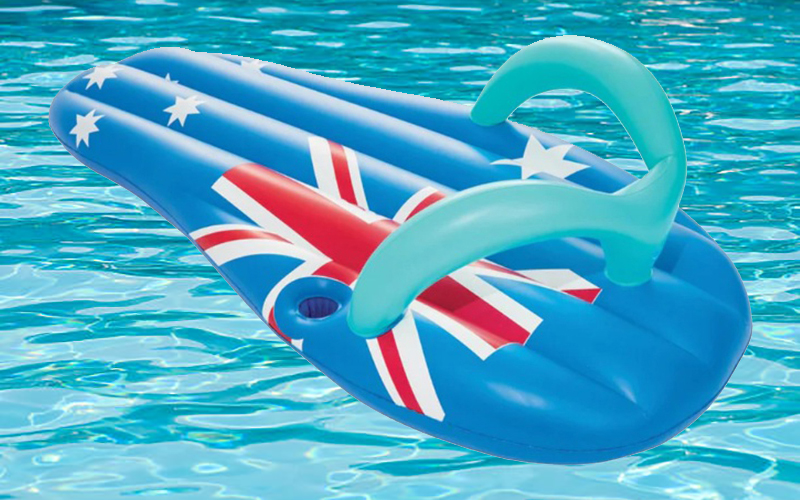
“Supermarket chains?” you ask. I refer of course to the Great Woolies Betrayal of 2024, when – without a word of reproof for Australia and its big day, the retail giant quietly scrapped merch like Aussie-themed hats, napkins and (no kidding) inflatable lilo thongs.
Oi Woolies
Why? Woolies won’t say, but if you point out it’s cheap, nasty, foreign-made dross which wasn’t selling and belongs in a Smokemart, you can’t be far off the mark.
So, was Woolies calling Australia “cheap and nasty”? Shock jocks and right wing talking heads didn’t bother finding out, jumping straight to demands for a boycott of the retailer for being insufficiently patriotic.
Woolworths later backed down, promising to bring it all back, but not before jingoistic vandals daubed “Aussie Oi Oi Woolies f— u” outside the chain’s Teneriffe (Brisbane) store.
The date mate
Then there’s the endless squabble over holding Australia Day on January 26, when the First Fleet arrived in Sydney Cove, 138 years ago this Monday.
“Asking Indigenous people to celebrate (that day) is like asking them to dance on their ancestors’ graves”, Reconciliation Australia’s Karen Mundine pointed out. She states the obvious: January 26 is “invasion day”, a day of infamy to many Indigenous Australians and their supporters.
If the point of Australia Day is unity in celebration, why is the ‘keep the date’ crowd treating a cohort of compatriots with such contempt? Their abusive ‘rebuttals’ suggest it’s “because we’re sensitive snowflakes”.
Pauline Hanson said the quiet part out loud: “Changing Australia Day won’t appease those with ‘chips’ on their shoulders. It wasn’t invaded; the country was settled.” Then there was Abbott Government svengali and head-kicker Peta Credlin: “The left want us to remain ashamed of who we are”.
RWNJs v Woke
There are few cogent arguments for keeping January 26, and even fewer attempts to address the pain and division intrinsic to January 26. There is, instead, a chorus which can be paraphrased as ‘shut up you woke, Australia-hating lefties, we don’t want to hear it’.
It seems many of us get mad as hell when Australia’s faults, foibles and former inhumanities are dragged out of the subconscious by one loud-mouthed leftie or another. To paraphrase Peta Credlin, it’s like they’re “ashamed of who they are”.
Four pillars of Aussie cultcha
According to the official, government line, Australia Day is “a time to reflect on what it means to be Australian, to celebrate our diverse, contemporary nation (and to) respect the survival and resilience of (First Nations) Peoples”. Those residing somewhere to the right of this have no problem with the celebratory bit, but recoil at any mention of the murky past.
“The modern Australia that emerged from British settlement … is something that all of us on balance can be proud of”, said former PM Tony Abbott, studiously ignoring what came before it.
Mainstream takes on our national day adhere to a common template of mateship, egalitarianism, freedom and prosperity (the ‘Lucky Country’). The right, with a Herculean assist from mainstream media, has taken ownership of all four of these cultural ‘pillars’, meaning its “forget the bad bits; let’s celebrate” approach has a rails run on the racecourse of public opinion.
Maaate
Early in his term as PM, John Howard re-defined mateship – a concept once synonymous with egalitarianism – in market-friendly terms.
“(Mateship is) the great Australian capacity to work together in adversity”, the former PM said. He quoted a prisoner of war, who “couldn’t remember a single Australian dying alone. There was always someone being there to look after him in some way (and) that expressed our mateship”.
Howard’s construct is more about the shores of Gallipoli than the pastoral frontiers of the Darling Downs, where historians tell us outback egalitarianism was the order of the day: “Jack is as good as his master.”
The other pillars of Australiana, prosperity and freedom, are a kind of conventional wisdom among Australians (no matter how in the tank our economy might be) and the often right-leaning institutions which feed our ‘we’re free’ vibe. Freedom has long been bread and butter for a private enterprise crowd which conflates economic freedom with civil liberties, and whose definitional dogma is rarely challenged by today’s free market Labor Party.
This, in turn, burnishes the right’s carefully-crafted credentials as better economic managers (i.e. the best bet for prosperity). That reputation imploded last year, in a long-overdue reality check.
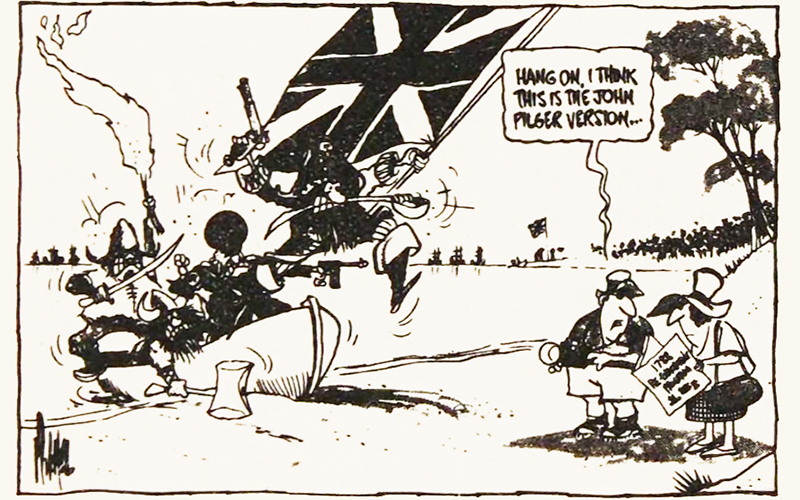
With today’s Labor Party largely ceding the ground over Australia Day, it’s left to a handful of voices to offer an alternate take. Among them, until recently, was the late John Pilger (1939-2023) a 60-year journalist, writer and documentary filmmaker whose work continues to resonate.
A classless society?
Pilger dismissed mateship as a now-mythical concept which has, in recent decades, morphed into something out-of-bounds to ordinary Australians: cronyism among a powerful, favour-swapping elite he called the “order of mates”.
This in turn shatters the illusion of Australia as an egalitarian, “classless society”, Pilger wrote.
“In the 1960s, Australia had the most equitable spread of personal income in the world”, he wrote in the 1993 update of his work, A Secret Country. But that was upended two decades later, Pilger insisted, when “the transfer of wealth, from the bottom to the top (became) epic”.
The other two pillars, freedom and prosperity, are things of the past for too many Australians, critics say. Welfare groups lament rising wealth inequality (which, they say, “threatens to exacerbate and entrench” class divides) while on civil liberties, Muslims, lawyers and activists have hoisted a massive red flag over our new hate crime laws, passed last week.
“By giving ministers broad powers, lowering legal thresholds, and creating vague offences, the Act puts fundamental freedoms at risk, including the right to practice religion, associate with others, and speak freely”, Muslim leaders said. The Greens agreed, warning the new laws would have a “chilling effect on political debate, protest (and) civil rights”.
The myth of egalitarianism
Voices such as these often find themselves ignored or excoriated by corporate media, whose agenda-setting power somehow persists. But the question remains: are they right?

The numbers clearly show that egalitarianism is indeed a myth these days, and prosperity reaches far too few Australians. Wealth concentration at the top is now a permanent feature of our economy, with the top 10 per cent of households having 46 per cent of total wealth as of 2022, while poverty hits one in seven Australians (3.7 million people) at last count, up from one in eight five years ago.
There are no stats on mateship, but if egalitarianism is intrinsic then it’s long gone. Even by Howard’s pared-down definition of ‘being there for each other, no matter who you are’, the signs are bleak: anti-Muslim prejudice is “systemic”, LGBTQ sexual harassment is widespread and discrimination against Indigenous Australians is rising, among other problems.
The curse of xenophobia
If the number of “F*ck Off, We’re Full”-style car stickers is any guide, mateship has been well-and-truly usurped by “every bogan for his or her self”.
Two of the major, respected indices ranking Australia’s freedom against that of other countries offer contrasting snapshots. The Freedom House index (of political rights and civil liberties) gives Australia an impressive 95 out of 100, but that was before Tuesday’s passage of hate speech legislation, which could criminalise criticism of leaders like indicted war criminal Benjamin Netanyahu, or muzzle dissent and even edgy commentary.
Meanwhile, the World Press Freedom Index ranks Australia a mere 29th in the world, handicapped by the world’s second worst media ownership concentration (which “limits the diversity of voices represented in the news”). “The most powerful political actor in Australia is not the Liberal Party or the Labor Party, it is News Corporation,” former PM Malcolm Turnbull said.
It turns out the four ‘pillars’ on which Monday’s Australia Day celebrations rest are made of hollow plaster board. If Australians insist on forgetting the past, they could at least keep a watchful eye on the present.

An Adelaide-based graduate in Media Studies, with a Masters in Social Policy, I was an editor who covered current affairs, local government and sports for various publications before deciding on a change-of-vocation in 2002.