
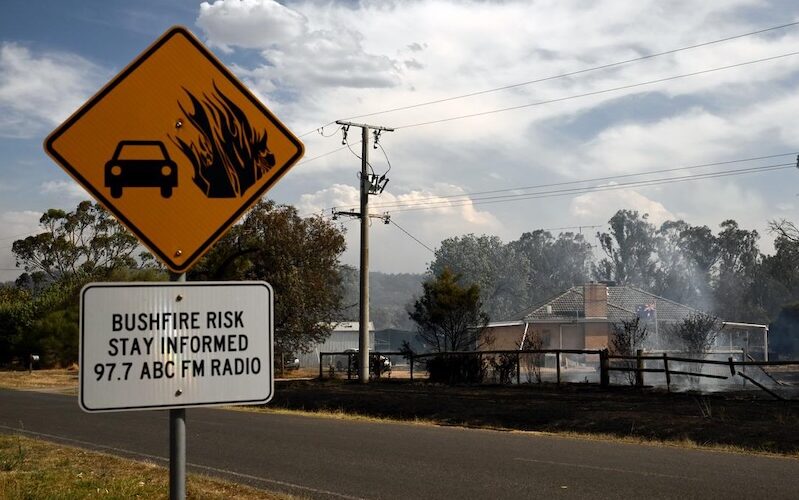

The spin cycle around devastating bushfires in Victoria this month is now a bureaucratic labyrinth of “lies and statistics”. Andrew Gardiner reports.
With Victorian bushfires torching an area almost twice the size of the ACT this month, locals in badly-scorched Alexandra, north east of Melbourne, were after blood. And political blood they got. Premier Jacinta Allan inadvisedly chose the town for a post-inferno press conference, walking into her own “Scott Morrison Cobargo moment” before being spirited out a back door to avoid mob outrage over fire readiness.
“By (November’s Victorian) State Election, 64 per cent of fire trucks will be out of date, dangerous, and should be off the road,” United Firefighters Union (UFU) secretary Peter Marshall said. On Allan’s claims the state’s emergency services were “well prepared” for this month’s fires, Marshall’s calm demeanour gave way to real anger: “She’s gaslighting firefighters … the spin is actually disgusting, it’s actually breathtaking”.
Documents seen by MWM suggest the “spin” goes a lot deeper than Marshall’s lamentations. Victoria’s Department of Energy, Environment and Climate Action (DEECA) has been accused of statistical sleight of hand after it deemed as acceptable the “prompt suppression” of just 80 per cent of fires in a given financial year.
Nothing to see here … on paper
Agencies including Victoria’s Country Fire Authority (CFA) easily meet that target line, routinely logging a prompt suppression rate of at least 90 per cent this decade. On paper at least, this conveys a “nothing to see here” narrative to a general public denied the full picture, Sue McKinnon from Kinglake Friends of the Forest told MWM.
Statistics from these agencies – spread over the course of three months or a year – leave the impression that there’s no urgent need for new equipment, research or personnel, and that the government is doing more than enough to address the threat. But what happens when (like this month) there’s a sudden spate of more than 200 fires, stretching personnel and resources to breaking point?
Breaking point
“If there’s a large number of fires at once, they simply can’t handle it,” McKinnon said. “Take Longwood (north of Melbourne) a massive fire where they were often fighting with outdated equipment, and without the benefits of new technology for quick detection and suppression”.
“So it got out of control, with 137,000 hectares burnt out and one man dead”.
The Climate Council says hotter temperatures, drier conditions and lightning strikes sometimes generated by the fires themselves will lead to more and more mass fire outbreaks, like the one we saw this month and earlier disasters like Black Summer in NSW (2019). These fires can overlap and produce massive infernos like Longwood.
Only 10-12 of the 200 fires across Victoria this month got seriously out-of-control, meaning the number of “promptly suppressed” fires likely met DEECA’s ‘acceptable’ target. Back in the real world, it’s clear to many that the destruction, at last count, of 410,000 hectares and 259 homes statewide attests to the failure of a broken system.
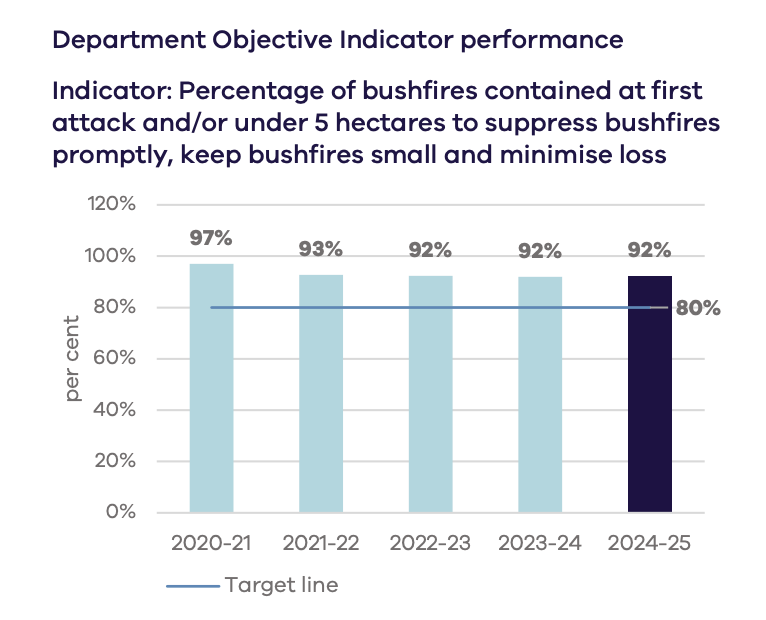
Agencies struggled with this month’s fires, despite easily meeting DEECA’s 80 per cent target for prompt fire suppression. Image: DEECA annual report.
The statistical subterfuge doesn’t appear to end there. Allan has long insisted this year’s Emergency Services Volunteer Fund (ESVF) tax, which the CFA relies on for funds, represents “a massive boost for new trucks, equipment and technology”.
More than half way through the current financial year, there is no sign of that “boost”, even on paper. On the flip side, the UFU’s Marshall estimates that by November this year, the number of obsolete and defective fire trucks will have jumped by more than 50 per cent over 18 months.
CFA volunteers have told the Weekly Times they’re being short changed under the new ESVF, gaining less under the $1.54 billion tax than they did under its predecessor, the $1 billion Fire Services Property Levy.
Budget increase … or decrease?
These claims appear to be borne out by official numbers. Late last May, State Treasurer Jaclyn Symes “signed a government gazette stating $312 million of the tax would be used to cover 95 per cent of the CFA’s 2025-26 budget, bringing the total allocation to $328 million”, the regional outlet reported.
That’s $9 million less than the CFA’s allocation from the previous year
“Only 20 cents in every dollar Victorians pay (in ESVF) will go to the CFA this financial year”, rural reporter Peter Hunt wrote. Yet, in the immediate aftermath of this month’s fires, the CFA’s board and CEO saw fit to declare its budget had “increased year on year … including an additional $20.3 million this financial year”.
Who’s telling the truth? That mystery could be solved, if the State Government stopped seemingly sitting on the CFA’s most recent annual report.
NSW and Western Australia
Problems with funding and equipment for fire services go well beyond Victoria. In NSW – where one truck actually caught fire last year on the way to a job on the Central Coast – last year’s $18.6 million fleet replacement program is seen as inadequate, amid a backlog of broken down vehicles.
“We need a plan in place, a proper structured plan where we’re replacing vehicles. We need to do that to get the fleet to be more reliable, we need to bump it up and replace a fair bit of the fleet now,” the Fire Brigade Employee Union’s Jason Morgan told the Newcastle Herald.
Over in WA, five brand new high-tech fire trucks were stripped from the State’s otherwise ageing fleet after a fire hose at a blaze in the Perth suburb of Welshpool stopped working. Investing in trucks with design faults drew criticism from members of the state’s United Professional Firefighters Union, who likened it to spending no money at all on new equipment.
Whither the drones?
McKinnon says government-funded research into new firefighting technology is now gathering dust as Victoria battles what’s forecast to be record levels of debt. Drones programmed to detect fresh fire outbreaks, drop retardant and to alert crews to the fires’ exact location are “science, not fiction”, ANU Senior Lecturer in Environment and Engineering Marta Yebra said.
Critics say the lack of money to act on such research, or to update truck fleets, puts regional and urban Australia in direct danger during the summer months. “It’s criminal neglect”, McKinnon said.
Many Victorians in harm’s way this month chalk up their survival (or that of their homes) to moments of blind luck, like a sudden, life-saving shift in the wind. Adequately equipped emergency services may have spared them that perilous moment, critics say.
Politicians and bureaucrats using “damn lies and statistics” to dodge accountability, fend off change or not spend money is, of course, a time-honoured tradition. But the money CFA volunteers are crying out for is to save lives.
You can’t always rely on the wind.
MWM reached out to the CFA, DEECA and other State Government representatives for comment. We had not heard back by publication time.

An Adelaide-based graduate in Media Studies, with a Masters in Social Policy, I was an editor who covered current affairs, local government and sports for various publications before deciding on a change-of-vocation in 2002.