
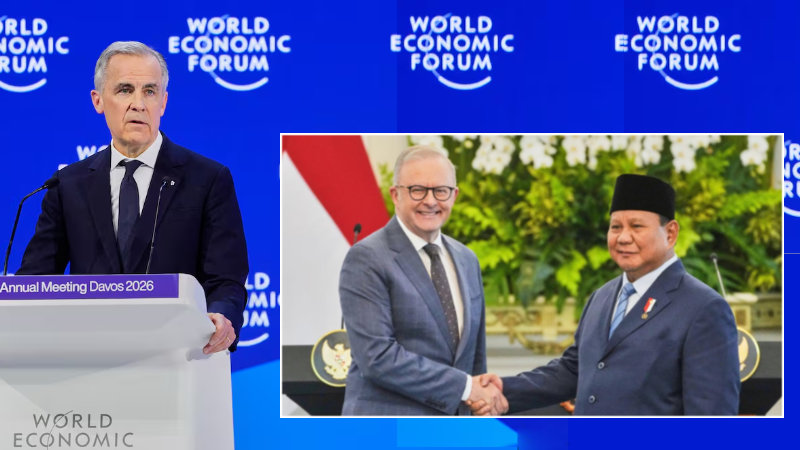
Canada’s redefinition of relations with Trump’s America serves as a stark reminder of Australia’s place in the world and our need to realign, too. Duncan Graham reports from our reluctant neighbour, Indonesia.
At the World Economic Forum in Davos this week, Canadian PM Mark Carney spoke of the end of the fiction of a rules-based world order. Without mentioning Trump once, the intimation was clear, “Call it what it is – a system of intensifying great power rivalry,
where the most powerful pursue their interests, using economic integration as coercion.
His main message was to call on “the middle powers” – countries such as Canada, Australia and, indeed, Indonesia, to decide whether to “compete with each other for favour, or to combine to create a third path with impact.”
Carney didn’t mention Anthony Albanese either, but the implications for Australia are equally clear. While Canada needs to distance itself from the US, so do we. And in the process get closer to our region in general and our closets neighbour, Indonesia, in particular.
If they want to.
Both sides of politics agree on Indonesia’s importance. But the feeling is not reciprocal. We don’t even drink their coffee.
We’ve had a free-trade agreement with Indonesia since 2020. It was supposed to boost business and draw neighbours closer. We’ve been energetic. They’ve yawned.
To wit: Indonesia is one of the world’s top five quality coffee bean producers with a range of varieties, yet it sends us only three per cent of its crop. Exporters are ho-hum, and importers are cautious. Despite rattling through a “bilateral value chain analysis”, we don’t know why.
So we buy from Brazil, Honduras and Vietnam – almost anywhere other than East Java’s splendid Dutch-developed mountain-flank plantations.
Agitators for closer ties leading to better relations have been pondering tariff-free business deals for decades and spruiking the pros; they’re more than proximity.
The market next door
Seen through the eyes of Western greed, the Indonesian market is an Eldorado – almost 280 million consumers, the fourth largest population in the world and the third biggest democracy. Splash while swimming off Darwin in the Arafura Sea, and your ripples will reach Flores.
Much of the land is so fecund that a parked walking stick will sprout while its owner takes a nap. The workforce is huge and cheap; the annual growth rate is nudging five per cent.
Volcanic ash, year-round tropical warmth, abundant rain, farmer ingenuity – everything needed for three crops of rice a year in some spots. Then the resources and minerals – gold, copper, coal, oil, bauxite, tin and nickel, gas and thermal energy.
The Chinese have been in the archipelago growing and digging since the second century AD, and the Dutch from the 15th century. In 2010, we reckoned the place might be worth a glance.
The Indonesia-Australia Comprehensive Economic Partnership Agreement floundered through a decade of on-and-off talkathons before the trade deal got shoved into place in 2020.
It wasn’t the only thing that was exhausted.
Indonesia got through two presidents and Australia six PMs
while the “agreement negotiations” went through wads of disagreements.
Katalis (catalyst) then became “a unique, five-year government-backed business development programme unlocking the vast economic potential of the partnership between Australia and Indonesia.”
What’s it all mean? Progressive high schools teach how to spot AI slops and excavate deepfake photos. They should also show how to read government spin.
What investments?
Five years on from the IA-CEPA signing, the final report, Unlocking Indonesia-Australia Investment, is an abundance of flaky optimism and a dearth of robust results.
The original enthusiasm came from forward-thinking economists, academic historians, social idealists and global thinkers. They had the ideas but not the clout. Fitting wheels to the tractor has been a $41.5m taxpayer expense.
What goodies does the investment return? Few, though we now know the deficiencies and incompetencies are shared.
It’s not only Indonesia’s fickle law enforcement system, aka corruption, plus shifts in policy that are turning once hirsute investors into baldies, but also Australian rules. We think we’re proficient and professional, which we are with bureaucracy, costs and frustrating delays in processing docs.
Has our generosity tilted trade to the point where the corporates can stand upright? The evidence is elusive. Some facts stripped of the Katalis gloss:
More than 2,000 Australian businesses are operating in tiny Singapore – just 179 in Indonesia.
The largest sectors are resources and energy, education, manufacturing, technology, and agrifood.
About 50 Indonesian companies are functioning in Australia; together they don’t put the Republic within coo-ee of the top 20 foreign investors led by the US, the UK and Belgium.
Some glimmers of hope?
We sell our education, but again, little to the neighbours. This year, around 19,000 Indonesians have been in Australia on a student visa. Other nations reckon we’re worth the longer and costlier trip – China, 143,000, India, 109,000 and Nepal, 54,000.
Grains and beef remain the big sellers. Indonesia is now our ninth biggest trading partner, two-way trade has almost tripled in the past four years, and Austrade is upbeat.
CEO Paul Grimes has told the Indonesian media that “Australia is striving to strengthen its role in the region through globally impactful partnerships, including climate change adaptation, risk mitigation, and the acceleration of renewable energy transitions”.
Sounds good on the page. What it means in the Republic’s factories is another matter.
There have been tangible wins for the profit seekers. Three unis (Monash, Western Sydney and Central Queensland) are already white-boarding in Indonesia; mega medicine is smoothing pillows for the sick rich.
The primary aim is not the needy poor, though according to crisis-respondent Oxfam International, Indonesia is “now the sixth country of greatest wealth inequality in the world … the four richest men in Indonesia have more wealth than the combined total of the poorest 100 million.”
Katalist venture – opportunity missed?
One beneficiary of Katalis has been an irradiation factory sterilising fresh fruits to control pests in mangosteen and mango orchards. But if the market is viable, why aren’t the exporters carrying the cost, not the potential buyers?
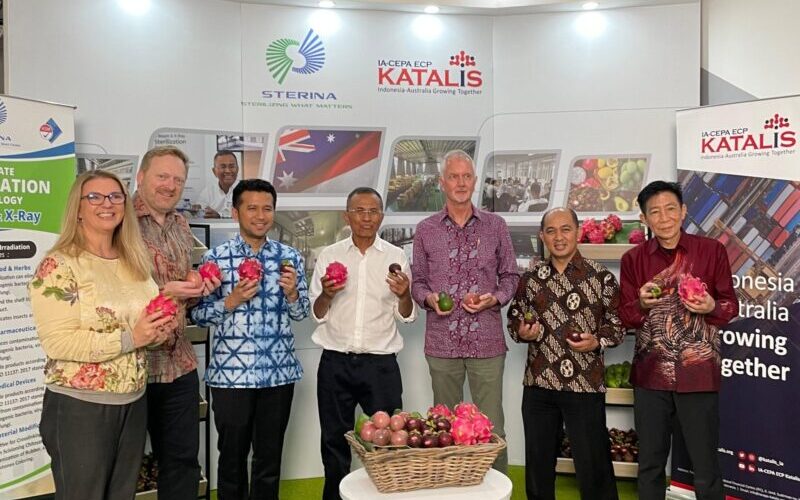
Katalis pests control. Image: iacepa-katalis.org
Katalis has recently produced a handsome 66-page ‘final report’ with Katalis director Paul Bartlett mildly castigating both nations for their apathy while listing “significant policy and analytical achievements laying the groundwork for future cooperation.
“Together, these achievements demonstrate that Katalis met its initial objectives, creating lasting platforms for innovation, investment, and policy reform that will continue to deepen the Indonesia–Australia economic partnership well beyond 2025.
“These outputs were developed through extensive consultation with both government and business sector stakeholders, ensuring policy relevance and ownership.”
To help make the jargon intelligible, MWM put some questions to Bartlett. His office replied: “Media interview requests require DFAT (Dept of Foreign Affairs and Trade) review/approval,” leaving all our questions unanswered:
- If you’re shutting shop, who’ll pursue your “recommendations for further exploration”?
- This year, more than “700 professionals from across multiple industries participated in monthly webinars delivered by leading Australian registered training organisations.” Online programmes would normally be an initiative and a cost for Indonesian education authorities. How many of the 700 participants now have jobs?
- “Katalis leveraged more than $133m in bilateral investment commitments.” Is “leverage” a synonym for introductions or something more substantial? What are the “investment commitments”?
- The deterrents for Indonesian investors appear substantial, particularly the visa application process for skilled workers. What’s being done to address this and the other issues identified by the focus groups? Do investors from Singapore and Malaysia face the same problems?
- You write that “investment remains significantly under-represented in priority sectors.” As IA-CEPA has been in place for five years, your statement suggests the forecast dawn of better relations has yet to rise.
In addition, there are no lists of factories being opened, no depth of exploratory bores, no kilometres of pipelines laid. If that’s happening, it should be in the headlines.
Getting on well with Indonesia beyond security and defence is a praiseworthy ideal that needs a sophisticated approach to a knotty market.
Katalis and the IA-CEPA have yet to find the right way to unravel; the scalp-scratching can be made easier with a cup of real Java spicing the bacon and eggs, or nasi goreng fried rice.
Overall, IA-CEPA seems more like a forced marriage than a union of equals,
Only the Ozzie groom is hot. Love unrequited.
BRICS and Bats: the global world order is changing, but who would know?

Duncan Graham has a Walkley Award, two Human Rights Commission awards and other prizes for his radio, TV and print journalism in Australia. He now lives in Indonesia.