

Is there a ‘bonanza’ for local film and TV producers in the new local content rules or is it just another Hollywood hustle by Netflix? Kim Wingerei asks.
The new laws require major streaming services with over one million subscribers to invest a minimum of 10% of their local spending or 7.5% of their Australian revenue on local content. When announced, it was hailed as a big win for Australian film production, with estimates of hundreds of millions in additional revenue.
Netflix is the biggest of the streamers, with (reported) Australian revenue of $1.3B last year. Their estimated market share is at least 25% according to MediaWeek (2024), indicating the total market for streaming in Australia at $5.2B.
The vagaries of multi-national revenue reporting notwithstanding, 7.5% of that figure is $390m if all streamers were to meet the requirements and follow the rules. That’s a big if.
According to a report recently published by the Australian Communications and Media Authority (ACMA), the top five streaming companies spent $414m in total on 4,500 commissioned, co-commissioned, or acquired Australian programs last financial year.
Paul Miller, Chair of the Streaming for Australia Coalition, notes in a press release issued by Netflix (sic!), the ACMA data “clearly shows that Australia’s SVOD services are already investing at a higher rate than Australia’s broadcasters,” concluding the local content quota is
trying to solve a problem that simply doesn’t exist.
Local content (ill) defined
Having dissected the ACMA data, Simon Nasht, an Australian documentary maker, points out that of the 4,500 programs “commissioned”, 4,459 were acquired, and of those, 3,901 were sports. That means a mere 1.5% of the streamers’ Australian content is new and original programs.
As Nasht quipped on LinkedIn, “Now we love our sport in Australia for sure. But to somehow spin that into pretending that you give the slightest damn about telling real, meaningful original Australian stories as drama, documentary, kids and culture?”
The reality is that investment in real local content by streamers is in decline. Their investment in new Australian adult drama dropped from $32.5m in FY2023-24 to just $19m last year, or 6% of the total $309m spent by the industry at large, as per ACMA figures.
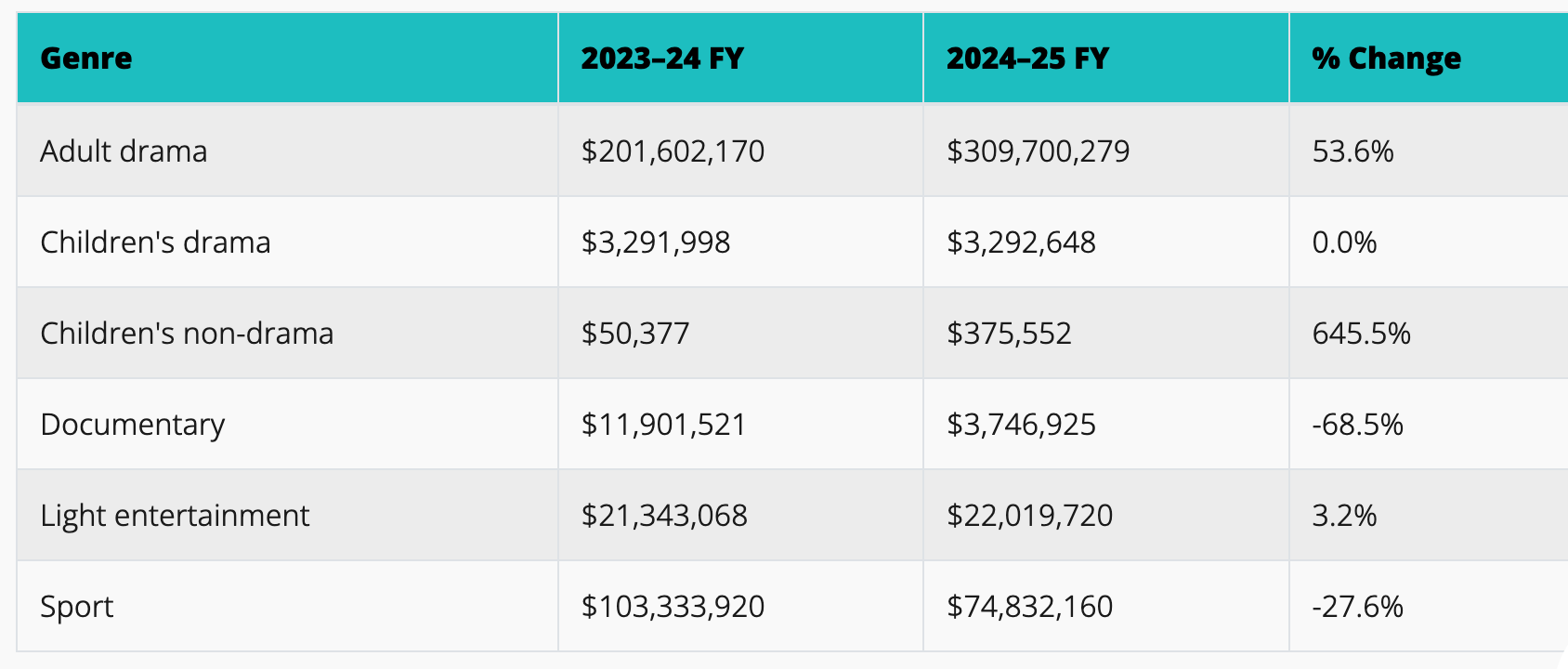
Content expenditure in Australia. Source: ACMA
The streamers themselves claim their spend is much more than that, conveniently omitting government subsidies, which can amount to as much as 40%. (Up until now, reporting has been on a voluntary basis.)
They also omit the fact that while the local broadcast industry still pays a license fee for use of broadcast spectrum, the streamers do not, and have an unlimited free distribution channel paid for by the public, aka the NBN.
And the enforcer?
The new content legislation coming into effect from January 2026 is meant to cover adult and children’s drama, documentary, arts and educational programs. Sports, acquisition of existing content, and light ‘entertainment’ such as the “Wayward Husbands of Wagga-Wagga,” are excluded.
In theory, this means there is potentially a big gap to be filled between the current spend (even if accepting the streaming platform’s own numbers) and what the law will require.
However, the law is rather schtum on how the regulation will be enforced, other than it being under the auspices of ACMA, a notoriously under-funded and ineffective regulator. ACMA is also in charge of enforcing the social media age ban, and is not getting any extra funding.
The arbitrary use of one million subscribers per platform is also fraught. For instance, should the proposed merger between Netflix and Warner Bros (which owns HBO Max) go ahead, it would mean one less streaming platform and potentially (likely) less revenue as a combined entity.
In addition, the streamers can choose to use 10% of their expenses as the base used for calculating their quota requirement. As every multi-national company accountant knows, this will bring creative license to lots of dramatic tension between their debit and credit entries.
Sportsbet Ads, Netflix Laws, and the Lobbyists Who Run Canberra | The West Report

Kim Wingerei is a businessman turned writer and commentator. He is passionate about free speech, human rights, democracy and the politics of change. Originally from Norway, Kim first came to Australia in 1989. Author of ‘Why Democracy is Broken – A Blueprint for Change’.