
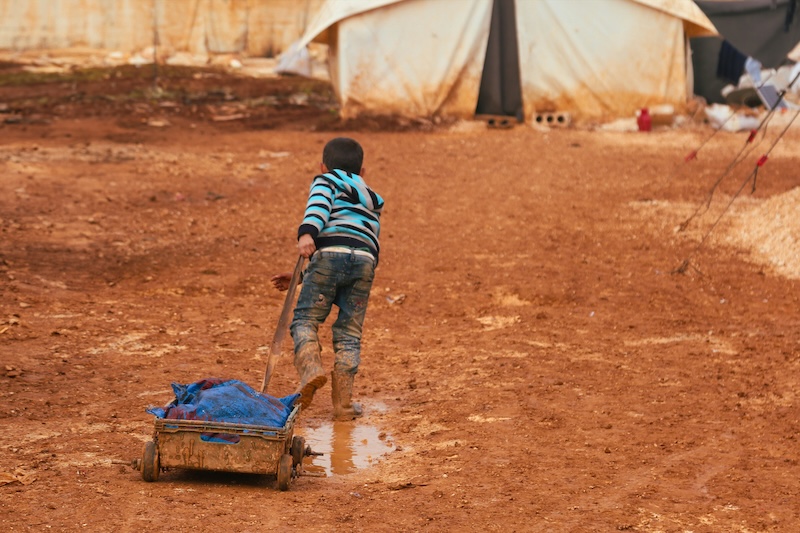

World Humanitarian Day reminds us this is the deadliest time in history for aid workers. Humanitarian and international relations expert Aleta Moriarty reports.
World Humanitarian Day, marked every August 19, arrives this year amid a terrible distinction: this is the deadliest period for humanitarian workers ever recorded. Since 2023, more than 1,010 aid workers have been killed across the world, almost three times the 377 killed in the three years before.
For three consecutive years, Gaza and the West Bank have been the deadliest places to be an aid worker with a cumulative death toll of over 560. Followed by 130 in Sudan, 60 in South Sudan, and 25 each in Ukraine and the Democratic Republic of Congo.
Palestine the deadliest
More recent data from the Aid Worker Security Database shows slight data variance, as illustrated in the racing chart but shows a clear picture that the Occupied Palestinian Territory has now become the deadliest place for aid workers since records began, surpassing every other conflict or humanitarian emergency recorded by the database
“While Gaza is the single largest driver of this extraordinary increase in aid worker deaths … the violence against aid workers has increased across many contexts. So Gaza’s both an extreme case and the clearest of a much wider erosion of humanitarian protection,” said Bushra Khalidi, Oxfam’s Global Humanitarian Policy Lead, based out of Jerusalem.
“Every attack that passes without consequence sends a message that humanitarian workers are basically expendable. That doesn’t mean that every aid worker death necessarily results from deliberate targeting but when clearly marked vehicles…and known humanitarian facilities are repeatedly destroyed without credible independent investigations the protections that are provided by international law become basically meaningless in practice.”
No apology for Zomi
Among the dead was Australian humanitarian worker Zomi Frankcom. On 1 April 2024, Frankcom and six colleagues from World Central Kitchen were killed in an Israeli strike on their clearly marked convoy.
More than two years later, her family is still waiting for a personal apology, for accountability, and for the outcome of an investigation by Israel’s Military Advocate General.
“The single biggest obstacle to ending impunity is really political will,” Khalidi has said of accountability for attacks on humanitarian workers in Gaza.
“It’s not that the law isn’t clear, and it’s certainly not that there is not enough evidence. It’s that Israel continues to be politically protected by very powerful states, including governments that are continuing to provide arms, that are maintaining preferential trade and diplomatic relations, and that are shielding Israel from meaningful consequences. You can’t keep calling for respect for international law while materially supporting the state that’s violating it.”
Disinformation a rising threat
The threats aren’t only physical. The Secretary-General’s own report on civilian protection flagged “targeted misinformation and disinformation campaigns” as a growing driver of risk to aid workers.
“We’ve seen a sustained disinformation campaign…often without credible evidence,” said Khalidi.
UNRWA says it has faced a sustained disinformation campaign throughout the Gaza war, in which allegations against individual employees have been transformed into sweeping claims about an organisation employing tens of thousands of people, amplified by social media.
This type of disinformation likely contributed to the increased death toll of humanitarian workers by muddying the waters.
Role of Meta and Facebook
It’s a question Meta has faced before: a 2018 UN fact-finding mission found Facebook played a “determining role” in the violence against Myanmar’s Rohingya, and the company’s own commissioned review later admitted it hadn’t done enough to stop
the platform being used to incite hatred.
Whether the same question gets asked of it, on Facebook or elsewhere, over Gaza remains open.
World at war yet massive budget cuts
The Uppsala Conflict Data Program counted 65 active state-based conflicts in 2025, up from 61 in 2024, the highest figure since it started counting nearly 80 years ago, with interstate conflict alone reaching levels not seen since the Second World War.
None of this is happening in a system with more money to meet it.
At precisely the moment humanitarian need has become overwhelming, the resources available to meet it are being dismantled.
In January 2025 the United States, then the world’s largest humanitarian donor, froze and then slashed its aid budget. By that May, at least 233,818 humanitarian jobs worldwide had already been cut, even as conflict kept rising globally and more workers than ever are being killed.
International Women’s Day. Never closer to equality, nor closer to losing it.

Aleta is a practitioner researcher in human rights, disability inclusion and gender. She is completing a PhD at University of Melbourne and has twenty years of experience working across agencies including the United Nations, UN Women, World Bank, and the University of Melbourne. She is currently standing as an Independent Candidate for Western Victoria. Her website is www.aletamoriarty.com