

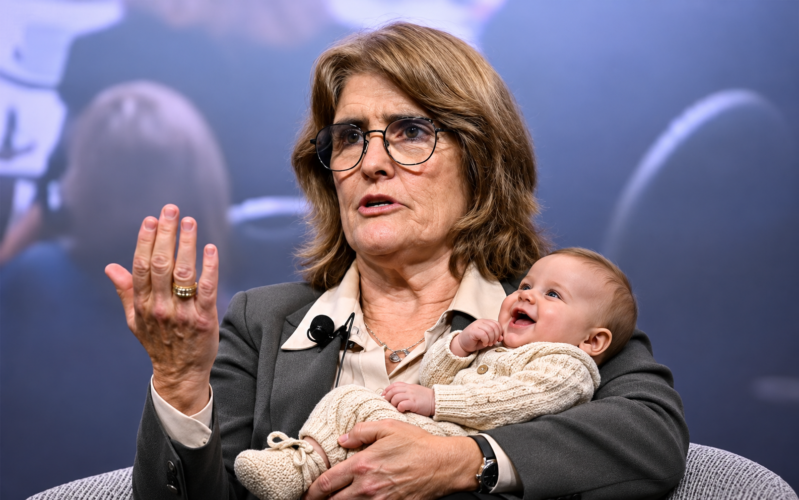

The Reserve Bank has developed a twist on the “don’t throw the baby out with the bathwater” proverb. It’s tossing the baby, hoping the child will take some bathwater with it, writes Michael Pascoe.
In fairness, our central bank is between the proverbial rock (inflation higher than it wants) and a hard place (high and rising unemployment threatening a per capita recession). The Melbourne Cup Day rate rise confirms the bank has forsaken “the narrow path” between those difficult alternatives, deciding to throw the economy (the baby) at the rock.
If you were given to theorising about how RBA staff might seek to manage the seven outsiders on the monetary policy board, you could think bank officials had been steadily talking up expectations of this rate increase even before the latest higher-than-expected CPI figures.
Market expectations – and the bank is all about expectations – were such that it would have been very hard for the bank to sit pat, yet three of those seven were prepared to.
That indicates to me the “certain” decision could have been quite uncertain if not for the very conscious expectations management
There’s a sentence in the board’s official statement that demonstrates the extent of baby tossing:
“The forecasts see growth in output slowing further over the coming year, which is expected to reduce capacity pressures and help return inflation to target.”
So having told everyone we have inflation because of a supply/demand imbalance, it’s now a good thing that output growth i.e. supply is slowing, the RBA continues,
“Higher interest rates and falls in housing prices and turnover are expected to weigh on growth in dwelling investment and household consumption. On the other hand, growth in overall business investment is forecast to be stronger in the near term, including data centre-related investment. Employment is expected to continue to grow, but the unemployment rate is projected to rise by more than expected in the August forecasts.”
Spinning one per cent employment growth forecast first makes softer reading than that the bank expects unemployment back above five per cent and rising in 2028.
Unemployment is raising
In context, before the RBA adds its usual “that’s still historically low” qualification, it will mean unemployment of five per cent and rising for the first time in six years. There’s no forecast beyond 2028, but you’ll note the trend and wonder what happens next if half the AI forecasts are true. (More about that another time.)
And for more context on the statement, it concludes with the usual platitude “the Board is focused on its mandate to deliver price stability and full employment”. The next trick here is that the bank defines
‘full employment’ as whatever the unemployment rate is when inflation is on target.
It’s just a fig leaf phrase.
And talking of AI, the forecasts in the RBA’s statement on monetary policy paint a bleak picture of diving dwelling investment as a data centre bubble passes through the system – data centres that certainly consume and inflate but whose eventual production value is moot.
Business investment
With this financial year nearly half over, the RBA reckons business investment for 2026-27 will land at a strong 7.8%, though down from 2025-26’s very strong 10.5%, and then drop to effectively nothing, 0.2%, next financial year. Hope you were one of the few who enjoyed the boom.
Dwelling investment, you know, housing, the core of our “cost of living” crisis, is predicted to drop from 5.8% last financial year to 1.3% come June 30 and shrink by 3.5% next financial year.
Yes, that is a bleak outlook. Forget whatever the government has ever promised about housing.
Inflation meanwhile is forecast not to drop back into the 2-to-3% range until the end of next year and not reach the RBA’s preferred target of 2.5% until June 2028. Pain for slow gain.
If it’s any comfort, by the nature of forecasts, they are more likely to be wrong than right. What matters is that the RBA is
setting rates to squeeze spending power based on those guesses.
Yes, the whippings will continue until morale improves. The bank assumes this is what it will deliver by keeping the cash rate at 4.8%.
Of course there is that lucky minority of us who get a little richer every time rates are increased. The public perception focuses on the individuals and businesses carrying mortgages and debts who keep taking one for the team by feeling the most pain.
No, it’s not really fair. The RBA officials make a big show of sympathy for mortgage holders, but there’s been a shift to try to downplay the inequitable nature of the pain.
I get the impression Governor Michele Bullock is sharing more of the policy performance role around with her visiting English deputy governor, Andrew Hauser, taking an increasing role.
And it’s a role of “yes, it hurts, terribly sad, but not many people are really hurting, and mortgages aren’t the main thing anyway”.
That’s a rough summary of his appearance at a conference last month, where Hauser said,
Only about two per cent of mortgages are actually in negative cashflow,
I’ll leave you to think what being “in negative cash flow” means for the couple of hundred thousand men, women and children who make up that two per cent and never mind the many more hovering near it.
Anyway, the RBA would have us believe the impact of their rate moves on the exchange rate is much more important anyway. Mr Hauser:
“There are four channels of the transmission mechanism. The first, and by far the most important in Australia and in most small open economies, is the exchange rate. Some of our models say that up to two-thirds of the effect of interest rates actually comes through the exchange rate channel. People say, ‘Hang on. There can’t be that much from people going on holiday.’ But of course, it’s much more than that. It affects the cost of everyone importing goods, businesses.”
Given the number of wheels that turn to produce exchange rates at any one time, I think the RBA needs better models.

Michael Pascoe is an independent journalist and commentator with five decades of experience here and abroad in print, broadcast and online journalism. His book, The Summertime of Our Dreams, is published by Ultimo Press.