


Australia’s AI processing centres are consuming millions of litres of drinking water and generating mountains of toxic waste. Claudia Weisenberger on the hidden cost of AI.
In February this year, OpenAI CEO Sam Altman told the AI Impact Summit that water concerns are ‘totally fake’. Meanwhile, OpenAI is building the $US500B Stargate Data Centre in Texas in a joint venture with Japan’s investment giant, SoftBank, plus Oracle, NVIDIA and others, which is expected to consume several million gallons of water a day (1 gallon = 3.78 litres), making it the largest consumer of water in what is a very dry region.
Sydney Water is preparing for data centres to consume 25% of Sydney’s drinking water by 2035.
No data centre operating in Australia is required to disclose how much water it consumes, nor is there a law currently requiring any of them to recycle it. And even if they do, the cooling process generates toxins hard to get rid of.
From drought-proofing to satiating data thirst
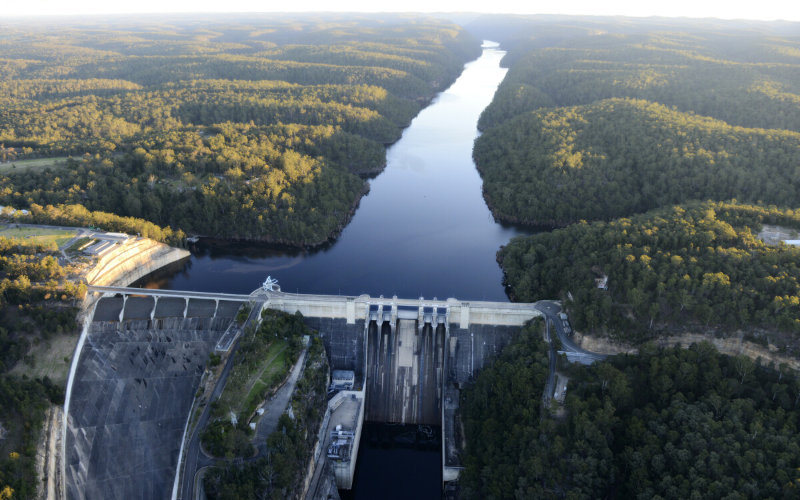
The Sydney Desalination Plant at Kurnell cost $1.9B to build and $700,000 a day to run, adding $22.04 to every Sydney household’s annual water bill. It was built to drought-proof the city. By 2035, data centres may need all of it. Sydney Water told a NSW parliamentary inquiry that data centres could
consume up to 250 megalitres of water per day by 2035.
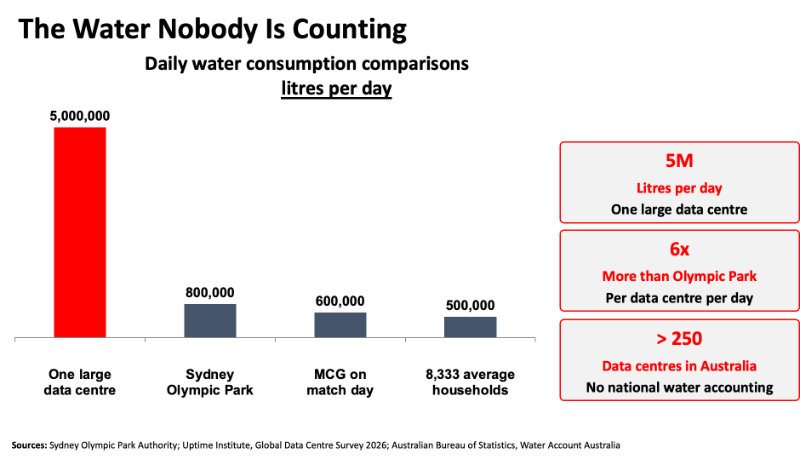
One large AI processing centre consumes about five million litres of water per day — enough to supply 9,000 homes. Sydney Water has received applications from developers seeking connections of up to 40 million litres per day for a single facility — equivalent to the entire daily water use of Parramatta, home to more than 70,000 people.
Paul Higham, Sydney Water’s head of business development, was direct: ‘It is rapidly becoming the largest new water demand in the city. There is no water utility in Australia that will turn around and say we’ve got that volume of spare capacity in our system.”
In NSW alone, 15 data centre projects collectively worth $51.9B have been endorsed. The companies making that investment are under no obligation to disclose how much water they use or recycle what they consume. Who pays for the new infrastructure their demand requires is now before the Independent Pricing and Regulatory Tribunal — the same body that sets household water prices.
Water contamination
The water that passes through data centre cooling systems does not come out the same as it went in. Biocides, heavy metals, corrosion inhibitors and PFAS — forever chemicals that do not break down in the environment — accumulate in cooling water and are discharged into municipal water systems. Once in the supply,
those chemicals cannot be removed by standard treatment.
This is already an issue in the US.
In February 2026, a Meta data centre in Cheyenne, Wyoming contaminated that city’s water reclamation system with rare metal-resistant bacteria during a cooling system purge. The system was taken offline for months. The city banned data centre water discharges.
Australia has announced legislation to set mandatory water standards for data centres — but it has not yet passed. Until it does, data centres are not legally required to disclose what they discharge. By the time contamination is detected, it may already be in the water system.
The consequences are already playing out in Australia’s region.
In October 2026, residents on the Indonesian island of Batam stormed a data centre compound carrying empty jerry cans after their taps ran dry for three months. Authorities had approved ten data centres on an island with no natural freshwater sources, whose 1.3 million people rely entirely on rainwater collected in six artificial reservoirs.
“Not a single drop has come through our taps for the last three months,” one resident told the BBC. “Our water supply had been reliable until the data centres came.” The companies declined to say how much water they were using. Reliable data on data centre water use, a local academic noted, remains scarce — partly because companies treat it as proprietary information.
Some companies are acting voluntarily. Amazon has partnered with Greater Western Water to supply recycled water from the Melton Recycled Water Plant to a new data centre in Melbourne’s west — the first Amazon Web Services facility in Australia to do so, with operations planned for late 2027.
Amazon does not publish the volume of drinking water its existing Melbourne and Sydney data centres consume.
Toxic waste
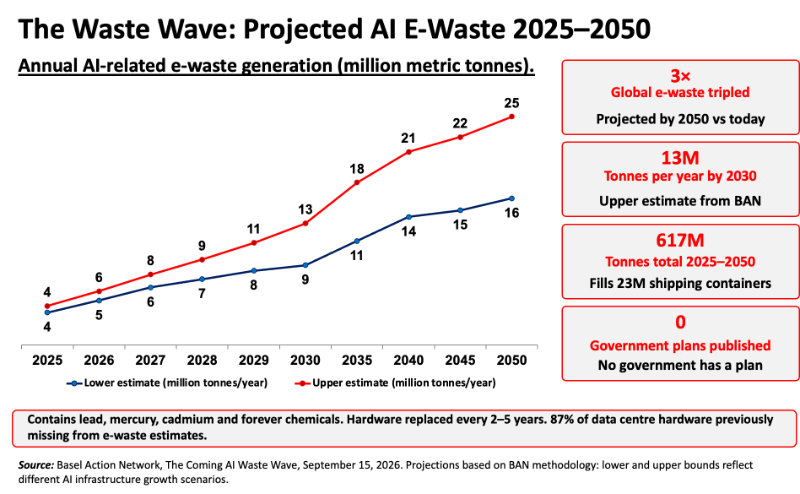
The Basel Action Network — a US-based environmental organisation that monitors the global trade in hazardous waste under the United Nations Basel Convention — published The Coming AI Waste Wave in September 2026. Its central finding was
AI’s data centre buildout could triple global e-waste over the next 25 years.
Between 2025 and 2050, AI infrastructure is projected to generate between 395 million and 617 million tonnes of electronic waste — enough to fill 23 million shipping containers placed end to end around the Earth six times. Previous estimates missed up to 60% of the hardware involved — cooling systems, power distribution, backup generators, networking equipment.
All of it contains lead, mercury, cadmium and forever chemicals. None of it has a disposal plan.
“If companies and governments do not begin planning for this new waste tsunami, today’s AI buildout could become an even more cataclysmic toxic waste crisis than we are already experiencing,” Jim Puckett, founder of Basel Action Network, said.
Australia’s existing e-waste scheme covers televisions and computers — not the transformers, cooling systems, power distribution units and networking hardware that data centres will retire at scale.
The peak industry body, Data Centre Australia, confirmed this year that questions about chemical waste from its members’ facilities were the first it had received on the subject. When those facilities eventually decommission their hardware, the environmental and financial cost of safe disposal will fall somewhere — on industry, on government, or on the public.
No Australian government has said which.
Australia is the driest inhabited continent on Earth. Two hundred and fifty AI processing centres are operating right now, with 225 more in the pipeline. No law requires any of them to disclose what they consume, what they discharge, or what they leave behind. The question is whether Australia will have a plan before the damage is done.

Claudia Weisenberger is a management consultant with deep experience in pharmaceuticals, hospital transformations, and strategic due diligence across four continents. She combines sharp analysis with hands-on execution.