

Heads are already rolling after NSW Legislative Council released its report into university governance, highlighting widespread transparency and accounting issues. Adam Lucas and James Guthrie report.
Last week, former La Trobe and Wollongong VC, John Dewar, left KordaMentha, the consultancy embroiled in accusations of university mismanagement and over-reliance on consultants. He may not be the last.
On 21 September 2026, the NSW Legislative Council released its much-anticipated final report into university governance. Across ten institutions, it documents a sector in which external consultants design restructures and create accounting measures to justify them, university-controlled commercial entities operate beyond public scrutiny, and deliberately opaque accounting obscures university finances from staff, students and the public.
The report treats these problems as interconnected. It highlights widespread transparency issues requiring systemic policy reforms to improve accountability and public trust in Australian public universities.
The role of external consultants is central to those reforms.
Many of these issues have also been on display in NSW’s Corruption Commission’s (ICAC) ‘Operation Scandi‘, which focuses on University of Wollongong in particular.
Consultants runs the show
Finding 15 from the report is blunt. It states that there is “insufficient transparency regarding the purpose, justification and outcomes of consultancy expenditure”.
NSW universities reported spending $139m on consultants in 2025 alone.
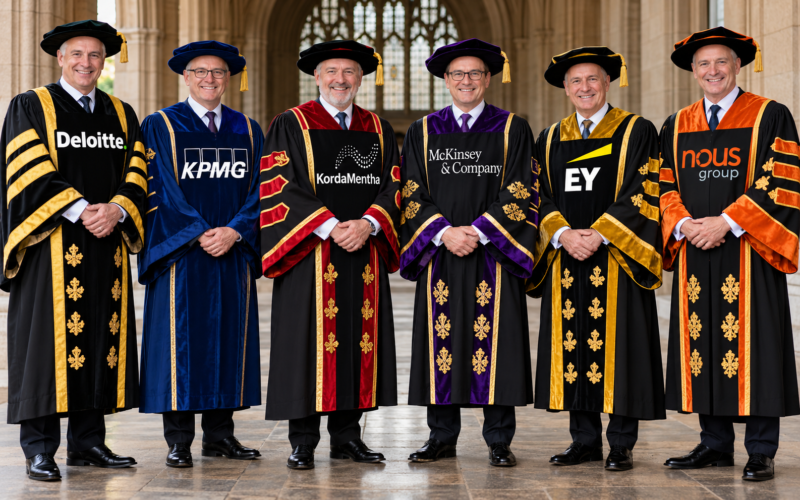
Deloitte received $26.46m, KPMG took $19.71m, while KordaMentha, McKinsey and EY together collected another $7.86m.
Universities cannot explain what this money bought. Recommendation 17 demands annual reporting on major consultancy expenditures, including purpose, justification, procurement process, and outcomes, in a legal, standardised form. It also recommends mandatory procurement guidelines requiring competitive tenders unless an exemption applies, along with published reasons for direct procurement, and greater contract disclosure.
The committee found that nearly 24% of consultancy engagements were directly sourced, minimising competition and value for money.
For example, at the University of Wollongong (UOW), KordaMentha partner John Dewar was appointed interim Vice-Chancellor in June 2024 while participating in his firm’s tender preparation meetings and after being told it was the preferred candidate. KordaMentha’s initial $310,000 contract grew to $3.8 million.
Dewar told ICAC he wanted the appointment to benefit his firm, creating “if not actual then certainly perceived conflicts of interest”. This was a striking admission given he’d earlier told the inquiry, “No. I do not accept that”, when challenged on his conflict.
The parliamentary committee found aspects of Dewar’s evidence misleading and raised potential contempt, warning that “the UOW example of a cavalier approach to consultant procurement raises very serious concerns as to practices across the sector.”
The Wright stuff. Uni of Wollongong CFO hands keys to KordaMentha
Conflicts of interest
At UTS, KPMG was engaged under a $7m contract for its “Operational Sustainability Initiative”, with extensions of up to $180,000 per week. At the University of Sydney, one of only two NSW universities to invoke the NSW Treasurer’s directive to avoid disclosing consultant spending, Professor Buchanan told the committee that the “secret” use of Nous Group in the Business School meant that “key strategic and financial decisions were thus displaced into a private, unaccountable domain,
undermining the public trust on which universities depend.
The committee was troubled by the prevalence of conflicts of interest among university board members, such as UOW’s and Western Sydney University’s ties to firms like Deloitte and KPMG, which could undermine governance integrity, contracts and appointments, as well as public confidence in university oversight.
The NSW report singles out specific firms for criticism. On KPMG, which remains embroiled in integrity audit scandals and conflict-of-interest failures, the committee said universities should follow the NSW Government’s lead in suspending further engagement. On KordaMentha, the committee found significant discrepancies between VC Dewar’s evidence and his later admissions to ICAC regarding conflicts of interest.
The committee concluded that Nous Group’s Timothy Orton “has not given honest evidence” about the relationship between its UniForum benchmarking business and its consulting arm. Various submissions informed the committee it was
selling both the benchmark and the solutions to fix results.
The committee’s own findings substantially endorsed this characterisation.
Benchmarking as a data heist
Finding 16 addresses what may be the most menacing development in NSW university governance: the sharing of staff and student data with private third-party organisations for benchmarking and analytics, which they sell to other universities internationally. The committee found insufficient transparency, accountability and informed consent.
Recommendation 18 is fundamental. It would prohibit NSW universities from providing staff or student data to private third-party organisations for any reason, including sector-wide benchmarking, unless they have obtained explicit informed consent, in line with the NHMRC’s ethical conduct statement.
Such reforms aim to empower the public and staff by ensuring transparency and safeguarding their data from misuse.
This recommendation directly targets the model used by firms like Nous, whose UniForum product aggregates data from 75 universities worldwide.
Accounting illusions
Finding 18 identifies “variations in accounting presentation and disclosure practices” that make it difficult for politicians, staff, students and the public to understand universities’ financial positions and assess claims of financial pressure.
Its paired recommendation 20 calls for enhanced annual-report disclosure of significant accounting treatments, contingent labour expenditure, consultancy expenditure, asset classifications and material changes in financial reporting practices.
The report also criticises the use of adjusted, non-statutory financial measures that diverge from audited accounts. Recommendation 14 goes further: universities should be prohibited from relying on adjusted financial measures in public justifications of restructures, budget decisions, and other significant organisational changes where those measures do not accord with audited financial statements, stating the obvious:
Any material differences between adjusted and audited results must be disclosed.
Wollongong University Inc. Profit over jobs as consultants prosper
Finding 13 adds that council decisions lack transparency, including the financial basis for those decisions. Recommendation 14 requires universities to publish council minutes, including the rationale for major decisions, subject to appropriate confidentiality. It further requires a review of commercial-in-confidence provisions to ensure they are not used to prevent disclosure of matters of significant public interest.
Commercial empires beyond scrutiny
Finding 17 identifies insufficient transparency regarding the activities, governance and financial performance of university-controlled entities and commercial operations which account for billions in financial resources.
UOW Global Enterprises (recently redubbed “Global Education”) operates campuses in Dubai, Hong Kong, Malaysia and India, with a Saudi Arabian campus approved by Council on 21 October 2024 “without the need to proceed to a formal vote”.
Our own submission to the NSW inquiry noted that this decision involved creating a foreign operating entity, exposure to foreign legal and regulatory systems, and no public record of a structured human rights or academic freedom assessment.
The inquiry examined UOW GE’s commercial activities in some detail, noting that its operations are
largely invisible to Parliament, the public, council, staff and students.
The report’s broader findings are damning: NSW universities may legitimately engage in commercial activities supporting educational objectives, but “public accountability must continue to apply regardless of the organisational structure through which those activities are undertaken.”
Finding 5 states that external oversight of university governance across all NSW universities is insufficient, despite substantial public funding. Recommendation 4 calls for the Legislative Council’s Tertiary Education Committee to annually inquire into universities’ fulfilment of their responsibilities under their enabling Acts.
Systemic issues
The report’s most significant contribution is its recognition that these problems are systemic, not episodic.
The corporatisation of university governance with councils dominated by corporate appointees rather than elected staff and students has created a culture where commercial confidentiality trumps public accountability, where consultants design the future of public institutions, and
where executives face no consequences for failure.
As the NSW report concludes, existing governance structures are “not fit for purpose, nor implemented in such a way as to enable public confidence”.
The question now is whether the NSW Government will implement these recommendations, or whether another comprehensive report into contemporary university administration will join the growing pile of inquiries documenting university governance and financial failures while nothing changes.
“Employability … interdisciplinarity”? Have our unis stopped believing in education?

Adam Lucas is an honorary senior fellow at the University of Wollongong and a founding member of Academics for Public Universities and Public Universities Australia. Prior to working at UOW, he was a researcher and policy analyst in the NSW Cabinet Office and the Departments of State and Regional Development, Aboriginal Affairs and Housing.

James Guthrie AM is Emeritus Professor in the Department of Accounting and Corporate Governance at Macquarie University. He is the joint founding editor of the Accounting, Auditing and Accountability Journal, which has been consistently ranked in the top five journals in his field.