



We’re at a lower political point than we care to realise, writes Michael Pascoe. It’s not just Albo’s mid-term doldrums.
Things are getting desperate when the scoop out of an “exclusive” interview with the Prime Minister is that he described monetary policy as a “blunt instrument”.
OMG! Hold the front page!
I’m personally not sure how you could have any discussion about monetary policy tightening without the blunt instrument cliché popping up. How do you describe grass without mentioning “green”? Where do bears defecate?
Yet it took not one but two senior SMAge journalists to headline that Albanese said “blunt instrument” allegedly for the first time since he became PM.
Specifically, James Massola and Paul Sakkal breathlessly reported:
“Interest rates are a blunt instrument,” Albanese warned. “They have an impact on people who have mortgages.”
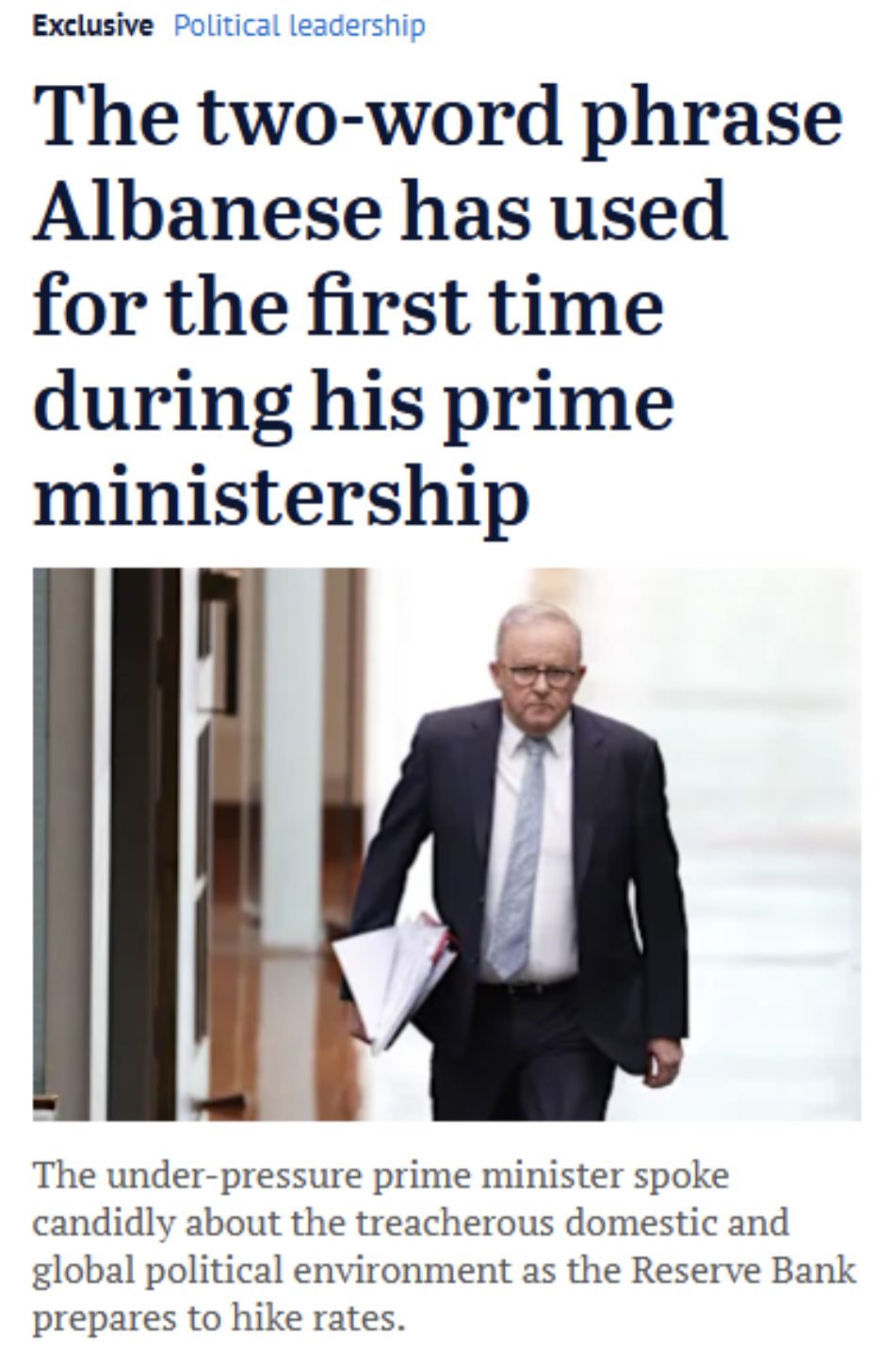
Source: SMH
Up the pole
You can’t get much higher up the “no shit Sherlock” pole than that.
From those two sentences the SMAge’s chief political commentator and chief political correspondent crafted these enthralling introductory paragraphs:
Anthony Albanese has labelled Reserve Bank of Australia rate hikes a “blunt instrument” hurting people with mortgages, while pivoting to pro-growth economic rhetoric as he braces for a fifth interest-rate rise this year amid mounting criticism of near-record government spending and poor productivity.
On Thursday, the under-pressure prime minister spoke to this masthead candidly about the treacherous domestic and global political environment. On Friday, he surpassed post-war reconstruction leader Ben Chifley to become the longest-serving Labor PM after Bob Hawke and Andrew Fisher.
A golden rule of journalism is that you lead with your best shot
as most people only read the first couple of paragraphs. The only thing this reader learned from the above is that most Labor leaders haven’t spent much time in the Lodge if one-and-a-half terms scores third place.
If Albanese hasn’t used the RBA’s own standard “blunt instrument” phrase in public before, it means he hasn’t spoken much about monetary policy.
Faint praise and not much
But the SMAge divined that “the sharp comment suggests he is trying to distance himself from the RBA as he struggles to lift his low approval ratings and economists warn of a possible recession”.
Well the second part of that is correct. Albanese is struggling and some economists are warning a recession is possible. (Underline my addition of “some” though as you can always find some economists running whatever line you want to run. Just ask the AFR.)
Like the bears and the Pope and where the sun rises, no prime minister embraces the RBA when it is increasing rates to squeeze people.
So the actual news about the “exclusive” interview is that it was a dud,
there was no news.
And that sums up where Labor’s political fortunes are nearly half way through this term.
That even shows in a rough word count of the article. In round numbers, of the 1200 words, 550 reported what Albanese had to say and 300 were devoted to what a Melbourne academic, Paul Strangio, thought of Albanese.
And if you want an example of faint praise, Strangio said Albanese’s staying power was a ‘signal achievement’ that set him apart from predecessors.
Wow. He’s survived as Prime Minister for 1.48 terms – build him a monument. (And never mind how helpful the quality of the opposition that been.)
No answer for malaise
At mid-term, Labor is stuck where it is with nothing new to say. It is suffering from poorly handling the reform bolt it shot in the May Budget, understandably has no easy answers for the electorate’s malaise, is constrained by economic circumstances and reality from buying popularity, now wears the mantle of “they are all the same” by copying the Morrison government’s grant-rorting corruption, and suffers a bumbling leader unable to successfully “throw the switch to vaudeville”.
How bumbling? Try the Keystone Cops spin effort over the $6 million Marrickville Golf Club Taj Mahal that sunk even deeper into sewage with disclosure of Albanese’s office trying to slur Helen Haines.
Try showing no thought or comprehension by presenting the RBA ditching credit card surcharging as a great money-saving win for consumers.
The public actually isn’t that dumb.
And then compound it by boasting of jumping into action at the behest of an unrepresentative small business lobby to increase government debt by $200 million in order to subsidise individuals and a few businesses who like to earn frequent flyer points using a credit card to pay the ATO.
(Thanks Albo, that’s how I now pay my BAS. Without you getting other taxpayers to subsidise me, it would make no economic sense at all.)
Unlike monetary policy, the government was well within its rights to lean on the RBA to not scrap the surcharge option, but that would have required a Treasury or PM&C awake and thinking. D’uh.
Low growth the new normal
Even good news – the record surge in investor loans for new housing – fails to score.
Stuck in the mid-term doldrums then with backbenchers getting nervous in the face of electoral uncertainty and a leader sinking in the polls, the Canberra game has moved to “blame the Treasurer”, keeping the gallery occupied with anonymous sources.
Well, taking responsibility has not been Albanese’s signal achievement. Luckily for Labor, the opposition is still Angus Taylor’s Opposition and there’s plenty of time yet for One Hanson to implode.
But that doesn’t make any of the underlying problems go away.
The really bad news, what the main players either don’t understand or refuse to admit, is that they won’t.
The most important commentary of the past month, perhaps the only important domestic commentary, came from Redbridge’s Kos Samaras in Pearls and Irritations.
Samaras explained that the golden era of post-war economic growth was not normal and is not coming back.
Luck running out?
Australia has been much luckier than most in that we have had two bites of one-off booms, the first being the West rebuilding after the war and the second via China’s rise.
Misled or misleading politicians can wax nostalgic about getting back to making cars and everyone getting ahead, simpleton populists can add some racism and magical thinking to the message, but they can’t change the underlying reality.
Please read all of Samaras’ column for the explanation but here’s an edit of the conclusion:
The pie will grow slowly from here, and nobody can change that. How it is cut is still up to us.
The established parties have spent 40 years selling the managed version. Every election they promise that home ownership will recover, that wages will outrun prices, that the next generation will do better than the last.
They speak as if 1965 were a destination that better management could reach. Every term the numbers get a little worse and the delusion continues. Voters notice and spot this delusion from a mile away.
They may not know the statistics. They know their adult children are still in the spare room. They know the house they bought for three times their income now sells for eight. They know they did what their parents did and got less for it.
The gap between what was promised and what was lived is where trust in the major parties has gone to die.
The populists then sell the unmanaged version. The boom did not end, they say. It was stolen. By migrants, by elites, by Canberra, by globalisation. Remove the thieves and 1965 comes back. It’s of course a blatant lie but also a powerful message because it is half true. Something was moved. A share of the gains did shift from wages to assets and from the young to the already established.
People are right to be angry about that.
There is no lever in Canberra that produces 3.8 per cent growth per person. There is no migration cut that makes a house cost three times a wage. A smaller intake does not bring back seven workers for every retiree. It moves the country towards two, faster. No tariff recreates a world in which the West had the factories to itself.
A party that rents its votes on the promise of restoration faces the same reckoning as the parties it displaced. It faces it sooner, because it promised more.
The awakening will not be comfortable. People who have lost a future they were promised do not thank whoever confirms that fact. Some will go looking for the next, louder version of the same promise. That cycle may run for a while yet.
But it does open the only politics that can work. One that stops promising 1965 and starts arguing about 2035. Who owns the housing. How work is taxed against wealth. Who pays for an older country. What a decent life looks like when growth is slow.
The post-war generation got rising living standards without the country ever having to choose who received them. Growth made the choice for us. That is what has gone. From here, a fair share has to be decided on purpose.
It is deeply serious and challenging stuff. Much easier to make a headline out of a “blunt instrument” cliché. Much easier to promise prosperity is just around the corner and blame Trump/Putin/RBA/Treasurer if you’re in government or the government/migrants if you’re in opposition.
The mid-term doldrums are not going to end.

Michael Pascoe is an independent journalist and commentator with five decades of experience here and abroad in print, broadcast and online journalism. His book, The Summertime of Our Dreams, is published by Ultimo Press.