



Facebook Australia is a bad corporate citizen, its business model toxic and its tax evasion practices, including dodging GST, rampant. Wally the Chartered Accountant and Michael West investigate.
The image of Facebook CEO, Mark Zuckerberg, at a dinner table with Jeffrey Epstein in 2015 enshrines the Facebook business model … seedy. Like The Plague, it has both spread and the loss of humanity.
- the spread of screen time and self-loathing for children using the app
- the spread of misinformation, lies, fabrications, distortions, and denials of facts
- the spread of human indecency, prejudice, hatred and social division
- the spread of emotional response and aggravation as a replacement for logic
- the spread of financial load on the populace to cover for the under-contribution of multinational corporations that are raking it in.
Elon Musk’s X is in the same toxic camp, but today we are on Facebook and its parent company Meta, which also owns Instagram. Facebook’s spread uses an algorithm across all aspects of the business model. Facebook is programmed to get away with whatever it can in pursuit of generating more money for itself.
It takes nothing seriously: the laws of the land, rules and regulations, social responsibility, or conventions of good corporate behaviour.
Online abuse, teen suicides (especially girls), minimum age requirements, financial disclosures, and income taxes are just a work-around for this corporate grub. It’s all about avoiding responsibility in pursuit of growing profits and cash flows from their very ugly business model.
Not our fault
According to Facebook, the misinformation and disinformation on the Facebook platform are not Facebook’s fault. There is nothing Facebook can do because it’s up to everyone else or anyone else.
“Our fact checkers operate independently it’s really up to them to apply their good judgements and their editorial techniques in order to undertake whatever research they need to in order to verify a claim.”
The Facebook algorithm is based on the premise that the costs of business will always be lower, and the financial returns higher, from breaking the laws of the land rather than following them. And so it is no surprise that their financial reporting is every bit as sketchy as their business model.
What have authorities done about it? Not much, apparently. What will authorities do about it? Nothing, probably.
Facebook’s tax evasion 2009-2016
Turning to the evidence at page 18 of the annual financial report of Facebook Australia Pty Ltd for 31 December 2017 that reveals eight years of tax evasion from 2009 to 2016.
Facebook Australia and some of its offshore related parties executed a legally binding settlement deed with the Australian Taxation Office (“ATO”) on 13 October 2017 to conclude an income tax audit relating to the 31 December 2009 to 31 December 2016 income years.
As a result of this settlement, an additional tax expense of $31.262m was incurred and recorded in current year tax expenses on the basis that the directors consider the settlement to be a refinement in the current period of tax liabilities estimates made in previous years.
Refinement?
“Refinement” is the word doing the heavy lifting in Facebook Australia’s disclosure about the ATO tax audit. Getting busted by the ATO involved a refinement: a minor adjustment or small change to an estimate that could have been expected.
The statement of cash flows for 31 December 2017 shows that Facebook Australia paid income tax of $49.2m to catch up after only paying $1.9m for the prior year to 31 December 2016.
No admission. Business as usual
Even though Facebook Australia was breaking the law and paying a pittance in income tax for eight years straight, it did not have to admit to doing anything wrong.
Nothing about mistakes or errors. Nothing about failing to meet its tax obligations at law. That’s the beauty of a settlement deed; you don’t have to admit to anything much. Just disclose that there has been a refinement and pay some more tax.
At least the ATO is trying. No doubt the Facebook Australia settlement helped the ATO with a KPI (key performance indicator), but did the ATO do enough to send a message that corporate tax evasion by multinational will not be tolerated and will be punished to full extent of the law?
Poor optics, wrong message
There is no mention of whether Facebook’s settlement with the ATO included any penalties. But the optics of the settlement deed are not good.
When a large multinational cheats on its taxes for 8 years straight, then the ATO is most likely to negotiate and settle rather than prosecute. The name of the game for a multinational corporation like Facebook then is to negotiate with the ATO and pay less tax over time than would be the case if they acted in good faith and followed the law.
The regulatory risk of engaging in corporate tax evasion is worth it because chances are the corporation will always end up with a better financial outcome over the long run. The sequence of events for a multinational like Facebook is: 1. reap financial rewards from tax evasion; 2. ATO audit and negotiated settlement is a cost of doing business and cheaper than paying fair share of taxes; and 3. Back to reaping financial rewards from tax evasion until the next ATO audit and negotiated settlement rolls around in the distant future.
Facelift for Facebook
Facebook’s tax evasion across 2009-2016 was facilitated by the absence of publicly available financial information about Facebook Australia Pty Ltd on the database of the Australian Securities and Investments Commission (ASIC).
On 4 November 2008. Facebook Australia Pty Ltd was incorporated. On 11 March 2009, Facebook Australia Pty Ltd hoodwinked ASIC (how easy) into believing that the company did not have to prepare and lodge audited annual financial reports because it was controlled by a foreign company which is not part of a large group.
Facebook Inc had revenues of $272m for 2008 and was valued at around $15bn.
Six years later, on 30 April 2015, Facebook Australia filed an annual financial report with ASIC for financial year 2014. Let’s count it up for ASIC:
that’s five years of missing financial reports
for a multinational company involved in tax evasion 2009, 2010, 2011, 2012 and 2013. Where’s the regulatory response?
Facebook’s tax evasion 2017-2025
There is no argument about whether Facebook pays income tax in Australia because it does. According to published ATO data, Facebook Australia Pty Ltd has total income tax payable of $184.9m over the eight years 2017-2024 at an average of $23.1m per year.
In recent years, the tax payable per year has been on an upward trajectory: from $20.3m for 2021 to $38.6m for 2024. Facebook Australia does pay income tax, but do they pay the income tax that they ought to? This is the relevant question.
Turning to the evidence of nine years of tax evasion from 2017 to 2025 revealed at page 10 of the annual financial report of Facebook Australia Pty Ltd for 31 December 2025.
Advertiser reseller revenue [gross amount $1.74 bn]
The Company acts as a reseller of advertising services to designated Australian customers through a reseller agreement with another group company and generates revenues primarily through resale of advertising inventory. These revenues consist primarily of advertising revenues generated by displaying ad products on Facebook, Instagram, Messenger and third-party mobile applications.
“Designated Australian customers” are the words doing the heavy lifting in the disclosure by Facebook Australia Pty Ltd about its revenue recognition from advertising.
Cherrypicking revenue
Facebook Australia Pty Ltd does not recognise advertising revenue from all Australian businesses that are advertising using Facebook and Instagram. Rather, Facebook arbitrarily decides which Australian customers provide it with Australian sourced advertising income that is subject to Australian tax and which that do not.
The arbitrariness of Facebook’s designated Australian customers is explained at page 20 of the annual financial report of Facebook Australia Pty Ltd for 31 December 2018.
Advertising reseller revenue refers to the revenue earned from reselling advertising services to larger Australian customers managed by the Australian sales team.
So larger Australian customers managed by the Australian sales team provide advertising income subject to Australian income tax, but the advertising income from larger Australian customers managed outside Australia and medium-sized and small Australian businesses are not subject to Australian tax.
Theoretically, the advertising income from all the medium sized and smaller Australian businesses could exceed the income of larger designated Australian customers. One can only wonder how much is slipping through the Australian tax net.
How they suck out the money
If Facebook Australia Pty Ltd is to be believed, then Australian source advertising income is being siphoned out of Australia by Facebook tax free.
As a further insult to the Australian tax base, Facebook does not collect goods and service tax from Australian advertising services to customers that are not designated by it as Australian customers.
How many millions in GST has been foregone
under the designated Australian customer approach of Facebook?
MWM has viewed a relevant Facebook document sent to an Australian small business. The Australian business pays money directly to a Facebook company overseas with no GST. Off the books, with no bank records in Australia, just the way Facebook likes it.
Income tax has a reputation for being complicated: maybe AI can help here. What does AI have to say about whether a multinational can designate who its Australian customers are for income tax purposes?
No, a multinational entity cannot simply “designate” or choose who its Australian customers are for Australian income tax purposes.
Objective reality ignored
Objective reality trumps labels. Under Australian tax law, customer status and the source of income are determined by factual realities – such as where the contract is made, where the customer resides or consumes the goods/services, and where the economic activities occur – rather than by internal corporate designations.
Multinational Anti-Avoidance Law (MAAL)
Aimed at Significant Global Entities (SGEs) with annual global income of $1 billion or more – the MAAL prevents foreign entities from artificially structuring sales so that Australian customers are technically billed or handled through an offshore entity while local Australian related parties perform the actual support work.
Substance over form
If a supply is made to an Australian customer and connected activities are carried out by a local associate or permanent establishment in Australia, the ATO looks through formal contractual labels to tax the local profits regardless of how the multinational labels the transaction.
Oh dear, AI does not appear to approve of how Facebook handles its income tax affairs in Australia.
Imagine Woolies pulling this stunt
Perhaps AI could help with these follow up questions. How many millions of dollars in Australian income tax has Facebook evaded over the nine-year period 2017 to 2025 with its designated Australian customers tax policy?
How much GST has Facebook failed to collect and remit to the ATO for advertising services rendered in Australia?
Facebook’s designated Australian customer policy is preposterous. The gall of it. Imagine if Woolworths Limited pulled an income tax stunt like Facebook. Here at Woolworths, we only pay income taxes on sales of inventory to our larger designated Australian customers.
Facebook’s tax evasion goes beyond designating who the Australian customers are It also involves overloading inter-company costs into Facebook Australia Pty Ltd.
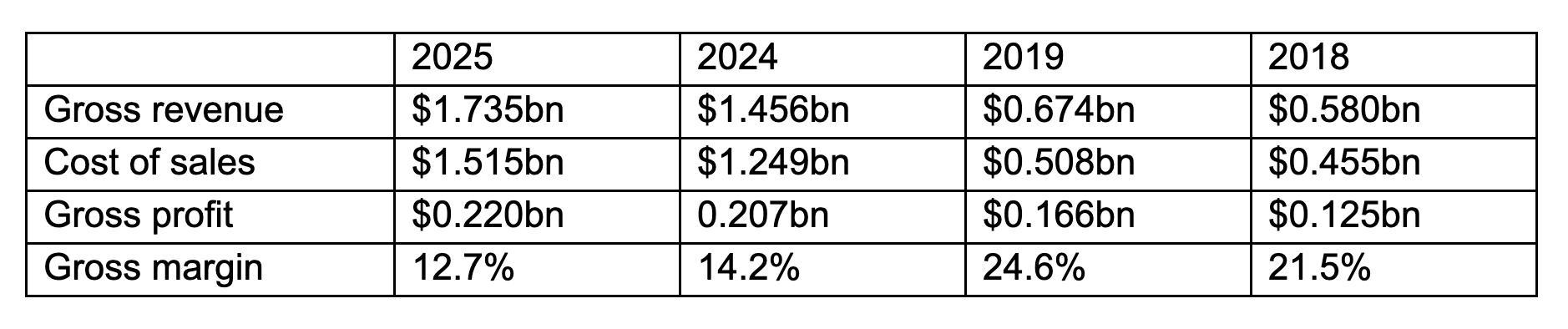
The resale of advertising inventory by Facebook Australia has experienced an alarming reduction in gross profit margin in 2024 and 2025 as shown below. What could possibly explain this? Maybe it’s the cost of petrol (from an imaginary Facebook brainstorming session).
In conclusion, and to paraphrase a statement made by a senior figure in the United States of America:
Australia is being ripped off by multinationals like Facebook.
And I’ll tell you what. We’re not going to have an Australia in 10 years if it keeps going like this. We’re a debtor nation, and we have to tax, we have to protect this country. And nobody’s doing it.

Michael West established Michael West Media in 2016 to focus on journalism of high public interest, particularly the rising power of corporations over democracy. West was formerly a journalist and editor with Fairfax newspapers, a columnist for News Corp and even, once, a stockbroker.

Wally the Chartered Accountant (not his real name) is a veteran of the accounting profession who is concerned about dishonesty and falling professional standards. Wally's true identity is known to MWM.