

Forget the lack of toilet paper or fuel. In a time of crisis, water supply may be the real problem. Rex Patrick lifts the lid on some uncomfortable national resilience vulnerabilities.
MWM has been ahead of mainstream media writing on fuel security, or our lack thereof. We’ve also fought in tribunals to gain access to Government documents such as the ‘National Liquid Fuel Emergency Response Plan’, which proved a very useful playbook for the public and other journalists when the US-Iran war broke out.
But we have other national resilience vulnerabilities. MWM is now on a mission to report what these vulnerabilities are and what Government is doing about them. But – true to form – the Government isn’t being cooperative, refusing to release details.
Fuel security. What happens if the bowsers start to run dry?
Supply Chain Resilience
The Office of Supply Chain Resilience was originally established inside the Department of Prime Minister and Cabinet during COVID, before later being transferred to the Department of Industry, Science and Resources.
Its 30 public servants monitor supply chains and identify critical vulnerability risks, which they are then charged with managing. They use a framework developed by the Productivity Commission in 2021, assessing import dependencies and vulnerability, as well as the degree to which Australia relies on a particular supplier.
Their assessment involves consultation with industry, and part of their vulnerability management includes asking industry to prevent, absorb, adapt or transform processes to limit the consequences of a shock to supplies.
MWM recently FOI’ed the Office of Supply Chain Resilience to scrutinise their work.
Water treatment chemicals
One of the more alarming vulnerabilities being examined by the Office of Supply Chain Resilience is water treatment chemicals that are used to treat water for consumption by households, as well as for a wide range of commercial activities, particularly agriculture.
Without chemicals, drinking water can be left with bacteria, viruses and other pathogens, which make it unsuitable for consumption.
Data shows that we import our treatment chemicals from China, Korea, India, Malaysia and Indonesia. Whilst there are other suppliers – Germany, USA and France – the point is we are dependent on overseas suppliers for a commodity that is crucial for life.
The Government, in responding to an FOI, has been extremely secretive about what it is doing to address this import vulnerability (which will increase MWM’s resolve to uncover more).
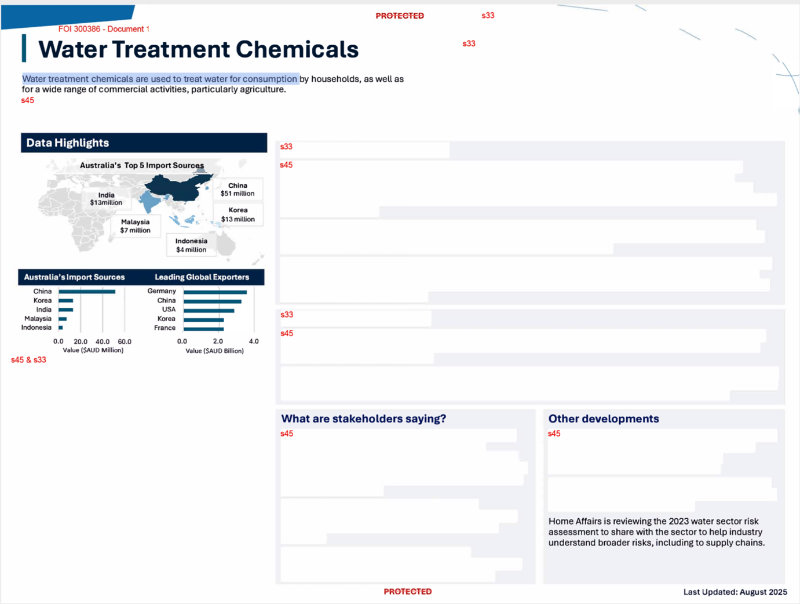
Secrecy over water vulnerabilities (Source: FOI)
Fuel, including Diesel
The Office of Supply Chain Resilience has also identified fuel, critical for transport, as a vulnerability.
The US-Iran war has greatly increased Australians’ awareness of our fuel situation. We rely heavily on imports of crude (to feed our two refineries) and refined fuels. Diesel dependency rests, in order, with Korea, Malaysia, Singapore, Taiwan and India. Aviation fuel dependency rests with, in order, China, Korea, Singapore, Malaysia and Taiwan.
Despite warnings from the Senate over past years and MWM highlighting our vulnerabilities, it’s taken the US-Iran war shock to cause the Government to act. In this year’s budget, the Government announced it’s expanding industry’s minimum stockholdings by an additional ten days and is establishing a $3.2B government‑controlled fuel security reserve which will hold around 1 billion litres of diesel and jet fuel to provide an additional buffer during any future crisis.
The Government is aiming to get Australia to a point where we hold 50 days’ reserves of both diesel and jet fuel. That still falls short of the 90 days we are obliged to hold.
Pharmaceuticals and medical products
Another identified vulnerability is pharmaceuticals and medical products, which are essential to the operations of hospitals, GP clinics, aged-care facilities and emergency services.
Disruptions, whether short-term or systemic, can severely impact clinical care and life-saving procedures.
Supply to Australia is dominated (in order) by the US, Germany, Ireland, India and France.
Australia does have national medical stockpiles with storage of drugs, vaccines, antidotes and personal protective equipment. There also exists a Medical Supply Security Guarantee legislation which requires manufacturers to hold in Australia a minimum of either 4 or 6 months of certain Pharmaceutical Benefits Scheme listed medicines.
Industry has called on the government to have a long-term strategy for attracting investment in domestic pharmaceuticals manufacturing. Whilst ‘Medical Science’ is an investment priority area under the National Reconstruction Fund, the conduct of science is not manufacturing.
What the Government is doing on that front is claimed to be too secret for us regular people to know, with
significant redactions in FOI documents released to MWM.
Agriculture chemicals
Agricultural production chemicals are another vulnerability. Unfortunately, the documents associated with this vulnerability were almost completely redacted.
It seems water and food are very secretive topics the Government does not want you to know about.
We did get a sense this year about this vulnerability, as fears emerged during the US-Iran war that our farmers would not get access to fertilisers, a critical input to farming that greatly increases crop sizes for any given land area.
We get much of our agricultural production chemicals from China, Saudi Arabia. Morocco, UAE and Indonesia. The Northern Australia Infrastructure Facility committed a loan of $220m to support urea production in WA. The $6.5B project starts production in 2027 and is expected to produce about 2 Mt of urea each year.
Telecommunications
A final area of vulnerability, which is especially critical because of the vast distances across the nation, is telecommunications. The Optus and Telstra outages have shown Australians how life can be disrupted with even short interruptions to communications.
Global manufacturing is dominated by a small number of suppliers, geographically dispersed: China, USA, Vietnam, Taiwan and Mexico. Local manufacturing tends to be relatively small scale.
The Security of Critical Infrastructure (Telecommunications Security and Risk Management Program) Rules 2025 require entities responsible for critical telecommunications to maintain a Critical Infrastructure Risk Management Program that minimises or eliminates the risks of disruption to the supply chain as far as reasonably possible, but little else is being done in regard to this vulnerability.
Why the secrecy?
COVID and the US-Iran war have raised awareness of our supply chain vulnerabilities.
Australians are right to expect their government to have learnt the lessons of these events and better prepare us for global disruptions. What’s the point of spending $368B on nuclear-powered submarines if our water and food run out, not through military attack, but because critical ingredients simply didn’t arrive.
More needs to be done. The establishment of an Office of Supply Chain Resilience is a good thing, but the secrecy levels around what they are, or possibly are not, doing is problematic.
Governments have not performed well on national resilience in the past and it’s so important it does deserve scrutiny. MWM will be focussing on this in articles to come. It’s an area of national security that the public don’t just have a right to know about; they have a need to know about.
Empty tanks and bare shelves. Australia’s fuel and supply security exposed

Rex Patrick is a former Senator for South Australia and, earlier, a submariner in the armed forces. Best known as an anti-corruption and transparency crusader, Rex is also known as the "Transparency Warrior."