

While the public debate on housing shortages is as ill-informed as ever, one solution is not just obvious, but been well and truly tested. Andrew Brown with the second in a series.
Ben Chifley started it, Robert Menzies kept it, in Vienna and Singapore, they never stopped. Public housing for working people is the most tested idea in housing policy, and Australia has done it before.
After the war, one new home in seven in this country was public housing, built under a Labor prime minister and kept going by a Liberal one, and they went to fitters, clerks and returned servicemen, not ‘charity’ cases.
The OECD average today is 6 to 7% of homes. In Britain it is 16% even after Thatcher sold the council houses; the Netherlands is above 30%; Australia sits at 4% with the Americans and Canadians.
Vienna keeps half its people in city-owned or cooperative flats and uses them to hold private rents down. Singapore houses 80% of its people in public flats, and most of them own the one they live in. A 10% target here only gets us to the middle of the pack,
and run as cost rental on fixed terms, it turns renters into owners.
Here is a fact to try on the next person who tells you government cannot build houses. Between 1945 and 1956, in a country short of bricks, timber and tradesmen, Australian governments built 96,138 of them.
State Housing Agreement
Ben Chifley’s government signed the first Commonwealth State Housing Agreement in 1945. Canberra lent the money, and the states built the homes. When Robert Menzies won in 1949, he kept the agreement going. In South Australia, another conservative, Thomas Playford, used the Housing Trust to build thousands of cheap, decent homes because he wanted factories, and factories need workers, and workers need somewhere to live. For Playford, housing was economic policy.
Nobody thought of these homes as charity.
That is the idea we lost.
Then the retreat. Today the Australian Institute of Health and Welfare counts about 452,000 social homes, of which 297,000 are public. More than 200,000 households are on the waiting lists, and you generally have to be in serious trouble to get on one. In most states, a nurse on a full-time wage earns too much to qualify and too little to buy. She is exactly who Chifley’s homes were built for.
A 10% target is hardly radical.
On the OECD’s league table, Austria and Denmark join the Netherlands above 20%, and France, Ireland, Finland and Iceland all sit between 10 and 19%. Australia joins the United States, Canada and New Zealand, as the countries that left housing to the market and now share our crisis.
We stood at the OECD average a generation ago. Getting back to 7% is the first milestone. Ten is the minimum worth aiming at.
Think Medicare, not the poorhouse
Nobody says Medicare has failed because people on good incomes use it. That is why it survives. A service only for the desperate gets starved and stigmatised. A service the middle uses gets defended.
Public housing should take people in crisis first. It should also be open to nurses, teachers, carers, cleaners, chefs and young families, at a rent set by income or by what the home costs to provide.
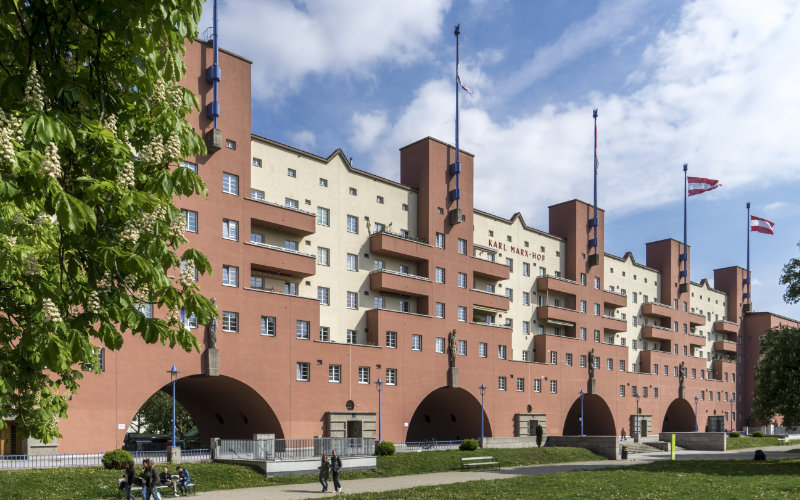
Look at Vienna. The city owns about 220,000 flats and supports another 200,000 cooperative homes. The City of Vienna calls this stock a market regulator with a price-dampening effect. It has never sold it. If you are a private landlord in Vienna, your competition is a well-built flat at a cost rent, and you price accordingly.
You can make a profit, but you cannot make a killing out of scarcity.
We have no such competitor. With social housing at 4% and rationed to emergencies, private landlords and developers set the price for everybody else. Put a tenth of the nation’s homes on cost rents and that changes.
Singapore took another road. Its Housing and Development Board has built more than a million flats, and about 90% of the households in them own theirs, the board reports. You cannot import Singapore’s land laws. You can import the lesson, which is that public building and home ownership go together.
Disadvantaging the young
My daughter is 25. She works, she pays rent, and on the Housing Supply Council’s numbers she will be 36 before she has a full deposit.
The national median rent is about $700 a week on Cotality’s figures. Offer her a public cost rental home at a quarter below that, the usual benchmark for affordable rent, for a fixed six years. She is $175 a week better off. That is $9,000 a year and about $55,000 over the six years, which beats a 5% deposit on a $900,000 home before she has saved a cent of her own.
Add it to the Council’s assumed savings rate and the full 20% deposit arrives at about 32 instead of 36.
The cheap rent is the incentive. It ends; she knows it ends, so she saves. When she buys, the keys go to the next 25-year-old. Done this way, public housing produces homeowners.
And if you doubt Canberra can manage property, it already does.
Defence Housing Australia looked after 17,353 homes at June 2025 and made an after-tax profit of $23.9 million. Nobody calls that welfare.
Nothing is missing except a decision, and a government willing to make it while the property industry objects. Next: the plan, the price and what it buys.
The housing crisis we didn’t have to have, and how to fix it

Andrew Brown is a Sydney businessman in the health products sector, former Deputy Mayor of Mosman and Palestine peace activist