
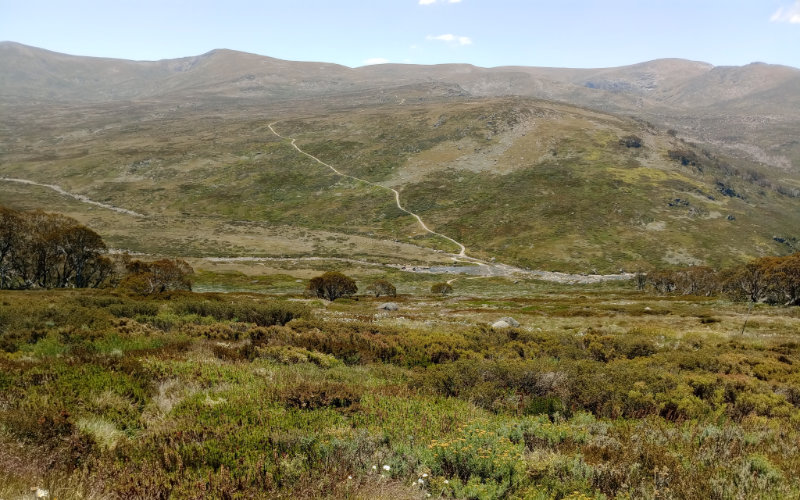
There is something missing from the heated debate about the culling of feral horses in Kosciuszko National Park. Richard Swain from the Invasive Species Council explains.
Too often, the debate about the Brumbies in the Snowies begins with the heritage of horses and ends with the welfare of horses, while the mountains, rivers, wetlands and native animals being damaged and pushed to extinction beneath their hooves are pushed to the margins.
Long before horses arrived, these mountains, rivers and wetlands were respected Country. They remain living cultural landscapes and some of the most environmentally significant places in Australia.
As a Wiradjuri man who has spent years working on and caring for these landscapes as a Snowy River guide, I’ve seen firsthand what happens when horses are allowed to
trample, trash and pollute fragile Country that was never built to withstand them.
Of course, horses have cultural meaning to some people. But that should not give them immunity from control when they are damaging a national park, or drown out decades of scientific evidence.
Misinformation risk
Misinformation and disinformation about feral animal control is becoming a political risk to effective invasive species management across Australia.
And it is not confined to anonymous accounts or fringe groups online. Misleading and unsubstantiated claims are being irresponsibly repeated and amplified by politicians, commentators and journalists, giving them legitimacy and reach. When those claims gain enough traction, governments can come under pressure to weaken, delay or abandon evidence-based control programs.
That threatens not only feral horse management, but control of deer, pigs and other invasive animals needed to protect native wildlife and Country across Australia.
The science
There have been over 20 peer-reviewed Australian field studies that confirm the role of feral horses in environmental damage. A similar online search will find no peer-reviewed Australian studies saying the opposite.
Feral horses graze and trample vegetation, compact and erode soils, damage waterways and reduce water quality. The habitat of threatened animals, including the corroboree frog, alpine tree frog, alpine she-oak skink, mountain pygmy-possum and broad-toothed rat, is affected by horse damage.
The NSW Scientific Committee has listed feral horses as a key threatening process. The federal Threatened Species Scientific Committee has described feral horses as an ‘imminent threat’ to efforts to prevent new extinctions and warns they may be the crucial factor that causes the final extinction of some alpine species.
And not just horses. Deer, pigs and other introduced hard-hoofed animals also cause enormous damage in Kosciuszko and should be controlled.
Indeed, hundreds of thousands of feral animals, including pigs and deer, are routinely controlled using aerial shooting across NSW, accounting for nearly 90% of all pest animals removed by government agencies.
Animal welfare
Perhaps the most serious claims being made against aerial shooting concern animal welfare, including claims of ‘extreme and inhumane measures’.
In July this year, an independent veterinarian observed 180 feral horses pursued during aerial control operations in southern Kosciuszko National Park. Of the 154 horses shot, every animal was killed. No non-fatally wounded horse was observed, and the median time between the first shot and insensibility was eight seconds.
Twenty horses were inspected on the ground shortly after shooting. All were confirmed dead, and none returned to sensibility.
This was the third independent veterinary assessment of aerial shooting in Kosciuszko since the method resumed in 2023, and its findings were consistent with the previous assessments.
Alternative culling methods
Trapping and rehoming have been used in Kosciuszko for well over a decade, but have consistently failed to reduce the horse population at the scale required.
Fertility control can be useful for small, geographically isolated and accessible populations where the objective is to maintain numbers. It cannot rapidly reduce a large population of free-ranging horses across vast and rugged alpine terrain.
No lethal control program is pleasant to contemplate.
The real question is which available methods can reduce horse numbers effectively while achieving the best possible animal welfare outcomes. It is a difficult environmental management problem that governments have an obligation to address.
Country came first
The rivers have stories. The mountains have stories. Native animals have stories. The bogs and wetlands themselves are part of a living landscape with cultural meaning stretching back thousands of generations.
We can recognise the place horses have come to occupy in the history and identity of some groups without accepting that they should remain in a national park regardless of the damage they cause.
Kosciuszko was protected because it is extraordinary.
Richard Swain is a Wiradjuri man who works as an indigenous river guide, running his own ecotourism business in Kosciuszko National Park. Richard is an Honorary Associate Professor, Fenner School of Environment and Society, ANU College of Science.