
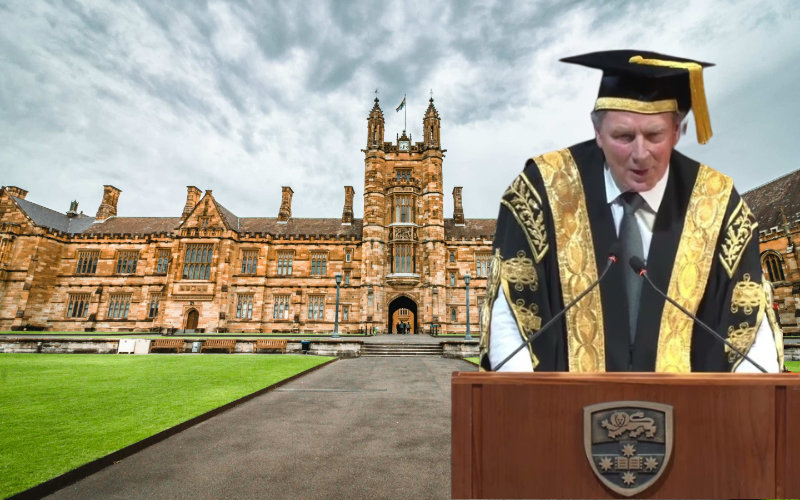
Sydney University’s Chancellor David Thodey has rejected a request by 600 alumni and academics to discuss the university’s ties with Israel. Stuart Rees reports.
On September 25, the governing body of the University of Sydney, the Senate, must decide whether a Convocation – a quasi-parliament – can be held to discuss the University’s ties with Israel and to assess limits to freedom of expression on the campus.
Although the request to hold a Convocation was signed by almost 600 alumni, academics and former Fellows of Senate, the Chancellor of the university, David Thodey, rejected it. Instead, as he was bound to do, he referred the question to the September 25 meeting of the Senate.
He also insisted the Senate would not be able to limit the university’s ties to Israel, which highlights why a Convocation is necessary.
Moreover, Thodey claimed that the university could not provide for the health and safety of those attending the Convocation.
As though concern with alleged antisemitism was the university policy priority, he reasoned that any resolution of the Convocation would come before the report of the Royal Commission on antisemitism and therefore
“would improperly pre-empt the Bondi Commission’s findings”.
Antisemitism or anti-Zionism? Sydney Uni pressure to silence Israel, apartheid critics
No dissent allowed
Universities’ imposition of intellectually dishonest definitions of antisemitism has led to the crafting of rules to forbid dissent about Israel’s accountability for genocide in Gaza.
These rules define Zionism as a core part of Jewish identity and are supposedly concerned to protect Jewish students who might be offended by pro-Palestine human rights advocacy.
In their deliberations, Senate members may recall that the university appears keen to agree with anything that the Envoy for anti-Semitism, Jillian Segal, wants or says. She views Sydney University’s imposition of a restrictive definition of antisemitism as ‘an important step’.
Having made several visits to Gaza, having lost close friends and their children buried somewhere under rubble from a bombed ‘safe house’, I found it morally repugnant that
while genocide continued in Gaza, my university was preoccupied with definitions of antisemitism,
and with disciplining staff and students who spoke about genocide or about ‘freedom from the river to the sea.’
The international context in which the Senate deliberates cannot be ignored.
Meanwhile, in Gaza …
In the past months during a so-called ceasefire, the BBC records that over 1300 more Palestinians have been killed, including 301 children.
The UN has reported that a reproductive genocide is underway in Gaza, with maternity wards having been attacked and fertility clinics destroyed. It says Israel is operating a systematic assault on the ability of a people to give birth safely, to keep newborns alive and sustain future generations.
Arguably, such developments could be the subject of unhindered comment in a university which respects freedom of inquiry, and would reject lobbying to stifle discussion of the inhumanities occurring in Gaza and the West Bank.
The UK government’s recent introduction of a trade ban on illegal settlements and its agreement with the ICJ 2024 ruling that Israeli occupation of Palestinian lands is illegal and must be ended could encourage Australian students and staff to speak openly about Palestinians’ rights.
Backed by Prime Minister Andy Burnham, Foreign Secretary Ed Miliband described events in the West Bank as ethnic cleansing and he accused Israel of turning a blind eye to war crimes.
Could he have made such statements on the campus of the University of Sydney?
In response to Miliband’s moral courage, overdue but inspiring, the Australian government ducked for cover. Foreign Minister Penny Wong announced that Australia would not be joining the ban on trade with ‘settler terrorists.’
Questions about courage or cowardice, about fearlessness or fearful compliance, may affect deliberations on September 25.
Allowing criticism of Israel?
Senate’s decision seems likely to depend on members’ attitude to a genocide and to their sense of responsibility to restore a university culture sufficiently courageous to criticise a racist, apartheid government which is indifferent to international law.
There is nothing even vaguely antisemitic about such commentary.
The background of members of the Senate gives few clues as to whether the request for a Convocation will be supported or whether the Chancellor’s rejection will be confirmed.
Over one third of the Senate have extensive business experience but may be unlikely to vote as a block.
A smaller number representing staff and students may want a university sufficiently mature to no longer fear taking strong stands on the ideals of a common humanity. But even that trend can’t be guaranteed.
Two members with impressive human rights credentials might be expected to support the request for a Convocation.
Tom Calma, former Aboriginal and Torres Strait Islander Social Justice Commissioner and Race Discrimination Commissioner, was also a former university Chancellor, so he might be moved by managerial perspectives.
Ben Saul, Professor of International Law at the University of Sydney and UN Special Rapporteur on Human Rights and Counter Terrorism, seems the most likely advocate for university reform via deliberations at a Convocation, assuming that he can attend the Senate meeting.
As the members of the University of Sydney Senate climb the beautifully carpeted stairs to the chandelier-lit entrance to the ornate Senate meeting room,
they will shoulder the responsibility to vote on a major social issue.
National and international developments affecting democracy, human rights and humanitarian law can and should be weighed by the Senate voters.
These 15 members of a university government can support requests for a Convocation and thereby revive decades-old but easily lost traditions of freedom of inquiry and debate.
The IHRA Definition Reshaping Arts Funding | The West Report

Stuart Rees AM is Professor Emeritus, University of Sydney & recipient, Jerusalem (Al Quds ) Peace Prize