
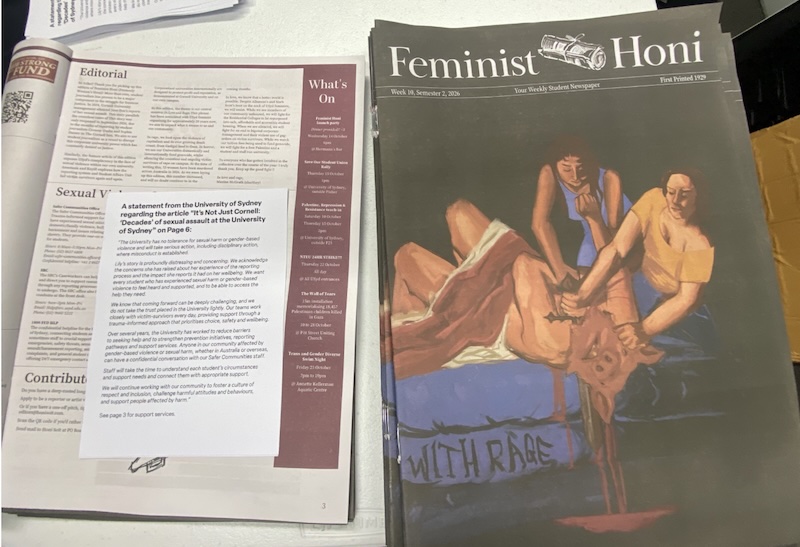

Student journalists at Sydney University’s Honi Soit have come under pressure from management in reporting a campus sexual assault case. Kalila Welch reports.
Content note: This article contains discussions of sexual assault.
On Wednesday morning, the University of Sydney’s Honi Soit published one of its most impactful stories in the year to date.
But what should have been a relatively straightforward story, on an issue well-covered by the paper in recent years, appears to have become a major battleground for the student paper’s editorial independence. Documents and email records show an extraordinary effort by the University to influence the substance of the story, which raised criticisms of the reporting, support and complaint-handling processes offered to victim-survivors on campus.
The aggressive PR approach is further evidence of how the corporatisation of universities is filtering down to the student experience – and, in this case, the ability of student journalists to report freely and truthfully on how their institutions are handling sensitive issues like sexual assault on campus.
A “highly irregular and concerning” intervention
The feature, penned by Honi Soit editors Kuyili Karthik and Anastasia Dale, was published as part of a special ‘Feminist Honi’ edition of the student newspaper curated by the SRC’s Feminist Action Bloc. It detailed the enduringly high rates of sexual assault on University of Sydney campuses, even in the decade since the publication of the Red Zone Report, and the reforms that have followed.
“Whatever steps the University is taking, it has not led to a meaningful decrease in rates of sexual harassment, sexual assault, or rape on campus,” the authors wrote.
Alongside a strong body of existing data, the piece drew on the personal testimony of Lily*, an international student who was recently sexually assaulted at a University of Sydney residential college. Lily, who spoke to Honi Soit on the condition of anonymity, recounted experiences with the university’s reporting processes and support services that had left her feeling “hopeless” and disillusioned.
Her criticisms revolved around the evidentiary burden placed on victim-survivors to enforce disciplinary outcomes proportionate to the alleged violence, noting that her dealings with the Student Affairs Unit had left her
questioning whether a complaint was really “worth pursuing”.
In the week before the story’s publication, Honi Soit approached the University of Sydney’s media office to request a general comment regarding sexual assault rates on campus. An initial statement was provided ahead of deadline, on Friday 9 October, but was accompanied by a request for further details on the specifics of the article.
The media office also raised concerns for the wellbeing of the victim-survivor interviewed, offering to connect them to the University’s Safer Communities and Wellbeing teams. The editors declined this offer as it would require providing further identifying details of the incident and therefore risk breaching the anonymity of their source, but did confirm they had performed their duty of care and that the individual did not require connection to further services.
Heavy-handed PR tactics
On Monday 12 October, a follow-up question sent by Honi Soit prompted a protracted back-and-forth in which the media office repeatedly sought further detail in order to respond “sensitively and appropriately” to all elements of the story that would be published, as a matter of ensuring “fair and accurate” reporting.
Cheek understands that this is not typical of the media office’s engagement with Honi Soit editors, and far-exceeded the level of detail typically required by the University to provide comment on a given story. This continued after the physical edition of the paper, featuring an abridged version of the story, went to print on Monday evening, ready for distribution on Wednesday.
On Tuesday, the editors agreed to send the press office a copy of a full version of that article that would be published online the following morning.
It is at this point that the media office raised concerns about “accuracy and fairness”, and requested an extension to the final deadline in order for the University to provide a revised statement. Honi Soit editors advised that amendments to the digital version of the story were still possible, but that the physical edition had already gone to print without a university comment.
Editors attributed this to the fact that the two pages allocated for the story in the ‘Feminist Honi’, a special edition of the paper published autonomously by the Student Representative Council’s Feminist Action Bloc, were not sufficient for the full story and all provided comments. The print version ends before the final two statements from the University and SRC Women’s Officer Statement, but notes the “full version can be read online”.
Management escalation
Following an off-record phone call between Honi Soit editors and the media office on Tuesday afternoon, the issue appears to have been escalated to the registrar, the administrative office that oversees student records and university compliance. That evening, deputy registrar Dr Ruth Townsend sent a seven-page letter addressed to Honi Soit, the chair of the SRC Publications Committee, and the President of the Students’ Representative Council.
The letter requested “urgent edits and corrections” to the online version of the article, notified them that a complaint would be made to the SRC Publications Committee, and asked that the University’s full amended statement be printed and physically inserted in the front cover of all print copies of the article prior to distribution.
In one section of the letter, the University alleges that Lily’s testimony does not accurately describe or provide full context regarding the University’s ‘assisted resolution’ framework, providing a list of ‘requested corrections’ that span seven separate points.
Another section takes issue with the framing of figures that show the number of sexual assaults reported to the University has increased, raising the argument that the rise could actually reflect increased awareness of reporting pathways, rather than increased prevalence of sexual harm.
Weighing against victims
While this could be true, it is not explicitly supported by the data – and we know, more broadly, that the vast majority of sexual assaults are still never reported.
The University’s key justification for the extensive correction requests was that any misrepresentation of reporting frameworks might discourage students from seeking support.
“We believe Honi Soit’s reporting in this instance breached basic journalistic principles of accuracy and fairness, and misrepresented University data and processes in a way that risked discouraging victim-survivors from seeking support,” a University of Sydney spokesperson said
The University made the suggestion that Honi Soit’s reporting risks “undermining years of work by the University to improve and build confidence and trust in our response and wellbeing services”.
However, the editors had already repeatedly referenced University frameworks, including paraphrasing key definitions and policies, and linking out to official policy documents within the piece. The article also links out to the University of Sydney’s Annual Report on Sexual Misconduct for 2025,
With that context, the nature of the corrections requested by the University would be considered by most journalists to be excessive and unreasonable, especially given the nature of the article and its focus on the personal testimony of an individual student. While student journalists are expected to report fairly and accurately, this expectation should not extend to defending or PR-ing the university’s policies on demand.
Pressure on journalists
Despite extensive requests for corrections that would serve to qualify or ‘contextualise’ Lily’s testimony, the University claims that it did not at any point “request changes to Lily’s story”.
“We’re extremely concerned for Lily’s wellbeing and take seriously her experience of the University’s reporting process. Our Safer Communities staff remain available for a confidential conversation with Lily to understand her needs and concerns and connect her with support, including helping her to explore any reporting options that she currently feels comfortable with.”
One of the editors, Anastasia Dale, told us that the University’s handling of the situation felt aggressive and made the editors unnecessarily stressed while reporting on an already sensitive topic.
“The whole process was highly irregular and concerning,” she said. “I just feel like it’s in such poor taste to be conducting yourself like this to female editors reporting on rape on campus.”
Together with her co-author, Kuyili Karthik, Dale told Cheek the university’s response had come as a shock, particularly given Honi Soit’s extensive history of reporting sexual violence on campus – which, to their knowledge, has not previously been met with such editorial overreach by the University.
“We wished to share the story of a victim-survivor and produce a well-researched article on sexual assault at the university. We believe we provided fair context of university policy. It is important to preserve the integrity of a victim-survivor’s account.
Her story deserved to be told.
With student journalism already facing growing financial and censorship pressures, the fight for publications like Honi Soit to maintain full editorial independence from their institutions is more important than ever.
For Honi Soit, the issue remains ongoing. But regardless of what happens next, it is clear that the story is resonating with students. The article has already become one of Honi Soit’s top-three performing posts on Instagram, and has encouraged others to come forward with their own stories and experiences.
Sydney Uni responds
Full statement from the University of Sydney:
“We acknowledge Honi Soit’s editorial independence and the crucial role student journalists play in reporting on sexual harm and bringing student experiences to light. At no point did we request changes to Lily’s story.
“We believe Honi Soit’s reporting in this instance breached basic journalistic principles of accuracy and fairness, and misrepresented University data and processes in a way that risked discouraging victim-survivors from seeking support. Despite repeated requests over several days to Honi, we were not given the key details until three hours before deadline and the editors ultimately chose not to include any of our response in the print edition.
“Fair and accurate reporting on this serious issue is essential because we want to ensure that every student who has experienced sexual harm or gender-based violence feels able to report it and access the help they need. The factual errors risk doing real harm and undermining years of work by the University to improve and build confidence and trust in our response and wellbeing services.
“We have made a formal complaint through the SRC’s established publications-governance process for review, and are seeking corrections to inaccurate descriptions of University data and processes, publication of the University’s response for the print readership, and constructive engagement with the relevant University teams.
“We’re extremely concerned for Lily’s wellbeing and take seriously her experience of the University’s reporting process. Our Safer Communities staff remain available for a confidential conversation with Lily to understand her needs and concerns and connect her with support, including helping her to explore any reporting options that she currently feels comfortable with.”
This story was co-published with Cheek Media.

Kalila Welsh is Editor at Cheek Media. She formerly worked at Mumbrella and has a Masters of Journalism