
Today is “International Day of Peace” and the anniversary of Australia formally recognising Palestine. What has happened since? Shamikh Barda asks.
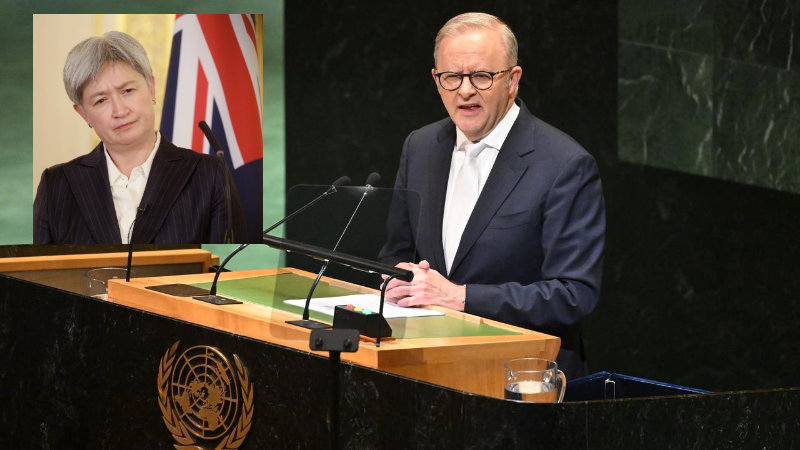
PM Anthony Albanese is at the UN today, promoting Australia’s bid for a seat on the Security Council, claiming it will “help with the cost of living back home”. In yesterday’s speak, he said, “We have an opportunity through this potential seat on the UN Security Council to play a key role in shaping the global issues that really matter to Australians.”
He also mentioned “to stand up to the Middle East conflict”, while highlighting Australia’s role as a ‘middle power’, and how “we’ve engaged with the war in Ukraine in the coalition of the willing,” while repeating the Government’s stance on recognition of Palestine.
Meanwhile, a year ago, Foreign Minister Penny Wong said the government would update its documents, websites and systems to reflect the recognition.
However, when one of the clearest tests of what recognition recently emerged, Australia stood idly by.
On 8 September, 12 countries, including the United Kingdom, France and Canada, announced that they would impose, support or consider restrictions on trade in goods from Israeli settlements in the occupied West Bank. Australia was expected to join the move, especially as it considers settlement expansion a
threat to the viability of a Palestinian state.
So the test was whether it would turn that position into actual policy. But Australia did not join the move. This is where the gap between position and policy becomes visible.
“Unintended consequences”
In public policy, the distance between a political decision and the practical tools used to carry it out is often described as an implementation gap. Wong justified Australia’s decision not to join the move by saying the government was not seeking a comprehensive ban on settlement imports.
She cited concerns about implementation and “unintended consequences”, and said the government would pursue more targeted measures. But this justification is less convincing when the initiative itself did not require every country to adopt the same measure.
Instead, each country was free to choose what it could implement within its own domestic system.
UN Security Council Resolution 2334 called on countries to distinguish between Israel and the territories occupied since 1967. The International Court of Justice made the same point in its 2024 advisory opinion. If a comprehensive ban is not the tool Australia chooses, what alternative can give its opposition to settlements real political or economic effect?
Words over deeds
Australia’s recognition of Palestine was presented as part of an effort to protect the viability of a Palestinian state. Yet Australia’s response to policies that its own government says threaten that viability shows the limits of what has changed since recognition.
And the test does not stop with settlements.
Australia now recognises the State of Palestine, while also saying Israeli policies in the occupied Palestinian territory undermine the viability of that state. In this context, Zomi Frankcom’s case puts the question in a directly Australian frame and tests whether recognition has changed anything in the way Australia deals with what happens inside the Palestinian territory it has recognised as a state.
This is not an abstract question for Australia. Zomi was one of seven World Central Kitchen workers killed by an Israeli strike in Gaza in 2024. They were there to deliver food. Yet in August 2026, Israeli military authorities decided that no one would face criminal proceedings over their deaths.
‘Not sorry’. Will international pressure mean justice for Zomi Frankcom?
Gaza is part of the occupied Palestinian territory and sits within the wider legal and political framework of the Palestinian state Australia has recognised. Wong said she did not have confidence in the Israeli investigation. Prime Minister Anthony Albanese called that decision an “outrage”.
Frankcom’s case does not test recognition in the same way that settlements do, but it raises a related question: what does Australia do when it demands accountability for conduct in Gaza, then says that accountability has not been achieved?
And if the accountability Australia is calling for is not achieved, the next question is whether it will stop at condemnation or use other tools to apply pressure.
Foreign policy tools unused
This is where the tools of foreign policy become part of the test.
Australia also has a history of using sanctions and economic tools as part of its foreign policy. The clearest historical example is South Africa. In the 1980s, Australia and other Commonwealth countries used economic and financial pressure against the apartheid regime.
The circumstances are different, but the example shows that Australia has used economic pressure when diplomatic statements were not enough.
But in the current case, we see not only the absence of broader measures against Israel. At the same time, cooperation continues in important areas, including security and defence. If Australia says Israeli policies undermine the viability of the Palestinian state it has recognised,
how does that sit with the continued expansion of cooperation?
Recognition therefore raises a question of policy coherence: are diplomacy, trade, defence and sanctions working in the same direction as the government’s stated goal of protecting a viable Palestinian state?
What has changed?
So what has actually changed since recognition?
It would be wrong to say the first year produced no results. Australia has provided funding to support Palestinian recovery and institutions. In July 2026, it announced a new package to support the “institutional foundations of a State of Palestine”.
Government institutions have also begun using “State of Palestine”, while measures against individuals and entities linked to settler violence remain in place. These changes are real, even if limited. But the limits of this shift are also visible in the diplomatic relationship.
Australia still has a representative office in Ramallah rather than an embassy, and Palestine has the same arrangement in Canberra. So while Palestine’s official status has changed, the diplomatic relationship has not fully changed.
Recognition means Australian institutions now have to deal with Palestine on the basis of its new status. Recovery means supporting the institutions capable of carrying that state.
For decades, Australian policy dealt with Palestine as occupied territory, an aid issue, a peace process and a state expected to come later. Australia now says it recognises Palestine as a state in the present. That creates a practical question: how should foreign affairs, trade, defence and other parts of government make decisions when the basic assumption has changed from a future Palestinian state to one Australia already recognises?
After one year, the question is not whether recognition has made any difference. It has, but only to a limited extent. Australia’s decision not to join the 12 countries did not create the gap between recognition and policy.
It simply made that gap easier to see.
Recognition has had little effect on its own policy choices.
Labor and Coalition vote down bill to strip tax breaks from charities funding Israel war machine

Shamikh Badra is a Palestinian-Australian researcher, human rights advocate and community organiser from Gaza. He is a PhD candidate at the University of Wollongong, researching Palestinian diplomatic resistance, and holds a Master’s in Peace and Conflict Studies from the University of Sydney.