


Australian Governments have given controversial surveillance companies Palantir and Cellebrite access to our data. Claudia Weisenberger investigates the danger of total surveillance to a free society.
‘Saying you don’t care about privacy because you have nothing to hide is like saying you don’t care about free speech because you have nothing to say.’
That observation is widely attributed to Edward Snowden — the former US National Security Agency contractor who in 2013 leaked classified documents revealing the scale of mass government surveillance programs. He has lived in political exile in Russia ever since.
But most people do have something they’d rather keep private. Not because it’s criminal. Not because it’s shameful. Just because it’s theirs. A message sent in anger. A search made in fear. A place visited that nobody else needs to know about. A financial decision that made sense at the time.
Privacy is not about having something to hide. It’s about having something that belongs to you.
In Australia in 2026, that is becoming harder to keep.
Two companies. One pipeline.
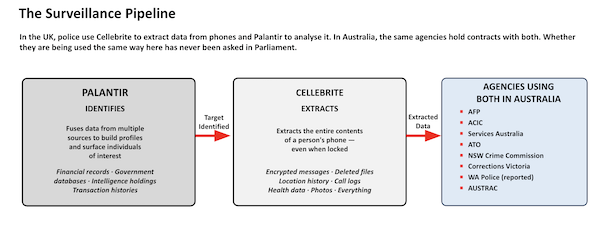
Palantir Technologies is an American company whose software is used by the CIA, the Pentagon and Immigration and Customs Enforcement. Its platforms fuse large datasets — financial records, government databases, transaction histories, intelligence holdings — to build profiles, identify patterns and surface individuals of interest.
Cellebrite is an Israeli company that does something more intimate: it extracts the entire contents of a specific person’s phone. Encrypted messages. Deleted files. Location history. Call logs. Health data. Everything. The extraction happens even when the phone is locked.
In the United Kingdom, where the NHS is already trying to exit a £330 million Palantir contract, police forces are simultaneously integrating Palantir and Cellebrite — using Cellebrite to extract phone data and Palantir to analyse it against broader intelligence holdings.
Cellebrite extracts. Palantir analyses.
In Australia, multiple government agencies use both. Whether that integration is planned here has never been asked in Parliament.
Sources: Computer Weekly, July 2026; AusTender CN3942923; NSW Crime Commission disclosure log; Victorian Parliament, May 2026; Senator David Shoebridge, Senate statements, August 2026
Already inside Australian government
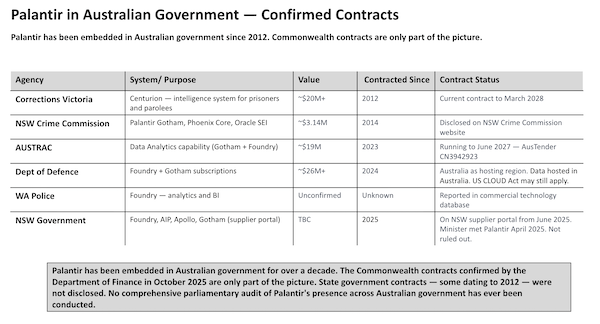
Palantir has been embedded in Australian government since 2012, when Corrections Victoria began using it for an intelligence system called Centurion — storing intelligence about prisoners and people on parole. Victoria has paid Palantir nearly $20 million since then. The current contract runs to March 2028.
The NSW Crime Commission has held Palantir contracts since 2014. Confirmed Commonwealth contracts include AUSTRAC — now worth nearly $19 million across multiple contracts — Defence, and the Australian Criminal Intelligence Commission, which runs the operational Fraud Fusion Centre.
According to Crikey’s analysis of AusTender records, Australian government agencies have spent more than $60 million on Palantir contracts.
Zero ethics assessments have been conducted.
Senator David Shoebridge of the Australian Greens has called for a full audit:
“Australians’ most sensitive data should never be handed to a US surveillance company, and not one cent of NDIS funding should end up in the pockets of big tech billionaires like Peter Thiel.”
Peter Thiel — the American billionaire and co-founder of Palantir — has been a vocal supporter of using surveillance technology to reshape the relationship between citizens and the state.
Shoebridge also confirmed that Cellebrite holds 128 active Australian federal government contracts worth more than $15 million — used by agencies including the Department of Defence, the Australian Taxation Office, the Australian Federal Police, ASIO, the Australian Border Force and the Australian Criminal Intelligence Commission.
Every state and territory police force uses it.
Palantir engaged with Australian government agencies for more than two years before completing its mandatory security clearance, which it received in November 2025.
Cellebrite committed to its cloud platform assessment in 2026, years after its technology was already deployed across dozens of Commonwealth agencies. Defence contracts note that data is hosted on Australian servers — but hosting location and legal jurisdiction are different things. Palantir is a US company subject to the US CLOUD Act, which can compel American companies to hand over data regardless of where it is stored.
The NDIA has no direct Palantir contract. It does not need one. Through the Fraud Fusion Taskforce, financial intelligence about NDIS participants and their providers flows to AUSTRAC and the ACIC — both of which do.
The Privacy Collection Notice participants were given does not mention any of this. The NDIS was the pilot. The same questions are already appearing in the health system — Department of Health file records contain entries titled ‘NDIS data,’ ‘Overlapping data and governance’ and ‘Integrated Health and Aged Care harmonisation.’
Sources: Victorian Parliament, May 2026; NSW Crime Commission disclosure log; AusTender CN3942923, CN41043683; NSW Parliamentary Budget Estimates 2026; Department of Finance letter to Digital Rights Watch, 2 October 2025; appsruntheworld.com (commercial database)
What surveillance does to a society
In the United States, Flock Safety built cameras to find stolen cars. The same network ended up tracking women seeking abortions and — in at least 26 documented cases — police officers stalking ex-partners.
A Washington Post investigation found one Georgia police chief had searched for his ex-girlfriend roughly 600 times. A database built to answer one question answers very different ones once someone thinks to ask. The NDIS data network was built to detect fraud. Nobody has asked what else it could answer.
The people building these systems are not shy about what they want.
Meredith Whittaker, president of Signal said; ‘surveillance is the economic engine of the tech industry.’
Sam Altman, CEO of OpenAI said; ‘An AI that can watch your computer screen all the time, record every call, have perfect context of your whole life.’
Alex Karp, CEO of Palantir said: ‘We want our enemies to wake up scared and go to bed scared.’
Alex Karp has defined ‘enemies’ to include not just foreign adversaries but internal threats to Western democracy — a category he and co-founder Peter Thiel have applied broadly. The company that builds the surveillance infrastructure
also decides who it is pointed at.
These are not warnings from critics. These are ambitions from the people building the infrastructure of your daily life — the systems that process your financial transactions, assess your eligibility for government support, analyse your communications and log your movements.
They are not building this for you. They are building it around you. And the person who controls the infrastructure controls the people inside it. Nobody asked whether you agreed.
The NDIS as the pilot
Samantha Connor AM, a disability advocate, put it plainly: ‘I am guessing that we are the guinea pigs for the rest of you. Because remember, they are calling this a pilot.’
Disabled Australians did not choose to be first. They were not asked. And when the officials running the system have made catastrophic, unlawful mistakes before — and faced no consequences — the question becomes not whether the technology is powerful, but
whether the people wielding it can be trusted.
The question is not whether you have anything to hide. The question is whether the people who can see everything — your finances, your health records, your messages, your location, your associations — will always use that power wisely. History suggests the answer. Robodebt provides the Australian example.
George Orwell understood that surveillance doesn’t need to punish you to control you. It just needs to exist. Once people know they can be watched — their searches, their movements, their messages, their money — they start making different choices. Quieter ones. Safer ones. Smaller ones.
That is what total surveillance does to a free society. Not with a knock at the door. Gradually. Quietly. Until silence becomes the habit nobody remembers choosing.
Robodebt encore? Palantir lurks as MPs shirk vote, NDIS Bill passes

Claudia Weisenberger is a management consultant with deep experience in pharmaceuticals, hospital transformations, and strategic due diligence across four continents. She combines sharp analysis with hands-on execution.