
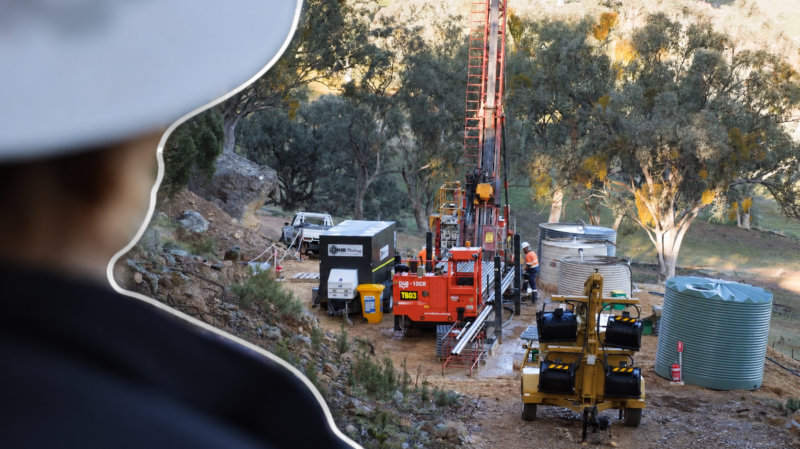

Mudgee residents fear lead poisoning as Bowdens Silver’s mine project near Lue heads for approval by the IPC. Michael Sainsbury with the story.
The proposed new Bowdens Silver mine site is more lead and zinc by weight than silver, and a suppressed study shows what mining lead near communities does to children’s blood, as Broken Hill residents have experienced. The Independent Planning Commission (IPC) is holding a public hearing this week.
Jamie and Sarah Inglis farm Angus, Hereford, Shorthorn and crossbred cattle on Havilah East, near Lue in the Mudgee region of central west New South Wales.
“It’s good country,” Jamie Inglis told MWM, “Absolutely, great grazing country and very productive.” However, the NSW government’s recommendation that the Independent Planning Commission (IPC) approve the first open cut lead mine in Australia for more than 100 years has them fearing for their livelihoods and their health.
“If our cattle were to test positive to lead, we are out of business,” Inglis said. “No one will buy our cattle. They are worthless. So our income goes to zero overnight.”
Scores of sheep, cattle and goat farmers, some of the nation’s best olive growers and dozens of winemakers in the region fear their soil and animals could be poisoned.
More lead than silver
Silver Mines Ltd’s Bowdens project would be built near Lue village, 2km from Lue Public School. Promoted as a silver mine, its primary product will be toxic lead, a metal governments long ago removed from petrol, paint and pencils. By weight, silver makes up less than 1% of the metal in the ore reserve, against about 42% lead and 57% zinc.
The mine would cover 258 hectares, taking in the open cut, a 100m high tailings dam and a 1km long waste rock dump,
an area equal to about 380 rugby league fields.
Towns Rylstone, Kandos, Mudgee and Gulgong lie within 50km, a combined population of more than 26,000 that can more than double in peak tourist season.
“There are so many problems with this mine, it’s truly bewildering that any responsible government could recommend it,” Lue resident and Lead Free Mudgee campaigner Susannah White said.
“Yet here we are, Bowden’s will destroy prime grazing land and water sources, scarring the landscape forever. It will lay waste to a substantial koala colony and destroy First Nations sacred places and artifacts. But at the heart, this is about the communities in the region, as well as tens of thousands who visit each year, facing a future tainted by toxic lead.”
Threatening water source
Lawson Creek, the Lue Valley’s main surface water source, flows into the Murray-Darling Basin. If the mine is built, it runs a high risk of pollution not only from lead but from arsenic and cadmium, and
from cyanide used in processing.
These are forever metals. The toxic precedent is the Lake George mine at Captains Flat near Canberra, which produced lead, zinc, copper, pyrite, silver and gold until the 1960s. Seepage of acid drainage and heavy metals remains an issue there today, with lead and zinc the main contaminants.
The NSW Court of Appeal voided Bowdens’ original 2023 approval in 2024 on technical grounds.
“Since the original approval, extensive new research has emerged within Australia and globally showing the lifelong impacts that lead exposure can have on kids and adults and the enormous social and economic costs,” NSW Greens MLC Cate Faehrmann told MWM.
That research included a key report for the NSW Environment Protection Authority (EPA) by Professor Mark Taylor and Dr Cynthia Barlow, Environmental Lead Risks at Broken Hill. It found childhood blood lead in Broken Hill remained elevated and that children across the whole city were at risk, not only those living near the mines.
The report identified current and legacy mines as the key sources of contamination driving lead levels in children’s blood. Taylor said in 2025 that exposure came mainly from swallowing dust, and rejected industry claims that the lead was naturally occurring.
Report suppressed
The government passed the report around mining companies but held back its public release for years, until Oct. 2023, after the IPC first approved Bowdens. Internal emails obtained by Mudgee olive farmer Jayne Bentivoglio showed government staff saying mining companies “would prefer we didn’t publish it”.
“The inconvenient truth is that silver, lead and zinc mining continues to poison a large number of kids in Broken Hill, so why would the situation be any different in Mudgee?” Faehrmann asked.
Broken Hill has underground lead, zinc and silver mines running through the city and an open cut mine 15km out of town. Long-term health tracking there shows persistent heavy-metal contamination from current and past operations.
Health experts have warned that the Bowden project’s baseline assessments rely on obsolete assumptions, with high quantities of lead concentrate in sealed containers to be trucked through local transport routes near Mudgee schools. Rather than enforcing modern safety benchmarks, authorities are relying on historic conditions for the redetermination.
Critics and health advocates say public health warnings about lead have grown more urgent as Australia lags the US and EU on national regulatory standards. The US Centers for Disease Control and Prevention (CDC) lowered its blood lead reference value to 3.5 micrograms per decilitre in 2021. The National Health and Medical Research Council (NHMRC) still uses the 5 micrograms per decilitre investigation level it set in 2015.
Putting children at risk
Local health professionals are also concerned. Retired GP Dr Peter Roberts cared for Mudgee and Lue residents and delivered their children over four decades.
“My primary concern is that this is really a lead mine and there’s a real smokescreen going on about the Bowden’s process,” Roberts told MWM. “We are retired but still live here, I’ve got my grandchildren going to the local school, and my daughter lives here.”
Faehrmann said lead “is a potent neurotoxin that
causes irreversible harm to children and serious health impacts for adults.
IPC rubber stamp?
The IPC site visits and three days of public hearings in Mudgee this week are critical.
After Bowdens’ approval was voided, the Minns government enacted new laws to make it easier for mining proposals to be approved. It then reversed planning reforms made after the Eddie Obeid and Ian McDonald corruption scandal, once more placing almost all approval power in the hands of the Planning Minister and his department.
The IPC has effectively acted as a rubber stamp under the Minns government. Since March 2023, it has refused no mine applications outright and approved five mining projects, extensions and modifications. They include the 19-year Hunter Valley Operations coal extension on Sept. 30, granted a week before the High Court ruled the IPC had acted unlawfully in approving the nearby Mount Pleasant expansion.
“The Government has proven that it can’t be trusted when it comes to protecting people’s health before mining interests,” Faehrmann said. “There is no safe level of lead exposure.”
The Bowdens redetermination is an unprecedented test of whether NSW planning laws can protect regional communities from heavy-metal contamination, or whether political and business expediency will override science.
Another coal project. BHP spins mine approval as pumped hydro ‘coal lakes’

Michael Sainsbury is a former China correspondent who has lived and worked across North, Southeast and South Asia for 11 years. Now based in regional Australia, he has more than 25 years’ experience writing about business, politics and human rights in Australia and the Indo-Pacific. He has worked for News Corp, Fairfax, Nikkei and a range of independent media outlets and has won multiple awards in Australia and Asia for his reporting. He is a fierce believer in the importance of independent media.