
Royal Commissioner Virginia Bell rejected claims pushed by the Israel lobby that pro-Palestinian groups “hijacked” this week’s protest and policing hearing. Quite the opposite, reports Stephanie Tran.
The idea that pro-Palestinian protests and anti-genocide protestors are antisemitic cracked at the Royal Commission this week despite efforts by the Commission and the Israel lobby to exclude pro-Palestinian voices.
At the opening of proceedings on Wednesday, Commissioner Bell said she had been provided with a newspaper article reporting that a prominent member of the Jewish community had accused counsel appearing for the Australian Palestine Advocacy Network (APAN) and the Palestine Action Group (PAG) of attempting to “hijack the Royal Commission”.
Following this, The Australian published remarks from Executive Council of Australian Jewry co-CEO Alex Ryvchin accusing APAN and PAG of using the “opportunity to hijack an examination of lethal antisemitism for their clickbait theatrics and gratuitous slurs against Israel.”
Commissioner Bell rejected the criticism.
“Ms Mathur did not hijack this Royal Commission,” she said.
She said counsel for APAN had appeared on behalf of an organisation whose interests were “substantially and directly affected” by the hearing because witnesses had made “trenchant criticism” of the group’s activities.
Commissioner Bell said the limited grant of leave to cross-examine NSW Jewish Board of Deputies president David Ossip was required by procedural fairness.
“Ms Mathur sought on behalf of her client to put matters that challenged the factual basis for the formation of that aspect of Mr Ossip’s opinion,” she said.
“She was granted leave to do that because procedural fairness, a concept familiar to lawyers but perhaps not more widely understood, demanded it.”
Bell: attacks on counsel rejected
The Commissioner also condemned attacks directed at lawyers appearing before the inquiry.
“Counsel appearing for groups at this Royal Commission should no more be the subject of Islamophobic or other attacks than members of the Jewish community who have been subjected to antisemitic attacks after giving evidence,” she said.
“It doesn’t reflect well on those who make either antisemitic or Islamophobic attacks on the interests that they seek to promote.”
Commissioner Bell’s remarks followed Tuesday’s seventh hearing block, which examined protest and policing. Although the Commission granted APAN and PAG leave to cross-examine witnesses, it did not call a single protest organiser or participant to give evidence.
Containing the counter-narrative
The Commission’s seventh hearing block was originally scheduled to run on Monday and Tuesday but was reduced to a single day, with only three witnesses called.
Monday marked the anniversary of the March for Humanity where 300,000 Australians marched across the Harbour Bridge demanding the end to the genocide in Gaza.
In opening the hearing, Counsel Assisting Richard Lancaster said the Commission was examining “opportunities to tackle antisemitism and strengthen social cohesion in the policing of public protest events.”
Lancaster said the Commission did not intend to conduct “lengthy hearings and a detailed factual investigation” into individual demonstrations by calling organisers, participants and observers to give their respective accounts.
The decision was criticised by the Palestine Action Group (PAG), which was granted leave to cross-examine witnesses but not called to give evidence itself.
Protest movement denied their say
“Not a single protester or protest organiser had been called to give evidence,” the group said in a statement.
“Despite submitting important evidence to correct the record, and despite being the organiser of the protests which have repeatedly been the subject of false statements and slander at the Commission, PAG has not been called as a witness.”
Lancaster acknowledged the Commission had received evidence from Jewish Australians who had participated in Palestine solidarity protests and felt welcomed.
“A number of other Jewish members have said that they decided to attend and participate in Palestine solidarity protests in pursuit of their understanding of the ‘Never Again’ call, and have experienced acceptance there, including after other protesters appreciated that they are Jewish,” he said.
“Never encountered a jot of antisemitism”
However, one such witness, Judith Treanor of Jews Against the Occupation ’48, was refused leave to appear.
In a letter to the Commission’s solicitors, Treanor said she had attended almost every major pro-Palestine protest in Sydney since October 2023 and had “never encountered a jot of antisemitism” at those demonstrations.
“I am deeply concerned that we will instead hear, once again, predominantly from Zionist and pro-Israel Jewish witnesses describing their perceptions of protests they have not attended, while Jewish people who have actually participated in those protests – and whose experiences contradict that narrative – are excluded from giving evidence,” she wrote.
Treanor stated that excluding Jewish participants whose experiences differed from those presented at previous hearings risked creating “a troubling circularity” in the Commission’s evidence.
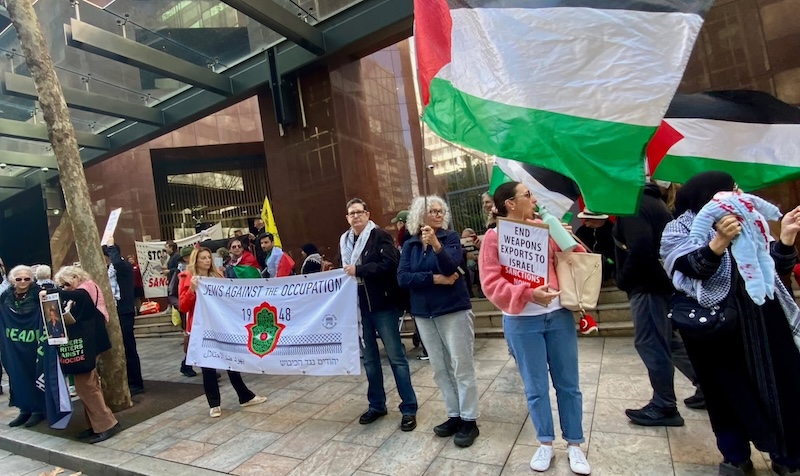
Members of Jews Against the Occupation ’48 at a protest. Image: Facebook
The Opera House
Much of Tuesday’s hearing focused on the 9 October 2023 protest outside the Sydney Opera House.
Appearing before the Commission, NSW Jewish Board of Deputies president David Ossip said there was a “proliferation” of “anti-Israel and anti-Semitic” sentiment during the Hamas attack.
During cross-examination by counsel for the Palestine Action Group, Dominic Toomey SC questioned Ossip about the timing of Israel’s airstrikes on Gaza and whether he was aware of evidence suggesting the rally had been organised to protest those military actions rather than celebrate the Hamas attacks.
Ossip said he did not accept that proposition. However, he acknowledged that Jewish Australians had attended the protest.
“There are members of the Jewish community who attended those rallies, and so is their absolute right,” Ossip said. “There’s no uniformity of opinions in the Jewish community.”
The Commission also heard evidence from Acting Deputy Commissioner Peter McKenna of the NSW Police Force, who said public perceptions of the Opera House protest had been shaped by dramatic television footage rather than officers’ experiences on the ground.
Never again. Worst antisemitism comes from Zionists says Australian Jew
Television edits misled
“Watching this on television, it looked terrible,” McKenna said.
“But when I speak to the police officers who were on the ground, they did not have concerns about being out of control.”
He said images of flares and smoke projected against the Sydney Opera House had become emblematic of the demonstration, but represented only
brief moments during a protest that lasted several hours.
“We’re talking hours of protest that has been reduced to seconds or minutes on a news grab. That has probably been conflated to make it more significant than what we would say it was, as far as public safety goes.”
McKenna told the commission that Strike Force Pearl dedicated 41 officers to reviewing body-worn camera footage, CCTV and other recordings from the protest.
A forensic voice analysis expert was also engaged to determine whether protesters had chanted “gas the Jews”, an allegation that has circulated widely since the demonstration.
After reviewing approximately 200 hours of footage, the expert concluded the phrase “Where’s the Jews?” could be heard, but found no evidence that the chant “Gas the Jews” had been used.
White supremacists with Australian flags. What really went down at Bondi

Stephanie is a journalist with a background in both law and journalism. She has worked at The Guardian and as a paralegal, where she assisted Crikey’s defence team in the high-profile defamation case brought by Lachlan Murdoch. Her reporting has been recognised nationally, earning her the 2021 Democracy’s Watchdogs Award for Student Investigative Reporting and a nomination for the 2021 Walkley Student Journalist of the Year Award.