
The Iran War, Donald Trump, and Israel’s antics have smothered news from our mistake-prone neighbour. Duncan Graham reports from Indonesia.
Prabowo Subianto Djojohadikusumo, 74, knows what death looks like in all its contortions. As an Indonesian former army general in charge of special forces fighting a civil war against jungle rebels, he would have seen enough holey corpses to satisfy his truculence.
He’s now in the club of aggrieved world leaders seeking relevance, but struggles for status. In a bid to ingratiate with Trump and join his disappearing Board of Peace, he stood at the far edge of a photoshoot and offered 8,000 troops for the US-brokered ceasefire in Gaza and a US$1B entrance fee.
This angered Indonesia’s largest religious organisations, human rights NGOs, and academics, who thought they deserved a say.
A public opinion poll has shown that most Indonesians are against the BOP. Likewise, The Jakarta Post: “Indonesia’s membership in the pro-Israel Board of Peace is by no means a masterstroke of diplomacy; it is a billion-dollar betrayal of the Palestinian cause.”
Sunni versus Shia
In the end, Pakistan’s hybrid democracy (the military approves elected parties) has emerged as the peacemaker. The East Asian nation has about 20 million Shia Muslims, the majority faith in Iran. In Indonesia, the sect is banned.
Prabowo has tried to save face by saying he never promised to pay the join-up fee and would withdraw from the Board “if it does not bring benefits to … Palestinians in line) with Indonesia’s national interests.”
Prabowo is no big-picture economist. During the election campaign, he promised Makan Bergizi Gratis – free school meals for 83 million kids– a fine policy, but then uncosted. Now we know the annual bill will exceed US$24.5B.
This month (April), the budget will be slashed by 10%, and six servings a week will be cut to five, according to some news. Other reports claim the changes will hit equipment like computers and motorbikes and leave the plates full.
The government says all is economically fine, but fiddling with Prabowo’s Triumphal March, aka the MBG, suggests otherwise.
Oil not a big problem
So far, there’s been little pain at the pump. Crude oil comes through the Strait of Hormuz – about 20-25% of total imports – the rest from Nigeria and the US.
Indonesia nationalised its fuel industry in the mid-1950s, so only Pertamina products are available at pumps with the same name. Pertamax, the most popular mix, is around Rp 13,000 a litre in big cities – AUD $1.20.
Diesel, known as DEX, is around AUD $1.24. Subsidised bio-diesel is half that price, though only to registered trucks.
Price shocks yet to come
Big price shocks have yet to come. Pertamina is the largest company in the country and, at times, scandal-ridden.
The demand is huge. The scuttlebutt forecasts fuel prices tripling, but there’s no proof. There are about 140 million motorbikes and 20 million cars in the Republic.
EVs are rare.
If things go badly – watch out. Indonesian consumers won’t just whinge to journos and head back to the footy and a punt. Social inequality is a growing concern, say uni academics, and people are getting angry.
The archipelago’s 285 million subjects need the leadership of a sage with charisma. When Prabowo does speak in public, he warns of unnamed foreign interests threatening the nation:
“Indonesians are not stupid. We know what’s happening. We know who is funding the movements aimed at mocking us. They are afraid of our strength and prosperity.”
This is dangerous stuff.
While appealing to domestic monochrome thinkers, it makes outside investors with larger palettes nervous.
Indonesia’s corruption culture includes mob rentals and crowd stirrers.
The big persona and the protest movement
The eighth president, and his last century military mates, mistake personality as a synonym for strutting and shouting. That myth has been encouraged by a tame media fearing accusation of treason should criticism take hold.
A favourite photo has him in uniform at his ranch astride a thoroughbred, looking much like the Italian fascist leader Mussolini reviewing supporters in the 1930s.
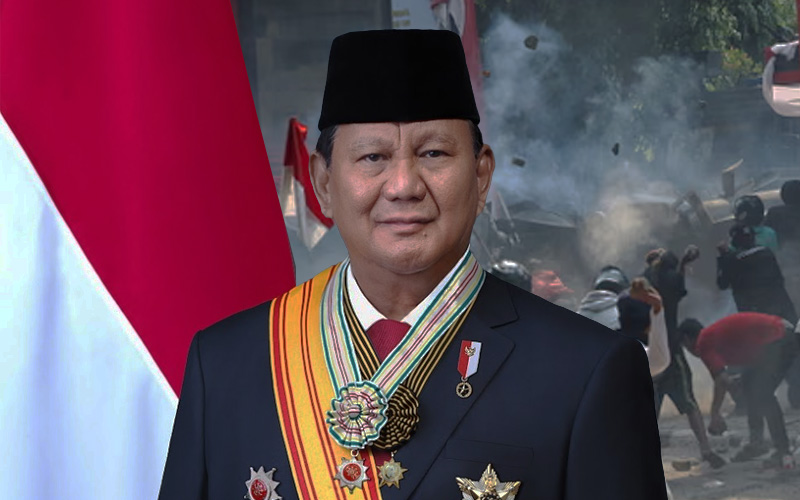
Since Prabowo’s inauguration in October 2024, there have been five mass protests, which in Indonesia means heavy-duty street fire-bombings. These have been put down with force, resulting in at least ten deaths and attacks on public and private buildings.
There have been 1,240 arrests in Jakarta; some are still being processed. Kompas claims 706 have become political prisoners.
ANU academic Dr Ed Aspinall has written: “Years of patronage politics have created an ever-widening gap between the political world of the governing elite who inhabit Indonesia’s democratic institutions, and that of the young protestors whose forebears played such an important role in putting those institutions in place.”
Political allegiance and corruption
In a bloodless domestic political coup, Prabowo has bought the support of more than 80% of the Parliament, seduced by promises of involvement with government and getting extra income and prestige.
Making the 14-party Advanced Indonesia Coalition into a permanent political alliance is on the menu. Opposition would then be left to academics and NGOs of courage. Last month, a key activist was splashed with acid on his way home.
Soldiers are believed to be responsible, under orders from an unnamed controller.
Prabowo presides over a flawed democracy riddled with graft. The sickness is known, the cure is understood, but there’s no political energy for change.
He struts when the position requires assertion by presence. He’s a misogynist: Just five women are in the 53-member ministry. His only son is single and lives in Europe as a fashion designer.
A divorcee for 28 years, he seems to prefer the company of macho men, though no longer in their league. He’s too short and portly, more like an aged Southeast Asian Kim Jong-Un.
Most Indonesian men die before they reach 70, so he’s beating the odds through getting the best medical care and having sturdy genes.
Back to the past
His father, Soemitro, lasted till he was 83, and his Granddad Margono, a year longer, so he may have time to garner enough fame to deserve a place in the pantheon of world leaders.
Or get ousted by an angry populace rejecting his back-to-the-past policies.
Against the strong wishes of electors with memories of last century’s Orde Baru (New Order), he’s made his one-time father-in-law Soeharto a National Hero. (He died in 2008, aged 86.)
A Time cover story described Soeharto’s 32-year rule as ” a period of intense authoritarianism, characterised by the centralisation of power.” The magazine alleged “Suharto Inc.” had filched US$15B in public funds.
The family sued but eventually lost. In a statement on the Supreme Court’s website, Judge Hatta Ali wrote: “The story in Time magazine is still within the press code of conduct, so it is not acting against the law.”
A more judicious relative than the current president would have quietly avoided resurrecting the past described by human rights researcher Andreas Harsono as including:
“Media censorship, tight restrictions on freedom of association and assembly, a highly politicised and controlled judiciary, widespread torture, attacks on the rights of minorities, massacres of alleged communists, and numerous war crimes committed in East Timor, Aceh, West Papua, and the Moluccan islands.
Bad human rights record
“National Hero sends a deeply troubling message to Indonesians and to the rest of the world. Prabowo has been implicated in serious human rights violations and war crimes while a general under Soeharto’s command, and was dismissed from the Indonesian army in 1998 for kidnapping student activists.”
He fled to exile in Jordan, and it seemed his ambitions had been dumped. Now he’s in the Jakarta Palace, but the errors of rule are mounting and worrying.
Right now, all seems safe and serene. Next week may be different. Australian holidaymakers should read about Indonesian affairs closely before they buy rupiah – if they can find such stories in the Australian media.
Better translate online copy from the daily Kompas and weekly Tempo.
Right is right shift in Indonesia as president Prabowo channels Donald Trump

Duncan Graham has a Walkley Award, two Human Rights Commission awards and other prizes for his radio, TV and print journalism in Australia. He now lives in Indonesia.