
What happened to Grace Tame tells you everything you need to know about who holds power in this country and how ruthlessly they will defend it. Andrew Brown reports.
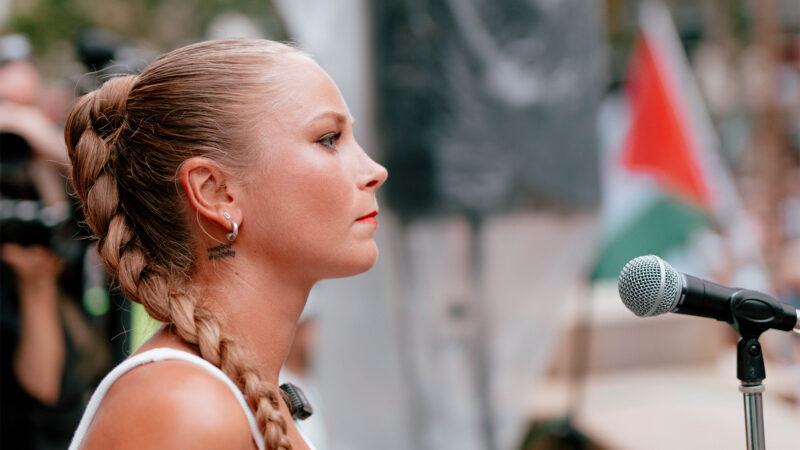
When former Australian of the Year, sexual assault survivor and outspoken human rights activist Grace Tame took to the steps of Sydney Town Hall, she did so as a woman who had already paid an enormous personal price for speaking truth to power.
I stood ten feet away when she spoke the words now being carved into something they were never meant to be.
Close enough to hear the cadence, not just the content. Close enough to feel the weight of what was said, not merely parse the transcript afterwards in an air-conditioned office with an agenda already written. Close enough to know, with the kind of certainty that only presence provides, that what followed in the days after bears no relationship to what was actually said.
It is not misinterpretation. It is not even spin in the ordinary, grubby sense, but wilful fabrication, coordinated and executed by people who know the truth as intimately as I do, and chose otherwise.
She did not call for violence. She called for solidarity. She stood before a crowd of more than five thousand people and spoke a rallying cry, “From Gadigal to Gaza, globalise the intifada,” and what she received in return was a campaign so precisely constructed, so rapidly deployed, that its architecture reveals itself to anyone paying attention.
This did not happen spontaneously. Outrage at this scale and speed rarely does.
Intifada
It begins, as these campaigns always begin, with the word “Intifada”.
A term carrying decades of contested history, used across the Arabic-speaking world in contexts ranging from armed resistance to civil protest, is hammered flat into a single, usable meaning. Violence. Only ever violence. The complexity is not missed; it is discarded. Deliberately. By people who know better and choose worse.
This matters. Because in the offices of News Corp Australia and in the coordinated communications of the Israel lobby, there are people who have spent entire careers studying the politics of the Middle East.
They know what the word contains.
They know what they are erasing when they reduce it. They do it anyway, because a flattened word is a useful word. It triggers before it can be questioned, condemns before it can be contextualised.
Then comes the extraction, the essential second move in a playbook refined across decades and continents.
Gadigal to Gaza
“From Gadigal to Gaza, globalise the intifada” is surgically separated from the speech it inhabited, stripped of the moral argument surrounding it, severed from the tone that gave it meaning, and made to stand alone like a splinter pulled from its timber and pressed into someone’s eye.
What remains is not a quote in any honest sense. It is a weapon, passed from the Telegraph’s midnight edition to Sky News’s dinner panel to a Coalition press release by breakfast, each repetition adding another coat of varnish to a lie.
Note, too, the word being quietly discarded in this process: “globalise.”
To globalise something is to spread it, to universalise it, to call for an idea or a movement to extend beyond its current borders. It is the language of internationalism, of solidarity across geography, of the kind of political imagination that has animated every progressive movement from anti-apartheid to the suffragettes.
When Grace Tame said “globalise the intifada,” she was calling for the spirit of resistance to oppression to be recognised everywhere, including here, on Gadigal land, where dispossession did not end and has never been fully reckoned with.
That word, “globalise,” does not sit comfortably in the campaign being run against her. So it is simply dropped. Edited out and rendered invisible. Because it points directly toward meaning, and meaning is the enemy of this operation.
And then the machine turns, and this is where the signature of coordination becomes unmistakable.
Coordinated attacks
Commentary converges with choreographed precision. The same framing, the same language, the same escalation across outlets that would have you believe they operate independently. The impression of organic public outrage is manufactured with the efficiency of a production line. Someone was working the phones.
These things do not self-assemble.
The consequence arrives exactly when it was designed to. Speaking engagements cancelled. Platforms withdrawn. A woman who forced this country to confront the systemic protection of child abusers, who sat across from a Prime Minister and refused to perform gratitude, quietly repositioned from national conscience to manageable problem.
But apply the logic they are selling, and it collapses immediately.
If the most extreme interpretation must govern the phrase, it must govern it entirely.
“From Gadigal to Gaza, globalise the intifada,” by their own reasoning, is a call for violent uprising not only in Palestine, but among First Nations Australians on their own land, and indeed across every nation on earth simultaneously.
Not one person making this argument believes that.
Not the Telegraph editor. Not the Sky News panellist. Not the Coalition frontbencher. Not the lobby operative who worked the phones to have her removed from platforms. They know the interpretation is false. They deployed it anyway.
When you know the truth and choose the lie, publicly, loudly, with consequences for a real person, you do not get the defence of honest mistake. You get the verdict that belongs to you: bad faith, pursued with intent.
A contemptible campaign
The campaign’s most contemptible manoeuvre comes last.
The insinuation, never stated plainly because stating it plainly would expose its falsity to open air, that words spoken at a peaceful rally carry some moral thread of responsibility for unrelated violence elsewhere. That solidarity and atrocity can be stitched together by proximity alone, without argument, without evidence, without decency.
This technique has a name in the study of information warfare. It is contamination. You do not need to prove a connection. You need only place two things in adjacent sentences and allow the reader’s pattern-seeking mind to complete the circuit.
News Corp has used it against unions, scientists, Indigenous leaders and the ABC for four decades. The Israel lobby deploys it on four continents against anyone who speaks the words “Palestinian civilians” without sufficient qualification.
In this case, they worked together,
and the result was a woman’s public standing quietly dismantled while both parties declared themselves merely engaged in vigorous democratic debate.
Staggering hypocrisy
Then comes the hypocrisy, so staggering it deserves its own paragraph.
The commentators who constructed their public identities on opposition to cancel culture deployed it here with cold, professional precision. Platforms closed. Invitations evaporated. The apparatus they spent years performing outrage about operated exactly as they always knew it could, because they were always among its most practised operators. The principle was theatre. The mechanism was always the point.
And into this, our Prime Minister stepped and called her ‘difficult’.
Not a rebuttal. Not an engagement with substance. A single, carefully chosen word that men of power have aimed at inconvenient women for generations, a word that says, without legal risk: she is the problem, not what was done to her. It was a signal, broadcast to every editor and every platform manager in the country, that the coast was clear. That is not leadership. It is complicity in a good suit.
5,000 Australians
Over five thousand people were gathered at that rally. Five thousand witnesses, standing in the Sydney evening, who heard the speech in full, who understood the tone, who felt the intent, who carry in their own memory the full human texture of what was said.
Five thousand people who can speak to the unbridgeable distance between what Grace Tame actually said and the version now being sold by those who were not there, who did not listen, and who have no interest in the truth of it.
That is not a fringe crowd. That is not a rabble. That is five thousand Australians who attended a lawful public rally, who listened to a lawful public speech, and who watched, in the days that followed, as everything they heard was systematically dismantled and rebuilt into something unrecognisable.
Ask them what they heard. Ask them what they understood. Ask them whether a single person standing among them that evening believed, for one moment, that they were witnessing a call to violence.
The answer is the story. The refusal to ask is the scandal.
No call to violence
The distance between what Grace Tame said and what she has been accused of saying is not a matter of interpretation. It is a matter of record, witnessed by thousands, and records do not dissolve simply because powerful institutions find them inconvenient, simply because a campaign has been built on their erasure, simply because the noise is loud enough that the truth struggles to be heard above it.
What was spoken on those steps was not a call to violence.
It was a refusal to accept it, spoken by a woman who has already paid dearly for her willingness to say out loud what powerful people prefer left unspoken. A woman this country once celebrated, then moved to silence the moment she stopped being convenient.
The attempt to transform that refusal into something sinister does not diminish her. It diminishes, permanently and on the record, everyone who participated.
And it demands an answer to a question that will outlast the news cycle, the cancelled bookings, and the coordinated outrage.
If this is what can be done to Grace Tame, former Australian of the Year, a survivor whose courage reshaped the law, visible, celebrated, and possessed of a public record that is the envy of most advocates alive, what can be done to the student, the union delegate, the whistleblower,
the ordinary person who considers speaking and, having watched all of this, decides not to?
That silence, the speech that never happens, the truth that never surfaces, is not a side effect of this campaign; it is the campaign.
This is a witch hunt. Its architects are identifiable. Its methods are documented. Its purpose is control of language, of narrative, of the precise location of the line that separates permitted speech from punished speech.
And the rest of us, five thousand of us and counting, having watched it operate in plain sight, no longer have the excuse of not knowing what we are looking at.
Before the baton falls. How power and framing normalised violence
Andrew Brown is a Sydney businessman in the health products sector, former Deputy Mayor of Mosman and Palestine peace activist