
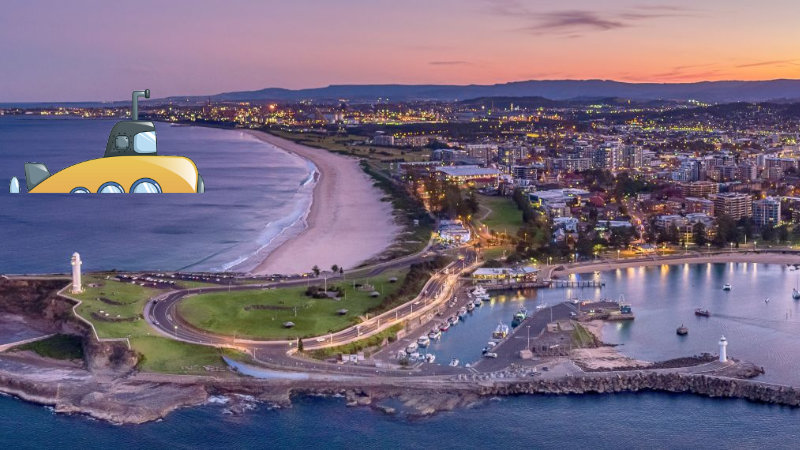
How was a Chinese Communist Party-connected Shanghai businessman allowed to purchase property within a stone’s throw of possible AUKUS nuclear sub bases in Newcastle or Wollongong? Rex Patrick seeks answers.
When media first reported that Chinese businessman Wang Yongxin, president of the Shanghai Xinyangg Chamber of Commerce, had bought significant blocks of land at Port Kembla and Newcastle Port precinct, the Australian government retreated into a cone of silence on whether the Foreign Investment Review Board (FIRB) had examined the purchases.
When MWM tried to use freedom of information laws to pursue the answer, Defence told us they had no documents and Treasury, the department where FIRB is to be found, told us to go away. They were neither confirming nor denying whether they did anything.
Neither confirm nor deny: Foreign Investment Review Board secrecy
However, when faced with MWM’s transparency challenge, the Government capitulated.
So, were they remiss in not vetoing a future Chinese AUKUS espionage base, or have they looked at it and concluded it’s OK, or have they done an analysis and are just keeping their powder dry?
FIRB rules for property purchases
There is no requirement for a foreigner to apply to the FIRB for the purchase of commercial land unless the purchase price exceeds $347m, or in the case of a Chinese national, on account of our free trade agreement, more than $1,498m. The threshold lowers to $75m if the land is ‘sensitive developed commercial land’, but being a neighbour to a ‘thought bubble only’ nuclear submarine base doesn’t count as sensitive.
If there is no requirement for an application, the Treasurer can still ‘call-in’ for review acquisitions if he or she considers they may pose national security concerns. He or she has up to 10 years to do so. A ‘call-in’ allows the Treasurer to issue a “no objection” notification, including with conditions, or prohibit the action, or require divestment.
A foreign purchaser can extinguish a ‘call in’ by the Treasurer by voluntarily notifying the FIRB of a purchase, although that doesn’t remove a last resort power, which, in exceptional circumstances, permits the Treasurer to Act where national security risks emerge.
Mr Yongxin did not make a mandatory application to the FIRB for the purchase of the land in the Port Kembla and Newcastle port precincts because he was not required to. He did not make a voluntary notification either.
Lawyer’s picnic at taxpayers’ expense
MWM made its FOI request to the FIRB in August 2025. The ‘neither confirm nor deny’ decision came a month later and, after some dialogue with the Information Commissioner, the matter was shifted straight to the Administrative Review Tribunal, and placed in the hands of Government lawyers.
In April this year, MWM emailed Treasury’s legal team and pointed to several government and Senate reports that showed that it was no secret that Defence and National Intelligence community agencies provide input to foreign investment reviews.
One of the examples MWM sent the lawyers for consideration was a 2021 Senate inquiry report that stated:
“Depending on the nature of the proposal and concerns it raises, the Treasury may consult with a variety of partner agencies as it assesses the application against the national interest, including:
- State and territory government departments;
- Department of Foreign Affairs and Trade;
- National security agencies;
- The Australian Competition and Consumer Commission;
- Australian Federal Police;
- Australian Criminal Intelligence Commission;
- Australian Transaction Reports and Analysis Centre;
- Australian Tax Office;
- Australian Securities and Investments Commission
- Department of Defence; and
- Department of Home Affairs.”
How would the fact Defence might have been consulted on Chinese Communist Party-connected land purchased next to potential sites for a future AUKUS submarine base be in any way controversial? The only controversy in revealing if documents existed would be if the Government was asleep at the national security wheel and
no assessment had been done.
Treasury held its ground, and the lawyers’ bills to the taxpayer kept accumulating.
Backflip
Last Wednesday, 5 minutes after a deadline had passed for the Treasury to make submissions against MWM, Treasury backflipped, advising the Tribunal:
“The respondent has reviewed its position in relation to the decision to neither confirm nor deny the existence of documents responsive to the request and now seeks to make a revised decision on material potentially within the scope of the request.”
And therein lies the circus that is our freedom of information regime.
After 12 months’ delay and tens of thousands of public dollars spent on legal fees, MWM’s FOI request will now get processed as it should have been processed in the first place, although it’s likely Treasury will paint the documents with overzealous redactions.
The transparency fight will continue, and the lawyers’ picnic will shift to the wine and Fromager d’Affinois cheese stage.
Espionage approval
When MWM requests documents related to the progress of Defence projects, no matter how benign, Defence rolls out “heightened espionage threats” in its attempts to justify wholesale redactions.
And yet the Government turned a blind eye to 13 consulate staff being assigned to the Chinese consulate in Adelaide, Australia’s naval shipbuilding city, while the United Kingdom and India, who have the largest diaspora bodies, only have fly-in-fly-out consuls.
And they have let Landbridge, a Chinese entity, lease the Port of Darwin a short distance from where Australian warships tie up and visiting US nuclear-powered submarines moor.
And it seems that if the intent of the Chinese Government is to stage future espionage from land within a stone’s throw of the East Coast AUKUS submarine base in either Port Kembla or Newcastle, they’re well ahead of the Australian Government.
As a result of the backflip, we’ll shortly find out whether the Treasurer exercised his ‘call in’ power.
Perhaps the Government has reviewed the purchase and is keeping its powder dry. But maybe they won’t be able to use the powder, no matter how dry it is.
But for the moment we’ll just have to wait for the FOI request to be processed properly to see the manner in which the Australian Government has left open the door to AUKUS espionage.
Chinese Whispers. Broken promises on Port of Darwin buy-back

Rex Patrick is a former Senator for South Australia and, earlier, a submariner in the armed forces. Best known as an anti-corruption and transparency crusader, Rex is also known as the "Transparency Warrior."