



Ordinary investors are shut out of Australian Government debt markets, forced to pay higher prices for these debts they own, at higher risk too. Veteran bond trader Philip Carden calls for a fair market.
In September 1970, the The Earl of Cromer, former ex-Governor of the Bank of England, wrote the Introduction for Baring Brothers’ 1970 “Merchant Banking Today”:
“Almost a hundred years ago Walter Bagehot wrote of Merchant Banking ‘We must not let daylight in upon magic’. In this introduction Cromer went on to say “He (Walter Bagehot) had been impressed by the legendary tales of the power and influence exerted by the merchant banks in the previous one hundred years, which had established the city of London as the pre-eminent international financial centre of the world.
These tales long lay dormant until the merchant banks again struck the headlines as advisors in the classic takeover battles, which have taken place over the last decade and a half (1955 to 1970). The demands of mass communication have caused the old legendary tales to be revived and new legends written. Instead of informing the public of what a merchant bank really does, a new mysticism has been created.
The purpose of this book is to try to explain as simply as possible what a merchant banks is, what business it transacts and what services it offers.”
Fast forward to October 2026, and it seems there is a different kind of magic operating in Australia’s Treasury Securities market today; a kind of magic that makes Treasury Securities disappear, then reappear in a less valuable form; or in some cases never to appear again!
In distinction to Walter Bagehot, once editor-in-chief of the Economist from 1861 to 1877, at Michael West Media, daylight shines in upon everything.
Through a glass clearly
In our Treasury Securities market – the market for Government debt – I see a market structure favouring one group of investors above Australian citizens – banks above ordinary investors.
The issuance of Australian Treasury Securities by Treasury’s Australian Office of Financial Management (AOFM) is structured in a manner
which discriminates against retail investors
in favour of large financial institutions and professional investors
In the primary market, where Treasury Securities are auctioned by the AOFM, retail investors are not approved to attend or bid in the Treasury Note and Treasury Bond auctions.
Their access is restricted by regulation and by statute. In the secondary market, the access of retail investors has been delegated to a market in a security related to Treasury Bonds called Exchange-Traded Australian Government Bonds, listed on the Australian Securities Exchange (ASX).
Price discrimination
In this secondary market Treasury Notes are not listed; and Treasury Bonds that are listed incur brokerage and ‘spread’ costs that make them more expensive than their counterparts offered by the AOFM at auction for chosen investors.
A Treasury Security, when issued in the government’s native currency, is a tradable security that constitutes the benchmark for interest rates, credibility, and liquidity in that country’s economy. As the benchmark tradable security, government treasury securities are the risk-free investment against which all other borrowers’ interest rates, credibility and liquidity is measured.
Therefore the business of issuing our Australian Government debt is the paramount responsibility of our government.
The process a government deploys when issuing its debt should provide equal access to all investors who are able to offer cash in exchange for a Government Treasury Security.
There should be no favouritism,
price discrimination or barrier to investing in Australian Government Treasury Securities for any Australian citizen who wants to invest. The Government Treasury should provide access to its Treasury Securities on equal footing and for equivalent value to all Australians, be they 18-year-old investors with only $100, or a major financial institution seeking a $1 billion as a liquid benchmark asset for their balance sheet.
The case for equal access
In my opinion, as a veteran Treasury Securities dealer over the past 45 years, I believe there are powerful reasons why our Australian Government Treasury should provide a single, nonexclusive investment facility for all Australian investors on equivalent value with unfettered terms.
Most retail Investors are taxpayers.
Tax revenue is the collateral used by the Government Treasury to secure the money it borrows when Treasury Securities are issued. Australian Tax Office data reveals the large majority of taxes are collected from retail investors.
The reality is that we the people provide the collateral to the Australian Government.
This places a moral obligation and the highest level of accountability upon the Government to build a public debt-funding structure operating on the legal principal of fair trade providing equivalent, unfettered access to all classes of Australian investors.
Money cannot be borrowed without collateral. Only a foolish borrower would put the significance of collateral in preference to a lender’s money. In the case of Australian Government Treasury debt, the taxpayers provide collateral and major Australian financial institutions are lenders to the Government Treasury.
Simultaneously, those same financial institutions also operate as borrowers from tax-paying retail Investors who themselves are unable to invest in Treasury Notes.
This represents a moral hazard because retail Investors who are unable to buy Treasury Notes from the issuer are frustrated to the point of despair when trying to buy Treasury Notes in the secondary market from the AOFM’s appointed financial intermediaries.
Stark difference in the US
When Australia is compared to our closest economic and cultural ally the United States of America the difference in investment access provided these governments is stark.
In the United States any person with a US social security number can buy any US Treasury Security issued by the US Treasury at any US Treasury security auction.
US citizens are empowered to place non-competitive bids at auction to buy US Treasury Securities in face values ranging between US$100 to US$10m. All bids received are guaranteed to be issued the relevant US Treasury Security priced at the auction value.
There are no fees, costs, no brokerage
no custody cost or registration fee just the price of the security per $100 in face value on a when issued basis as issued by the US Treasury. This Facility is named TreasuryDirect and can be accessed online by clicking this LINK to the US Treasury website.
There is no facility offered by the AOFM like the US Treasury’s Treasury Direct facility.
Higher returns for the banks
To repeat, for the majority of Australian investors, it is practically impossible for most to buy an Australian Treasury Note, at any price; let alone when issued by the AOFM at its Treasury Note auctions.
It is possible for Australian investors to buy Australian Treasury Bonds in the secondary market, but only when listed on the ASX as exchange-traded Australian Government Bonds. Whilst this security is similar to an Australian Treasury Bond it is not a Treasury Bond as it does not possess all the valuable characteristics of an Treasury Bond.
Exchange-traded Australian Government bonds cannot be sold to the Reserve Bank of Australia for liquidity. This is because they are lodged in a separate registry to those the Reserve Bank will buy. This diminishes their value to investors because liquidity is one of three characteristics possessed by Treasury Notes and Bonds that place them in a class above all other Bonds.
Exchange-traded Australian Government Treasury Bonds are also expensive to buy due to exchange costs such as brokerage and price spread.
A parcel of exchange-traded, Australian Government Treasury Bonds with a face value $180,000, maturing on April 21, 2027, traded on the ASX recently at a price of $100.10 per $100.00 face value. After adjusting the price for brokerage and the bid/offer spread paid, this security returned a yield to maturity of just 4.5%.
If the buyer of this Treasury Bond had been able to place a noncompetitive bid in the Treasury Note Tender that was scheduled for 7 days later, he would have bought a Treasury Note maturing April 9, 2027, at a yield to maturity of 4.9525%.
That yield is 0.4525% higher than what was received on the ASX listed exchange-traded Australian Government Bond.
That is a 10.05% higher yield return.
Price discrimination and access restrictions imposed upon Australian retail investors needs to be removed by way of Government policy deregulation.
Such deregulation will benefit tax-paying Australian citizens who are greater in number and larger by aggregated investment value than the privileged financial institutions currently enjoying the benefits of unfettered access to the Australian Treasury’s primary issuance of Treasury Notes and bonds at its auctions.
The benefits are displayed by in this table:
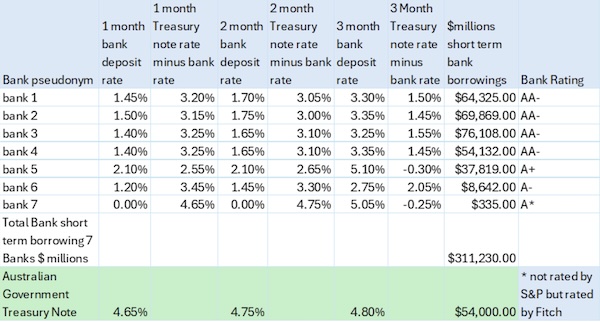
- This reveals that Australian bank investors are happy to make short term loans amounting to $311 billion to just seven of this country’s 117 banks. Accordingly, this also reveals that one, two and three-month Treasury Note yields offer an average of 2.24% higher yield than their corresponding bank deposit yields.
- Further, when lending to these seven banks, lenders take a higher risk than when buying a Treasury Note.
Standard and Poors credit ratings for the banks as listed in the above table are all rated riskier than our Australian Treasury. The Australian Treasury is one of only 9 AAA rated countries in the world.
Lower return for higher risk
Surely these investors who would mostly be Australian taxpayers, as providers of collateral for Australian Treasury debt deserve the opportunity to invest directly into Australian Treasury Notes and Bonds at the higher income and lower risk level provided by Treasury Notes.
Why would any Retail Investor make a 3-month Bank Term Deposit at 3.35% with a bank rated AA-, when a Treasury Note is available at a rate of 4.95% issued by my Government’s Treasury rated AAA?
The amazing fact that has occurred in our treasury note market recently over the past five years occurred with the author of this article’s managed investment fund.
Disrespectful
This investment fund was mandated to invest only in Australian Government Treasury Notes and Treasury Bonds. Initially investments were targeted at Treasury Notes where it became impossible, under existing Government market regulation for the fund manager to buy Australian Treasury Notes at a net positive cash flow after paying brokerage, registry and custody costs.
On several occasions in 2024 to 2025, the fund manager approached various primary market Treasury Note dealers approved to place bids in Australian Office of Financial Management Treasury Note Auctions. Most of these dealers, as listed here, for a variety of different reasons were unable to assist the fund manager’s request to buy Treasury Notes.
This is a morally reprehensible and disrespectful
way to treat any lender who is providing a borrower’s collateral. Following this the fund was closed and its unit-holders returned their investment money to short term bank deposits.
This experience raises the question: If Treasury Notes and Bonds are issued on behalf of the Government and supported by the public credit of Australian taxpayers, what public-interest objective is served by regulation preventing individual Australian households from purchasing those Treasury Notes and Bonds directly from the Australian Treasury?
The facts are that the Australian Prudential Regulatory Authority reports Australian households have a total of AU$1,771.72 billion outstanding in Australian Approved Depository Institution (mainly bank) deposits.
Household deposits of AU$1,771.72 billion are more than Australia’s national debt by nearly double! Our research indicates (see table 1 above) that a large slice of this will be deposited at rates lower than those offered by Australian Government Treasury Notes and Bonds.
Depositors gouged?
It is not a far stretch to make the observation that some banks may be reasonably avoiding selling Treasury Notes or Treasury Bonds to depositors in Australian because they have a higher incentive to raise deposits at a price that supports higher shareholder returns than selling a Treasury Note.
When the Australian Treasury appoints financial institutions as Treasury Note and Treasury Bond Market Makers it is clear that conflicts of interest and fair trade should somehow be taken into account.
When government creates and governs over statute and regulation that restricts access and fair price discovery by its citizens in the national debt securities market then that, although legal, is an example of poor governance that needs attention.
You never know, deregulation and an even playing field might raise money for Treasury at the same price the Banks are paying for short term deposits.
A summit to replace Australia’s housing casino. Build homes, not excuses

Philip Carden is a fund manager and adviser on debt securities. Formerly head of Macquarie Bank's treasuries department he now runs Carden Treasury Corporation.