
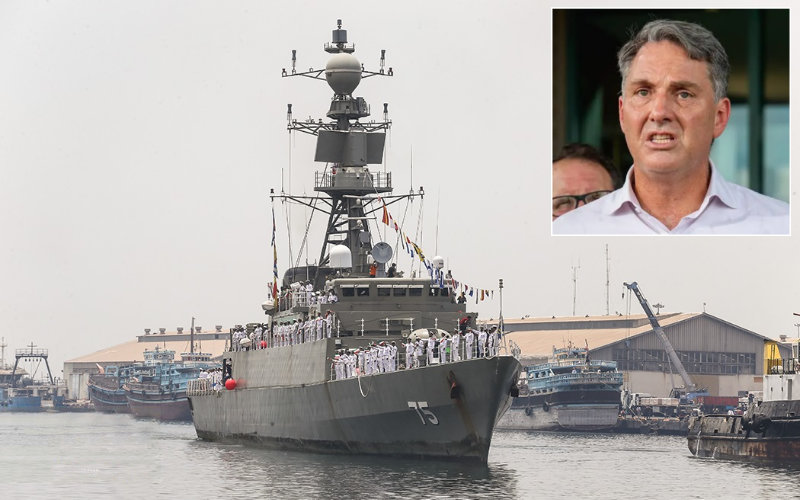

Defence Minister Richard Marles was not informed until after the US submarine with three Australian Navy personnel onboard sank an Iranian frigate. He should have been, Rex Patrick reports.
On March 4, USS Charlotte sank the Iranian Frigate INIS Dena, resulting in at least 87 deaths. After the sinking, Prime Minister Anthony Albanese revealed that three Australian submariners were on board. MWM requested access, under Freedom of Information (FOI) laws, for any briefs provided to the Defence Minister, Richard Marles, by the Department of Defence.
There were no briefs, not until after the event.
We’ll never know if the Government would have left three Australian submariners onboard as it deployed in support of the US – Iranian war. Maybe it wouldn’t have. But they didn’t get to make a choice because they were never told. And that must be, in anyone’s books, a significant failure.
US war on Iran exposes Australia’s frail defence, AUKUS even more
Following orders
In FY2023/24, Australia, as a part of AUKUS, began embedding sailors in US Navy submarines. That embedding followed the signing of a September 2023 Memorandum of Understanding (MOU) between the US and Australia on the exchange of defence personnel.
The MOU is not public. However, a December 2024 Chief of Navy Directive that was recently leaked reveals a granting of additional authority to US Navy commanding officers to issue lawful and reasonable directions to Australian submariners onboard US submarines. It says:
“… RAN members embedded on USN Submarines must comply with all lawful and reasonable directions given by USN members of a superior corresponding rank that relate to the carrying out of functions within the responsibility of that superior.” [bold in original].
The consensus view is that the war against Iran is not lawful under international law. The Albanese Government has avoided directly dealing with that legal issue, but has expressed support for the United States “acting to prevent Iran from obtaining a nuclear weapon”.
US or Australian submariners are not responsible for the declaration of war and are not to make a legal determination as to the lawfulness of the war. That is for others, with responsibility for any breach of law resting with the president himself.
Submariners must follow their national law and do as they are commanded, albeit they should not follow an order that would constitute a war crime.
A submarine commanding officer would refuse an order to sink a hospital ship, but an order to sink an enemy-flagged warship, in its own or international waters, is accepted as lawful. The sinking of the IRIS Dena was lawful.
Failure to rescue
The USS Charlotte did not pick up any survivors. Whether that is a crime is a grey area of international law.
Submarines are extremely vulnerable when they are on the surface and are also not well equipped to deal with large numbers of sailors, many of them injured, on account of limited space and limited medical facilities. It may be better for other ships in the area to rescue the survivors, as Sri Lankan Navy vessels did.
The Australian submariners onboard would have been operating in accordance with the Chief of Navy’s December 2024 directive.
After the sinking of IRIS Dena, the Prime Minister advised the public that Australians were onboard USS Charlotte but that “No Australian personnel participated in offensive action against Iran”.
That statement was disingenuous and an attempt to sidestep the potential magnitude of what had actually occurred.
Australian submariners did not have to personally press the torpedo ‘fire’ button to play a part in the sinking of a warship.
The conduct of warfare on a submarine is a team effort.
Whether you’re a machinist’s mate keeping the multitude of systems going, the navigator getting the submarine safely to the combat zone, a reactor operator making sure the systems onboard are supplying energy to propellors and ship systems, a cook feeding the crew, a communicator receiving the order to attack Iranian ships, or the sonar operator that detects the target, you’re part of a team that wither succeeds or fails is conducting its assigned task.
The Commanding Officer of USS Charlotte knows that and would never claim he did it alone. The Islamic Revolutionary Guard Corps might also reasonably disagree with Albanese’s proposition.
Defence failing
Australian military officers do not normally know the disposition of the US submarines, unless they are in waters that Australia is responsible for in submarine waterspace management (keeping friendly submarines apart is similar to keeping friendly airliners apart).
But they had an obligation to make inquiries about the possibility that Australian personnel could be drawn into a conflict deemed to, in any lawyer’s view, contravene the international rules-based order and one that the Australian Government has not subsequently committed to.
That they did not is perfunctory at best.
What would the situation be now if the Iranians, as they could have, viewed the participation of Australians in an offensive action as an act of war?
What would have happened if the attack hadn’t gone as it did and the Iranian vessel had counterattacked and sunk the US submarine, with the loss of the Australian submariners onboard?
These are not questions that should be resolved by happenstance.
In 1989, a pipe bomb blew up the car of the wife of Captain Will Rogers, the Commanding Officer of USS Vincennes, which had accidentally shot down an Iranian civilian airliner in the Persian Gulf a year earlier. In this case, did our Defence Department unwittingly endanger the family of our submariners (and any collateral damage a reprisal attack may involve)?
The fact is, the rare modern-day sinking of a vessel by a submarine will be a hard secret for those involved to keep from their submariner mates, who may inadvertently leak the names.
Let me be clear, this author isn’t saying our submariners should have disembarked or that they should have stayed onboard, rather that Australian involvement in a conflict must be a conscious decision of the Government, and for that to occur,
the Government of the day must be informed.
The minister ought to seek answers as to why the Government was left in the dark. Someone should be held to account, and a deterrent should be established to ensure there can be no repeat.
No one wants Australia to blindly find itself in a war, or to unconsciously draw terrorism to its shores.
Tolling the Strait. Is Iran acting with reason in a Trumpian world?

Rex Patrick is a former Senator for South Australia and, earlier, a submariner in the armed forces. Best known as an anti-corruption and transparency crusader, Rex is also known as the "Transparency Warrior."