
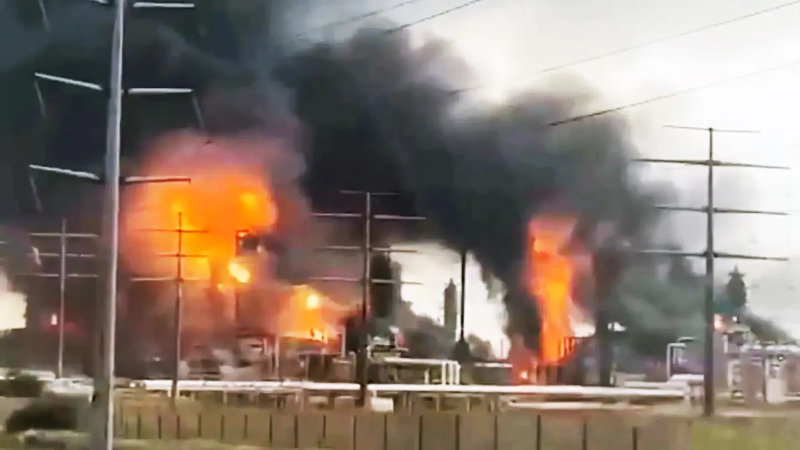
While the “Iran war” is fuelling Israel’s desire for Middle East chaos, Australia finds itself in strategic quagmire of confused priorities and escalating energy costs. Stuart McCarthy reports.
According to the 2023 Defence Strategic Review, Australia is confronting the “worst strategic circumstances since WWII.” A need to “pivot” from pointless “forever wars” in the Middle East towards the Indo-Pacific and counter a rapid build-up of Chinese military power evidently warrants an overhaul of our “not fit for purpose” defence force, expenditure of up to $368B on AUKUS submarines and a plan to enter the “missile age.”
No mention is made in that “strategic” document of this country’s most serious vulnerability. Namely, our systemic exposure to exactly the kind of global oil shocks triggered by the latest Middle East military fiasco.
Our lack of preparedness for these shocks is the result of at least two decades of inexcusable incompetence across the political spectrum.
The reality we face is that Australia has been caught with its pants down during a seismic but foreseeable shift in the global geopolitical landscape. The fallout from the current Middle East war will hit us hard, and we are not prepared.
Even if the Strait of Hormuz – the vital artery for 20% of global oil supplies – is miraculously reopened to merchant shipping within the next few weeks, an economic recession is already a safe bet. The 1979 oil shock saw a severe recession across industrialised countries. Australia saw a double-dip recession, and unemployment rose to more than 10%.
Oil dependency
Australia produces less oil now than it did in 1979, but demand has doubled over the same period, in line with economic growth. We are now 90% dependent on imported petroleum fuel.
The 20 years needed to transform our road transport fleet have been squandered, and we are at the tail end of a jet fuel-dependent global air transport system. The demand-led Covid recession saw a 7% decline in domestic petroleum fuel consumption, mostly as a result of the near total shut down of the aviation sector, but we now face a collapse in the availability of globally traded petroleum fuels, affecting the entire transport sector.
And there’s more. As much as two-thirds of the Urea fertiliser used by Australian farmers also usually comes through the Strait of Hormuz. There are already shortages of some essential medicines and other manufactured goods, which rely on fragile, just-in-time global supply chains.
The stability of our financial system remains as dependent on the assumption of perpetual economic growth as it did before the 2008 financial crisis. Oil supply and economic shocks such as these are blithely dismissed as “externalities” in business-as-usual finance and economic models. Much of the financial capital we need to properly transform our economy to a sovereign resilience model is sure to evaporate in equities and finance markets.
This shock will undoubtedly be much worse than what we saw in 1979.
And who will pay the price? In short, we all will.
The cost of war
Since the end of WWII, the human costs of Australia’s wars have been carried solely by the tiny proportion of our community who serve in the defence force, their families and the populations of countries “over there.”
For most of us, mere curiosities on the evening news or social media feeds.
Within military circles, Australia’s contributions to US-led wars in the Middle East and elsewhere have often been disparaged as niche wars. Relatively small contingents of “niche” capabilities were assigned to US-led military coalitions with little impact on overall strategic outcomes other than legitimising US hegemony, while minimising domestic political risk and accountability in case things went wrong.
Given this government reflexively committed us to this war with even less forethought than previous governments in the last several wars, it would more accurately be described as Albanese’s rubber-stamp war.
Within hours of the first Israeli and US air strikes against Iran on 28 February, Albanese regurgitated the Israeli pretext that Iran posed an imminent nuclear threat. This pretext has already been publicly debunked by the US Director of National Intelligence.
The US Director of National Intelligence has debunked the lie (endorsed by Albanese, Marles & Wong on 28 Feb) that Iran posed an imminent nuclear threat. As with Iraq in 2003, the Australian government has commited us to a war predicated on a lie.https://t.co/vEoixIF5Xm
— Stuart McCarthy (@StuartMcCarthy_) March 18, 2026
Unprovoked attacks
For the second time in less than a year, the attacks were launched even as US officials were negotiating with the Khamenei regime over its uranium enrichment program. Iran would be irrational to come back to the negotiating table because that is now proven indicator of the next Israel-US aerial bombardment campaign.
The degree of Israel-US incompetence on display here is breathtaking,
even before any moral or legal considerations are made.
Now facing a direct existential threat, the Khamenei regime, on the other hand, has responded with a coherent strategy of lateral escalation, for which they have been preparing since at least 2003.
From their perspective, to “win” this war, all they need to do is survive.
Their strategy is to inflict severe economic pain on the global economy by closing the Strait of Hormuz until the US eventually comes to its senses, and to drive a wedge between the US and the Gulf states, which host permanent US military bases that project power across the region.
These bases have been a growing source of tension in the Middle East since the Iranian revolution in 1979 and the Russian invasion of Afghanistan later in the same year. The US at the time saw a Russian presence in Afghanistan as a threat to its vital national interests in maintaining access to Middle East oil exports, responding with a permanent military presence in the Gulf states under its “Carter doctrine.”
Over time, this US support also allowed the Gulf states and Israel to contain the perceived threat to regional stability from the Iranian regime.
Now, almost fifty years later and with the NATO-led Afghanistan and Iraq wars in the rear view mirror, US bases nonetheless remain, part of a self-perpetuating escalatory spiral with Iran.
Iran will not be content with Israel and the US merely stopping their attacks. They are now demanding that US bases in the Gulf be shut down permanently. The Gulf states – despite their serious diplomatic efforts to establish stable relations with Iran – are trapped in the middle of a war they didn’t want, and they have no clear way out.
War out of control?
On Wednesday night, Israel bombed South Pars, the world’s largest gas field jointly owned by Qatar and Iran. Iranian officials have vowed to launch retaliatory strikes against gas and oil infrastructure elsewhere in the region. This marks the next step up the escalatory ladder, and it means the duration of the energy and economic shock will be measured in years, not months.
Trump no longer has control of the situation, even if he ever did. Netanyahu has for many years envisaged not merely regime change but the fracturing of the Iranian state as a strategic win for Israel, and he – not Trump – is calling the shots.
For Australia’s part, our rubber-stamp contribution of an air force Wedgetail surveillance aircraft, ostensibly to help defend the United Arab Emirates from incoming Iranian missiles, has actually played into the hands of the Iranian strategic narrative.
Regardless of Foreign Minister Penny Wong’s nauseating semantics over this aircraft playing a “defensive” role,
Australia is now party to the war with Iran,
from our own base at Al Minhad in the UAE, which has already been targeted by the Iranians at least twice. We are one of only a small handful of Western countries with a permanent military presence in the Gulf, a presence that in and of itself is helping to fuel the escalatory spiral.
While all this plays out “over there”, for the first time in almost a century, some of the human cost of this war will be carried by the wider public here at home. Costs for fuel, food and utilities will continue to soar, as will mortgage payments and rents. Savings and investments will take a hit. Many people will lose their jobs. Some will lose their homes.
Among them are those who used to be considered Labor’s core constituents – the “Aussie battlers” who work hard but struggle to make ends meet – before the “workers’ party” abandoned its principles in favour of banal neoliberal economic rationalism, political careerism and mindless identity politics.
We can only hope that this shock might at last see a consensus emerge for a rational, sovereign, independent national security and foreign policy. Our policies of vassal state subservience to the US and, in this case, Israel are beyond unfit for purpose. They are directly undermining our vital national interests. In the meantime, we’re in for a rough ride.
International Relations and Iran ft Scott Burchill – MWM Live

Stuart McCarthy is a medically retired Australian Army officer whose 28-year military career included deployments to Afghanistan, Iraq, Africa, Indonesia and Papua New Guinea. Stuart is an advocate for veterans with brain injury, disabilities, drug trial subjects and abuse survivors. Twitter: @StuartMcCarthy_