
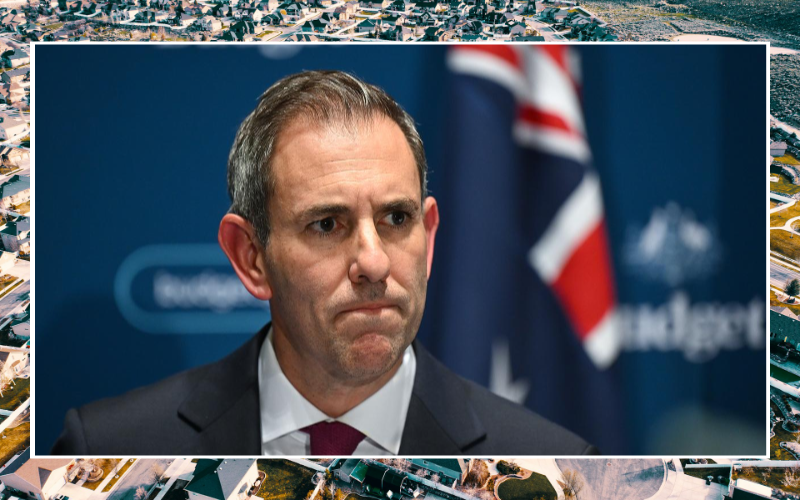

Hailed as the biggest reform since the GST, Treasurer Jim Chalmers promises cheaper houses through first home buyer support, negative gearing and Capital Gains Tax changes. Harry Chemay reports from Canberra.
The Labor Government just delivered its 2026-27 Budget, its fifth since being re-elected in 2022. It has a strong sense of déjà vu about it.
Not because the key tax reform initiatives, a tightening of negative gearing and capital gain tax concessions, were widely telegraphed prior, but because it takes me back to the 2021-22 Budget and to one of the first pieces I wrote for MWM.
In that piece, I noted that the total value of Australian residential property had crossed the $8 trillion dollar mark just before Budget day 2021. In so doing, it had then surpassed the combined value of the entire Australian superannuation system, the value of all companies listed on the Australian Securities Exchange and the total annual value of Australian GDP by about one trillion dollars.
“Australia’s housing market doesn’t just exceed the productive economy any longer, it simply dwarfs it”, I wrote, as the national median dwelling price tipped over the $650,000 mark, with Sydney’s median housing price reaching $1.1 million.
Looking back at those 2021 prices from today’s perspective, aggregate residential property is now north of $12 trillion, the national median dwelling price is close to $1m, and Sydney’s median house price is well past $1.4m. It makes those 2021 prices appear little more than a quaint historic artefact.
Housing continues to utterly dominate the nation’s economic affairs in a way few other developed economies experience.
The 2026-27 budget is designed to curb the enthusiasm of residential property investors while reigniting Australia’s lethargic business productivity growth.
Songbirds and snakes. How to end the ‘Hunger Games’ of housing affordability
The CGT Balancing Act
According to the Budget Papers, only around 7% of taxpayers report a net capital gain each year. Most use the CGT discount method of calculating their tax liability.
The changes to the CGT regime will only apply from July 1, 2027. The 50% discount will still apply to gains accrued on eligible existing investments prior to the start date, irrespective of when the gain was realised.
Given how broadly telegraphed the proposed CGT changes were before the Budget, it is not surprising that voices opposing in anticipation have been loud, strident and vociferous from the business community, particularly from Australia’s startup ecosystem.
Those who take significant risks to start a business, create jobs and add to Australia’s economic output do so in the hope that their shareholding will eventually provide a return commensurate with all the risks taken, sometimes over decades. To them,
reverting to the pre-September 1999 regime may result in the after-tax rewards being insufficient to justify the risks involved.
That is a legitimate concern.
The Government appears willing to negotiate here, indicating that further consultation will be undertaken on the details, including with early-stage and startup businesses. In addition, and on a first reading, there appears to be no diminution to the range of CGT relief that small business owners currently enjoy, including rollover relief into superannuation.
Rebalancing economic incentives
Overall, this Budget could be described as ‘bold’, seeking as it does to implement perhaps the most comprehensive change to Australia’s taxation system since the Ralph review and the introduction of the GST in 2000.
The proposed changes reflect the reality that household wealth in Australia today is dominated by residential property, with some three dollars in housing wealth for every one in superannuation. It is the distribution of that wealth that has become increasingly skewed, with housing outcomes just as likely to now be determined by familial ties as by individual earning capacity.
As I concluded in my 2024 series on Australia’s ‘Housing Hunger Games’:
“Left unchecked by neglect, wilful or otherwise, Australia is at risk of turning into a nihilistic nation where the aim of the game is to ‘beggar thy neighbour’s children’. Therein, one’s main financial objective is to opportunistically build wealth through property, accepting that, in doing so, home ownership will be less attainable for future generations. The mitigant, therefore, is to have a first home deposit ready for each child, acting as the Bank of Mum and Dad”.
Jim Chalmers’ fifth Budget is an attempt to address that growing intergenerational imbalance. As to how these proposals now morph into Treasury Bills, are debated upon, negotiated, amended and ultimately pass into legislation, time will tell.
It will be anything but a smooth passage.
Wealth inequality. Housing cost is hollowing out middle Australia

Harry Chemay has more than two decades of experience across both wealth management and institutional asset consulting. An active participant within the wealth and superannuation space, Harry is a regular contributor to investment websites in Australia and overseas, writing on investing and financial planning.