


Government appeal fails at the third hurdle after years of fighting against disclosure of FIRB decision to sell baby food company to China. Rex Patrick strikes again.
The Foreign Investment Review Board (FIRB) is a non-statutory body that examines most proposed foreign investments in Australia, deciding whether the investment is in the national interest.
The FIRB makes recommendations to the Treasurer, although some less important decisions are delegated to senior officials, and the Foreign Acquisition and Takeover Act (FATA) permits the Treasurer to impose conditions on a foreign investor,
While this writer was still a Senator, how the FIRB worked was on my agenda. Back in 2020, I asked to look at how Treasury and the Treasurer had determined it was a good idea to sell Tasmanian baby food company Bellamy’s to China Mengniu Dairy Company.
A big fat ‘No’
The response I got was a straight-out ‘no – you’re not entitled to see it’.
I appealed their big fat ‘no’ to the Information Commissioner, and four years later, in October 2024, she ruled that I (and other Australians) were entitled to see how foreign investment decisions were made.
Treasury were having none of that and paid the thousand-dollar Administrative Appeal Tribunal application fee to challenge the Information Commissioner’s ruling. They also engaged the Australian Government Solicitor to take on the new battle.
In February 2026, the matter was heard in Brisbane. The decision of Deputy President O’Donovan was handed down on 30 June.
Treasury was wrong, again.
Doctor delusional
The arguments that Treasury made in the Tribunal will leave readers asking, “what were they thinking?”, with Treasury’s argument described in the decision.
“The basis on which the Secretary advances [that everything is confidential] is that the deliberations of the FIRB and the processes associated with it have a quality of confidence about them such that anyone who engages with the process regards everything that is exchanged and generated by the request for approval as having a confidential character. It is submitted by the Secretary that the relationship between an approval applicant and Treasury is somewhat analogous to a doctor/patient relationship in the sense that the entire exchange is confidential.”
Of course, matters between a doctor and a patient are private. The public has no business knowing about your medical issues. But to suggest the same kind of secret relationship should exist between a government body making national interest determination and a company who wants to profit from an acquisition is just crazy.
Treasury even went so far as to suggest that information that was already in the public domain is scooped up into their so-called doctor/patient relationship (even though Section 125 of the FATA specifically authorises the disclosure of information that is already in the public domain)
The Deputy President rejected these woopie-weed suggestions:
“No person dealing with Treasury could expect, based on the FATA secrecy provisions, that by including information in an application for approval means that every word of the document thereby becomes confidential and the entire process is cloaked in secrecy. The statutory framework expressly allows for the disclosure of component pieces of public information that have been given to Treasury. The framework does not convey a representation of absolute secrecy about the process.”
He went on to point out:
“It should also be kept in mind that the [investment] application is being made to the Australian Government which is subject to a statutory disclosure regime imposed by the Parliament through the FOI Act. The FOI Act regime is flexible enough to allow the Parliament to exempt certain bodies and Departments from the operation of the Act. It has not exempted the FIRB or those parts of Treasury that support the FIRB.”
Foreigners will still invest
The ‘genius’ commercial minds inside Treasury also suggested that if the FIRB processes were disclosed, foreign companies would back off on information they provided to the FIRB or would not turn up to make money in Australia.
The Deputy President wasn’t in any way impressed with their argument.
“The evidence does not sustain the necessary conclusion that unless the whole FIRB process is cloaked in secrecy then there will be a chilling effect on the information flow to Treasury. Indeed, the evidence provided by the respondent suggests that New Zealand undertakes a more open assessment process in relation to foreign investment without obvious adverse consequences for the flow of information.”
He went on:
“If it is the case that investors are as sensitive as the Secretary contends, I would need a great deal more evidence, including from potential investors or those who advise them, that foreigners who make money from investments in Australia would not co-operate as fully with the process, unless the process itself is cloaked in secrecy, rather than just protective of specifically identified, genuinely confidential information.”
The final pitch made to the Tribunal was that China would be upset with Australia if we disclosed information about how the China Mengniu Dairy Company proposal was decided. Deputy President O’Donovan was having none of that, either:
“… I am not satisfied that the documents are exempt from disclosure on the basis that disclosure would or could reasonably be expected to damage the international relations of the Commonwealth.”
The “Rex amendment”
When Prime Minister Anthony Albanese introduced his assault on transparency Bill (FOI Amendment Bill 2025), there was a schedule in it that perhaps only I and some Treasury officials fully appreciated.
Schedule 9 of the Bill sought to enhance secrecy around the FIRB when an FOI request was made. The provision was to apply to matters that were still being finalised by the Administrative Review Tribunal. My matter was the only one being finalised – it was the ‘Rex’ amendment.
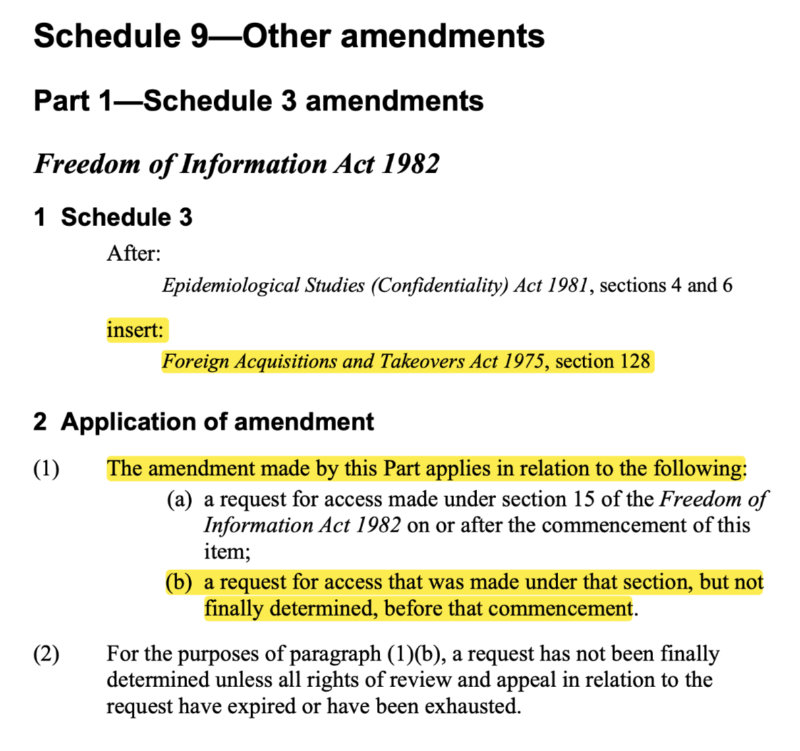
The provisions died when the friendless Amendment Bill was discharged from the Senate notice paper.
Appeal likely
In June 2020 the Productivity Commission released a study into Foreign Investment in Australia. In that review the commission observed:
“When a foreign investment proposal is blocked, the action of the Treasurer is gazetted, but no reasons are provided for the decision. The Treasurer only occasionally issues a press release stating the decision and the reasons for it (usually when an investment proposal has a high profile). And if the Government identifies potential problems with an application and encourages the investor to withdraw, there is no public communication at all.”
The Commission went on to declare, “The lack of public disclosure is at odds with good regulatory practice.” It concluded, “Poor understanding of the decision-making process, particularly the reasons for applications being rejected,
may mean Australia is seen as a difficult country in which to invest.
So, the FOI win is a good thing. But I’m pretty sure Treasury will adopt the Albanese’s Government’s new secrecy tactic – take an FOI winner to the Federal Court and threaten $150,000 in costs if they dare defend their win.
Treasury have been wrong three times on the law around FIRB secrecy. They did not stop at being wrong twice; it’s hard to imagine they’ll stop at being wrong three times.
Odd bedfellows. Pollies weigh in on unfair transparency fight

Rex Patrick is a former Senator for South Australia and, earlier, a submariner in the armed forces. Best known as an anti-corruption and transparency crusader, Rex is also known as the "Transparency Warrior."