


What our Prime Minister, premiers and chief ministers think about gun control is something we ought to know about. But our Prime Minister is shielding those views from public scrutiny. Transparency warrior Rex Patrick reports.
On December 15, 2025, a day after the Bondi terrorist attack, National Cabinet met on the topic of gun control.
The Prime Minister, premiers and chief ministers left the meeting with a strong public commitment to strengthen gun laws. Only Australian citizens would be allowed to hold a gun licence, which would now be granted after checks that drew on nationally shared intelligence – including from the Australian Security Intelligence Organisation.
Those licence holders would be limited on the number and type of firearms they could hold and on the period over which the licence was valid. Finalisation of a National Firearm Register long-promised would be accelerated.
Eleven months later there’s been some progress on implementation, but also departures from the united front presented on the day after the Bondi massacre, particularly around the limit on the number of guns a licence holder can have.
I suspected there would be differences of opinion, and differences of politics and so requested access under Freedom of Information (FOI) laws access to details of what was considered and discussed in National Cabinet on that day.
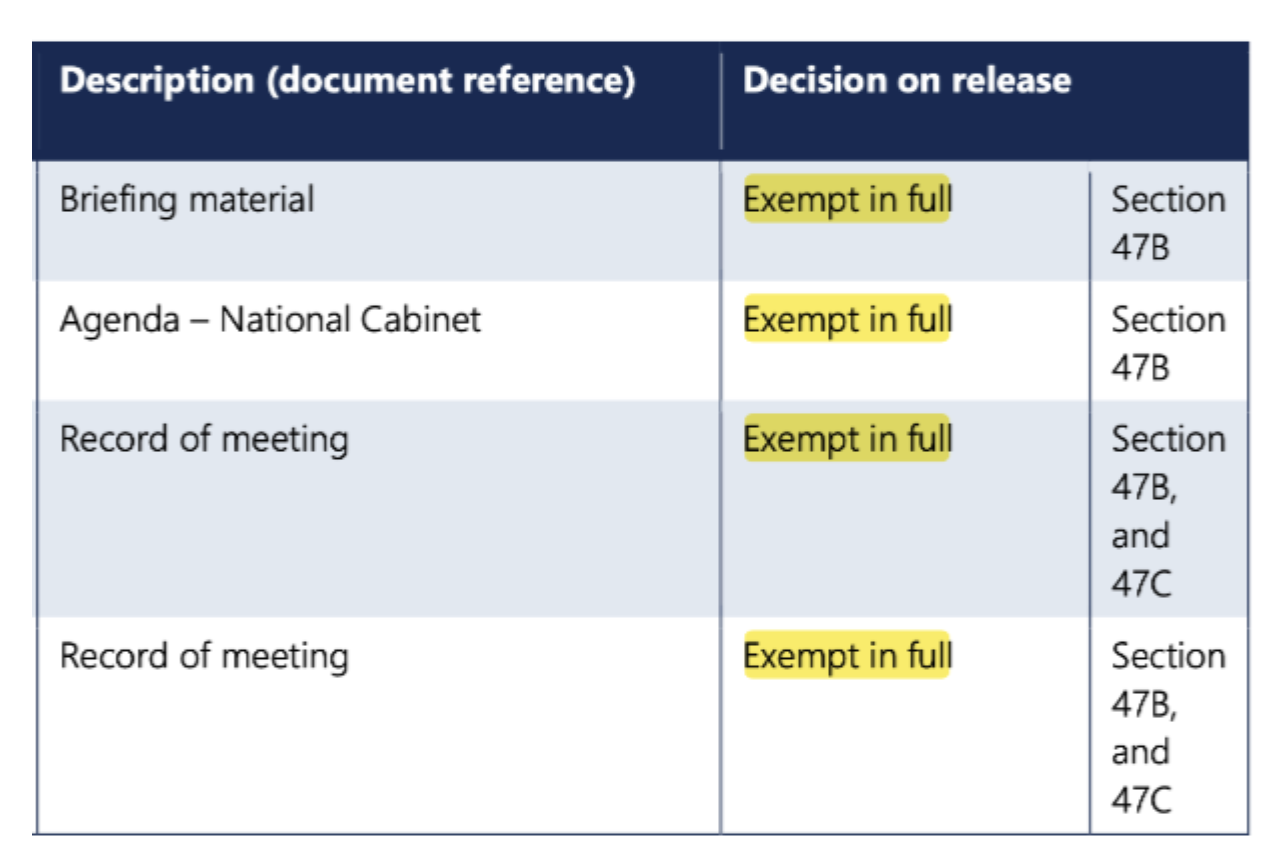
FOI Results (Source: PM&C)
In a flash, the secrecy shutters came down.
Scomo secrecy, a blast from the past
The first ever meeting of National Cabinet was on 29 May 2020. The so-called ‘cabinet’ was formed at the initiative of then Prime Minister Scott Morrison in response to the COVID pandemic. The now defunct Council of Australian Governments (COAG) agreed on 13 March 2020 that National Cabinet would by the future peak intergovernmental forum of the Australian federation.
National Cabinet went on to make some very big decisions that affected the liberties of Australians; whether they could leave their house, whether children could go to school, whether citizens could or could not cross a state border etc.
But the Prime Minister, premiers and chief ministers were making these decisions behind closed doors. Secrecy seemed to be Prime Minister Scott Morrison’s motive for calling the meeting a cabinet. Cabinet deliberations in Australia are by convention secret, and Morrison appears to have thought calling something a ‘cabinet’ would pull a shroud of secrecy over its discussions.
Morrison’s approach contrasted strongly against German Chancellor Angela Merkel’s ‘open response, open recovery’ pandemic approach. Merkel was stressing that public trust, transparent communication, and social cohesion were key to tackling the COVID-19 pandemic effectively.
Judicial override
I was a senator during COVID. I used Freedom of Information laws to challenge the status of, and secrecy of, National Cabinet; and I won.
The challenge took place in the Administrative Appeals Tribunal (now the Administrative Review Tribunal). But it might as well have been in a Court. I had Senior Counsel on my side and Morrison had Queens Council, and the matter was heard by Federal Court Justice White.
Justice White rejected Morrisons claim that National Cabinet was a Cabinet:
“The mere use of the name “National Cabinet” does not, of itself, have the effect of making a group of persons using the name a “committee of the Cabinet”. Nor does the mere labelling of a committee as a “Cabinet committee” have that effect.”, His Honour said.
Justice White examined the character of the National Cabinet to see whether it had a key Cabinet characteristic – collective responsibility and cabinet solidarity.
Collective responsibility and cabinet solidarity is a long standing and integral part of the Cabinet system. It requires that whatever the range of private views put forward by ministers in the Cabinet, once decisions are arrived at and announced they are supported by all ministers.
Is Albo’s ‘Richardson Review’ into Bondi independent or for a roving insider?
It ensures that the Government is collectively accountable and responsible to the Parliament and their electorate.
National Cabinet did not have collective responsibility or cabinet solidarity.
Scott Morrison would walk out of national cabinet and declare that schools would remain open. Victorian Premier Daniel Andrews favoured remote learning while NSW Premier Gladys Berejiklian and WA Premier Mark McGowan kept schools open but encouraged parents to keep children home where possible.
The same lack of solidarity occurred on the issue of state border closures. Morrison wanted the borders opened while McGowen wanted and kept WA borders shut.
Justice White ruled emphatically that National Cabinet was not a cabinet and was therefore not entitled to Cabinet confidentiality.
Precious petals
Morrison’s back up position was a ‘precious petal’ argument. His Department argued:
“I consider the release of National Cabinet deliberations and documents, other than by those formal decisions and announcements by the Prime Minister and members of the National Cabinet, would lead to an apprehension on the part of National Cabinet members and caution in their contribution to discussions.
Such an outcome would in my view prejudice and weaken the ability of the National Cabinet to make decisions to achieve the best outcomes in the national interest.”
This was rejected by Justice White. The doors to National Cabinet were opened for all to see who had what view and why.
And so, it was with great surprise (actually, not really) that Prime Minister Anthony Albanese, that champion of transparency in opposition and secrecy addict in government, rejected my request to see what his and the premier’s and chief minister’s views on gun control are.
He pulled the failed argument of Morrison out of the secrecy playbook arguing (almost identically to that above):
“I consider that disclosure could reasonably be expected to damage Commonwealth–State relations by disrupting or creating difficulty for ongoing discussions, including the development of joint or parallel policy responses.
Disclosure would also be likely to adversely affect the level of trust and cooperation between the Commonwealth, States and Territories, and impair the future flow of confidential information necessary for effective National Cabinet and intergovernmental engagement.”
The views of the Prime Minister, premiers and chief ministers are not to be released to me,
God forbid the voters finding out how our political leaders really think while they can still be held accountable. Truth is they’re all gun shy.
If Albanese has his way those views will remain secret for at least twenty years, by which time the now Prime Minister will be long retired and, health permitting, enjoying life at his cliff top retreat aged 83 or more.
Just like Morrison, Albanese is trying to close the National Cabinet door.
I’m a pretty good predictor of what challenged to secrecy will and won’t succeed. My challenge will succeed because there is incredible public interest in the issue of gun control, and especially the views of the prime minister, premiers and chief ministers.
This is to be contrasted against a political interest of the prime minister, premiers and chief ministers not wanting the people they represent to know their views on the topic.
I’ll win in the end, but with challenges taking four years to get through the Information Commissioner’s review process, my win might be moot. By the time access is granted Albanese might not be the prime minister, and there will likely have been a change of many of the state leaders.
It’s transparency SNAFU.

Rex Patrick is a former Senator for South Australia and, earlier, a submariner in the armed forces. Best known as an anti-corruption and transparency crusader, Rex is also known as the "Transparency Warrior."