


Global consultancy firm KPMG had overlapping roles at Uni of Wollongong in a private-public partnership (PPP) deal that went badly wrong. James Guthrie and Adam Lucas report.
The University of Wollongong’s (UOW) 2014 student accommodation deal was a spectacular governance failure. This $170m deal granted a private consortium an exclusive 39-year license over more than 1,000 beds.
It included a $120 million upfront cash payment to UOW, but flawed revenue guarantees and occupancy models fatally undermined the project, culminating in an early contract termination, leaving university coffers short by at least $220m.
Wollongong Uni. Hundreds of millions paid for exiting dud contract
Central to this debacle was consultant KPMG’s simultaneous involvement as an accounting and advisory firm across overlapping entities and partnerships.
By acting both as external auditor to the private developer, sell-side transaction advisor to the equity investors, and internal auditor to UOW, while embedding KPMG partners on UOW’s governing board, KPMG again demonstrated
its penchant for engaging in institutionalised conflicts of interest.
This closed circuit compromised independent oversight, insulated senior management, and directly contributed to operating activities that led to financial insecurity and hundreds of job losses across UOW.
KPMG roles overlap
Evidence presented to the NSW Parliamentary Inquiry into University Governance and ICAC Operation Scandi in 2026 highlights that distinct KPMG partnerships operated simultaneously on every side of the transaction across multiple corporate entities:
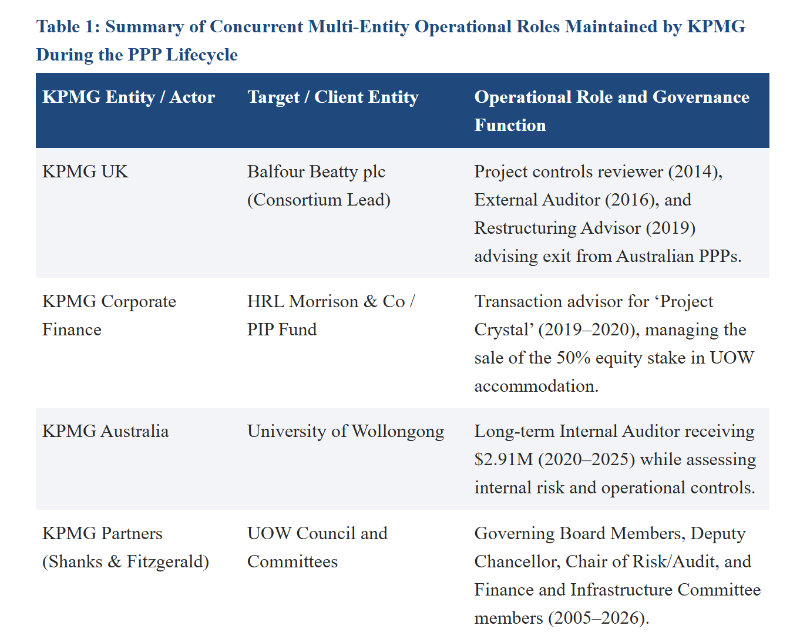
KPMG UK:
Reviewer, External Auditor, and Restructuring Advisor to Balfour Beatty.
Balfour Beatty plc (UK) led the L+LP consortium with a 50% equity stake. After conducting project control reviews in 2014–2015, KPMG UK became Balfour Beatty’s external auditor in 2016. In 2019, KPMG UK conducted a financial review exposing debt-concealment practices and advised Balfour Beatty to ditch its Australian projects and exit risky overseas concessions, leaving the consortium in disarray and triggering UOW’s buyout.
KPMG Corporate Finance:
Transaction Advisory for Morrison & Co’s PIP Fund.
In July 2019, HRL Morrison & Co (NZ), which was managing the PIP Fund’s 50% equity stake, retained KPMG Corporate Finance for ‘Project Crystal’ to manage the sale of its social infrastructure assets. Throughout 2019 and 2020, while UOW navigated financial distress and attempted to buy out the failing PPP, KPMG Corporate Finance actively advised the private equity seller on extracting maximum value from the buyout.
KPMG Australia:
Internal Auditor and Embedded Council Board Representation
At the same time, KPMG Australia served as UOW’s internal auditor, collecting $3m between 2020 and 2025 alone. This commercial engagement coincided with KPMG partners sitting on the UOW Council for over 22 consecutive years (2005–2026). Two senior KPMG partners chaired the Risk, Audit, Finance, and Infrastructure Committees, which oversaw the university’s financial accounts and PPPs.
Governance failures
The PPP’s governance structure had severe financial consequences.
Under the 2014 deed, UOW had to pay Contingent Financial Support (CFS) whenever student occupancy fell below base-case projections, effectively guaranteeing private investors 85% of commercial revenues. Between 2018 and 2020, UOW paid the consortium $32m in direct student CFS subsidies. Facing ongoing annual liability estimates exceeding $8m, UOW exercised early termination in January 2021 for unknown reasons.
The total exit payment required to extinguish the 39-year contract reached $442.6m ($116m equity buyout, $215m senior debt payout, $110m swap break costs, and $0.8m cancellation and other costs). To fund this outflow, UOW issued $350m in new long-term debt notes specifically for the loan buyout, causing total borrowings to surge from $175m in 2017 to over $724min 2020.
Annual interest servicing costs rose to $30m in 2022, diverting crucial operating funds from teaching and research, the university’s core activities.
Despite the scale of this buyout, financial reporting irregularities occurred under the oversight of Council committees containing a KPMG partner.
In 2021, the NSW Auditor-General issued a high-risk finding against UOW for a $169m prior-period accounting error in which 2020 accounts improperly omitted termination liabilities. When questioned under oath during the 2025 NSW Parliamentary Inquiry regarding this error, KPMG partner Warwick Shanks, a professional audit partner sitting on the Finance and Infrastructure Committee, claimed amnesia, stating:
I do not recall the situation. I know that surprises you because it is a big number.
Attracting regulatory scrutiny
The NSW Parliamentary Inquiry into University Governance and ICAC Operation Scandi highlights the dangers of managerial ring-fencing of accounting information and consulting-firm capture in public higher education.
When commercial consulting firms embed senior executives on governing boards and university administrations while earning millions in advisory, audit, and restructuring fees,
they compromise public accountability.
To protect public statutory authorities from similar debacles, structural policy reforms are urgently required.
State governments must enact legislative prohibitions that prevent serving university council members from holding material partnerships or financial interests in commercial consulting firms the university engages.
Furthermore, statutory rules should ban public universities from utilising non-statutory or ‘adjusted’ financial metrics to justify workforce restructuring and sackings. Reestablishing democratic governance with genuine staff and student representation remains a necessary antidote to corporate financialisation in Australia’s public universities.
“Battle for the soul”. KPMG whistleblower’s court win threatens Big 4 super-perk

James Guthrie AM is Emeritus Professor in the Department of Accounting and Corporate Governance at Macquarie University. He is the joint founding editor of the Accounting, Auditing and Accountability Journal, which has been consistently ranked in the top five journals in his field.

Adam Lucas is an honorary senior fellow at the University of Wollongong and a founding member of Academics for Public Universities and Public Universities Australia. Prior to working at UOW, he was a researcher and policy analyst in the NSW Cabinet Office and the Departments of State and Regional Development, Aboriginal Affairs and Housing.