
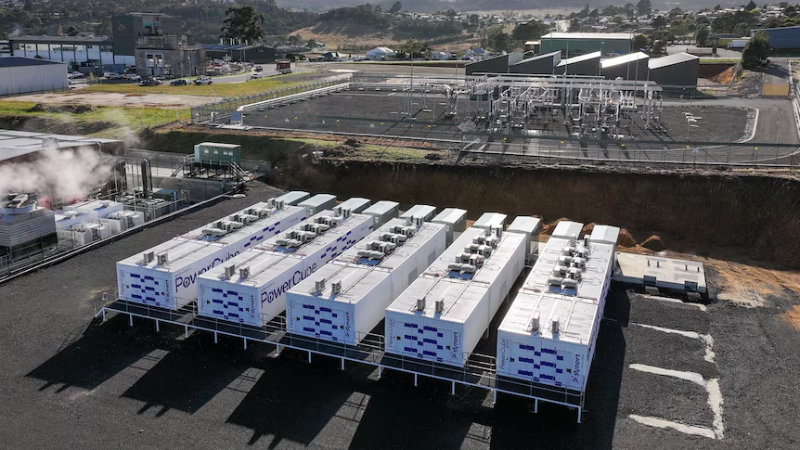
Investors baulked at the valuation of aspiring AI data centre darling Firmus, while other data centre builds are facing grassroots opposition. Claudia Weisenberger asks, how much will AI cost us?
After months of hyped up expectation, Firmus Technologies pulled its planned $44B float from the ASX as potential investors questioned the extreme valuations of an unproven company with $50m revenue.
Meanwhile, in Lane Cove, Sydney, a community of 374 residents stopped a $1.2B AI data centre being built within metres of their homes. Owner Goodman Group (ASX: GMG) had to withdraw from the project.
The residents won, but Goodman will build in another suburb. And the five questions nobody in government is asking remain unanswered: what are these facilities really for, who is paying for them, who profits, who is accountable, and what happens when the systems inside them cause harm?
AI data centres
The data centre term conjures up images of rows of hard drives storing your holiday photos and business records. But what Firmus, Goodman et al. are building is not just digital warehouses, but AI processing centres.
These are the engine rooms of systems that determine who receives welfare payments, whose disability funding is cut, whose phone is searched at the border or at a routine roadside police check.
Calling them data centres is like calling a nuclear reactor a warm water facility.
The NBN has cost Australian taxpayers $51B and counting. It was sold as faster internet and it also built the fibre backbone that helps every one of these AI processing centres be commercially viable. Australians paid for the foundation. Private companies are building empires on it.
The Australian Government’s own document, released on 23 March 2026, confirms more than 250 of these facilities are currently operating in Australia, with a further 225 in the development pipeline, according to the Australian Energy Market Operator.
By 2030, they are projected to
consume 13% of all grid-supplied power in the National Electricity Market.
Globally, the nine leading cloud providers are on track to spend $US830B on AI processing infrastructure in 2026 alone — a 79% increase on the previous year. Moody’s projects $US3 trillion in global spending over the next five years.
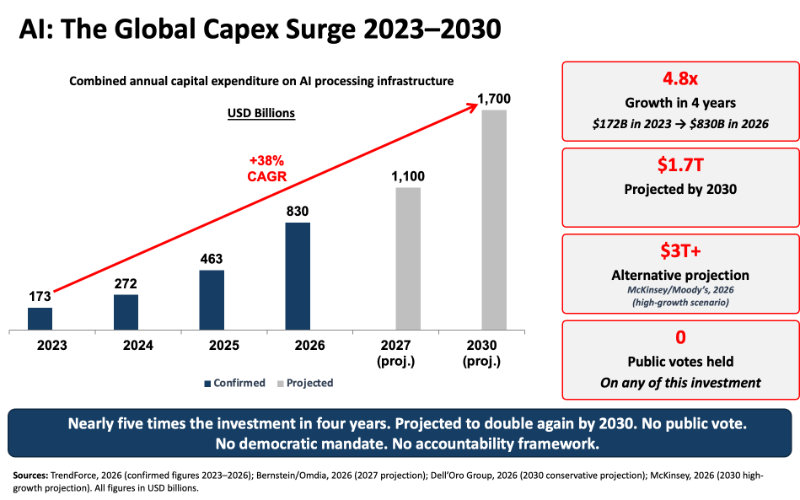
Much of the growth is debt-financed, with Morgan Stanley projecting global AI-related bond issuance will reach $US570B in 2026. Firmus alone planned to borrow $45B to complete its data centre builds.
Microsoft has committed $25B to expand AI processing capacity in Australia by 2029, but has not yet specified where the new facilities will be built. Amazon has separately committed $US20B to Australian AI infrastructure by 2029.
The scale and the cost
The billionaires building this infrastructure capture the returns, and the scale of these companies is eye-watering. Amazon’s AWS operating income reached $US39.8B in the first half of 2026. Households absorb the costs in rising energy prices, in water scarcity, in higher interest rates, and in the price of everything else.
Much of the infrastructure is public in its costs and private in its returns, including the water these massive data centres need to cool down, which is particularly of concern in one of the driest countries on earth.
A single large AI processing centre can consume up to five million litres of water per day for cooling, six times the daily water use of Sydney’s Olympic Park. Some larger facilities consume up to 40 million litres per day, equivalent to 80,000 households. Sydney Water projects that
data centres could consume up to 25% of Sydney’s drinking water by 2035.
No Australian law requires a data centre to disclose how much water it uses. The federal government’s March 2026 document sets out voluntary expectations only; they are not enforceable requirements.
No national water accounting framework exists for data centres, and there is no requirement to disclose daily consumption.
And then there is the energy cost. By one estimate, global data centres consume more electricity than all of Japan, a country of 125 million.
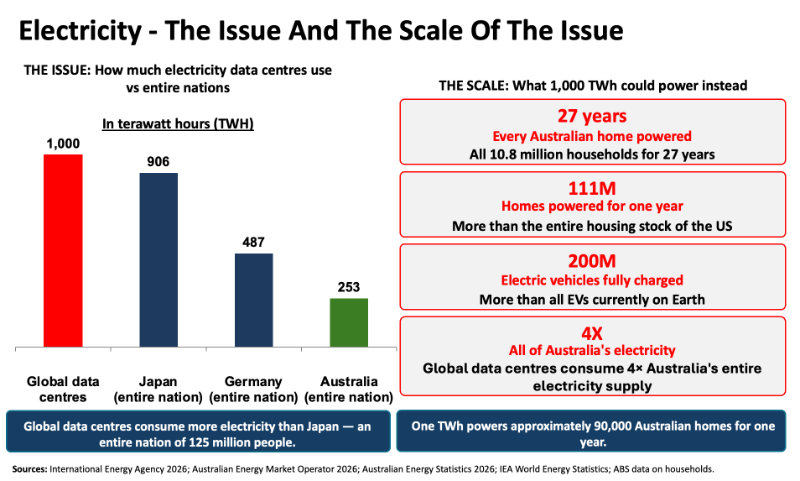
Without significant new renewable generation, data centres could push NSW power prices 26% higher by 2035, according to the Climate Council. The data centres need uninterrupted power at a scale that wind and solar cannot yet match, and there are fears the current boom will accelerate new coal and gas generation.
What will these centres do?
AI systems are trained on the sum total of human-generated data — our knowledge, creativity and compassion, but also our biases, our cruelties and our capacity for self-deception. They do not distinguish between wisdom, prejudice, hatred and greed. They inherit all of humanity’s traits and reproduce them at hyper-digital speed.
In Australia, the consequences are already visible. An algorithm determines NDIS funding for 800,000 people with disability without clinical review. Every AI processing centre approved in Australia is another node in a network that is becoming, without a single democratic vote, the backbone of the state.
The technology companies promise medical breakthroughs and shared prosperity. The same infrastructure processes your financial transactions, welfare payments and personal health records without your knowledge, while the AI systems inside it are already displacing the jobs of the people whose data it collects.
When AI causes harm
Under current Australian law, there is no liability framework for AI-caused harm. If an algorithm wrongly cuts disability funding, who is responsible? If a corrupt AI agent accesses government health records and takes three months to say so, what are the consequences? And when a rogue AI agent gains access to Medicare data, who do we call?
The answer, under current Australian law, is nobody. Parliament has yet to properly legislate enforceable protections.
The Lane Cove community stopped one facility. Goodman Group will build elsewhere. Firmus will survive for now, albeit at a lower valuation. The hundreds of planned data centres will still be built, and many remain uncontested. In New South Wales, a data centre can receive planning approval in 75 days,
significantly less than getting approval for a home extension.
The regulatory framework meant to govern this infrastructure has not kept pace. The Federal Government is expected to introduce regulation next year. New South Wales has issued guidelines. Both arrived after the 250th facility was already approved.

Claudia Weisenberger is a management consultant with deep experience in pharmaceuticals, hospital transformations, and strategic due diligence across four continents. She combines sharp analysis with hands-on execution.