
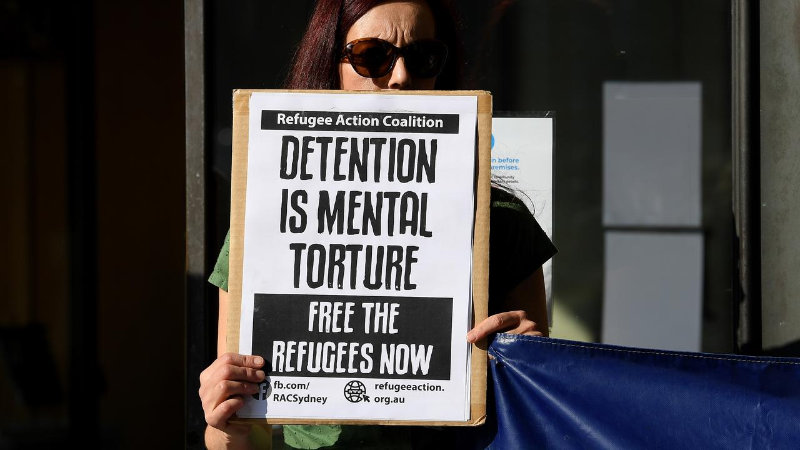
After almost three decades of running Australia’s detention centres, private contractors keep falling short, adding to the plight of refugees.
Since US prison and ICE contractor Secure Journeys announced grand intentions on winning the Australian immigration detention contract in 2024, its failures have been well-documented. Long-term detainees say it’s not much different to Serco, just more corners cut.
While media focus has been on escapes, drugs, suicide and staffing pressures, the issues are systemic. Self-harm, people missing necessary care due to lack of staff, medical records misplaced, staff assigned specialist duties without adequate training, and unclear reporting lines for matters requiring escalation.
These are findings of the Commonwealth Ombudsman’s March 2026 report on the change of detention providers. They go directly to the capacity of a company awarded a five-year contract worth $2.3B to deliver the services for which it is paid.
Add the separate five-year health services contract of $866,295,100, and it comes to about
$3.21B to support the detention of around 1000 people.
(Not so) Secure Journeys
The consequences reach beyond security failures and escapes. People in closed detention depend on Secure Journeys for movement within a centre, to hospital and access to clinical services provided under a separate contract. Human rights lawyer Alison Battisson told MWM, “When those arrangements fail, a medical service can exist on paper while people give up engaging because it doesn’t work in practice.”
One man at Melbourne Immigration Detention Centre describes a recent failure to obtain emergency help. After months of chronic illness, he began to experience pain in the afternoon, which escalated overnight, when medical services are limited to a nurse on call.
At 5 am the next morning, he urgently requested an ambulance. He says he was told to wait until the shift changed at 6.30 am. The ambulance wasn’t called till 7 am.
His account describes friends carrying him to meet the ambulance because he was told by staff to walk but wasn’t able.
What clinical assessment justified the delay, and why didn’t staff help?
At the same centre, a man with stomach cancer remains detained while his family is desperately seeking help. His daughter Olivia’s Change.org petition in February 2026 described his dependence on nutritional shakes (due being unable to tolerate solid food) and an uncertain timetable for further cancer treatment.
He has signed to return to his country of birth, but as this is unlikely to be viable as his health deteriorates, his continued detention requires explanation. The government describes immigration detention as a measure of last resort, but in this case it is both unnecessary and harmful.
According to Battisson, “A family campaigning from outside cannot control appointments, medication or transport while the state controls access to all three.”
Secure Journeys is responsible for detention operations, including escorts and transport. Healthcare Australia provides clinical services, medication management and specialist referral pathways. Home Affairs commissions both; the Australian Border Force oversees detention operations.
The human face behind Australia’s inhumane treatment of refugees
Poor coordination
The division of contracts makes coordination an essential part of the service. A referral cannot deliver treatment without an escort, and follow-up care is impossible if a hospital discharge plan is not available or followed.
For many, medical care is impossible unless they agree to be handcuffed, despite immigration detention being administrative – recent litigation shed light on the damage of this practice, but little has changed.
Secure Journeys’ published contract requires expert skill and care, cooperation with other providers and information sharing. It expressly says another provider’s acts or omissions do not relieve the company of responsibility for its own services. The obligation to work together is already there, but
detainees report constant failures, leaving them to support each other.
The Ombudsman’s findings do not identify the cause of every individual incident, but the chronic failures point to a need to examine the operating model.
An officer who cannot assess a medical emergency needs immediate access to someone who can, and authority to act on that advice. An understaffed shift needs an escalation process that works in real time. Moving a seriously unwell person to another team or another shift cannot discharge the responsibility to respond.
Shifting the burden
When the system isn’t working, individuals, public hospitals, families and fellow detainees bear the consequences.
The ABC reported in September that Secure Journeys’ contract did not require specific staffing levels. That does not excuse inadequate staffing; it places greater weight on whether government can verify and enforce the promised outcomes.
Home Affairs’ annual report records that the new detention and healthcare contracts began with base periods during which performance management frameworks, including abatement and incentive regimes, did not apply. People remained dependent on the services while providers established their systems. Government designed those arrangements and must account for their consequences.
Secure Journeys and Home Affairs claim they’re addressing concerns, but general assurances don’t resolve the real harm caused by avoidable failings, including poorly trained and disgruntled staff.
From bad to worse and back again?
Two years into the Secure Journeys contract, there’s already talk of a change. Serco has been discussed as a possible replacement, which would ignore the consistent failings over 15 years (2009-24). The failings in the transition between contracts are also well-documented.
Responding to valid and long-term criticism with another shuffle of the deck chairs would let the government
treat a systemic failure as a procurement problem.
Immigration detention was privatised in 1997, and the failures have been rigorously documented ever since. What would it take for another tender to resolve failures to assess service capacity, enforce obligations and respond to evidence of harm?
The deep scars of detention
There is a further limit to any contract remedy. Amnesty and the Human Rights Commission have documented the psychological harm of prolonged, uncertain detention. The Refugee Council of Australia has documented barriers to outside advocacy; the Human Rights Law Centre has joined calls for effective independent review. Mental health treatment remains necessary, but its provision
cannot excuse maintaining conditions that cause or aggravate illness.
While the detention system is increasingly populated by people who have been through the justice system, their past convictions and served sentences do not eliminate a duty of care. Neither clinical standards nor contractual obligations are a matter of political capital or public sympathy.
“For anyone approaching the end of life, alternatives to detention including palliative care with family access and dignity in dying must be assessed,” Battisson told us.
There needs to be accountability across the board, including Secure Journeys and Health Care Australia for their performance, but also for the Department of Home Affairs commissioning and overseeing that performance; and for continuing to detain seriously ill people.
Restoring Serco would ignore its long record of failures and leave decades of questions about detention unanswered. (MWM first wrote about Serco in 2015.)
Editor’s note: The source for this article wishes to remain anonymous but is known to MWM.
Nowhere to go. Refugees stranded in Indonesia while the world looks away.

Kim Wingerei is a businessman turned writer and commentator. He is passionate about free speech, human rights, democracy and the politics of change. Originally from Norway, Kim first came to Australia in 1989. Author of ‘Why Democracy is Broken – A Blueprint for Change’.