
So far this year, 52 women and 21 children have died from domestic violence in Australia, an epidemic that cannot be stopped by words alone. Andrew Brown with the fifth in a series.
In August 2024, Anthony Albanese declared a national emergency on violence against women. He convened National Cabinet for it, which prime ministers do not do for issues they intend to leave alone, and he told the cameras afterwards that women dying was a crisis demanding action.
By the end of that year, 106 Australian women were dead.
The figure for 2023 had been 74, and for 2022 it was 56. Last year it was 79, and so far this year it is 52. Those numbers come from Sherele Moody’s Australian Femicide Watch, because no Commonwealth department keeps a count.
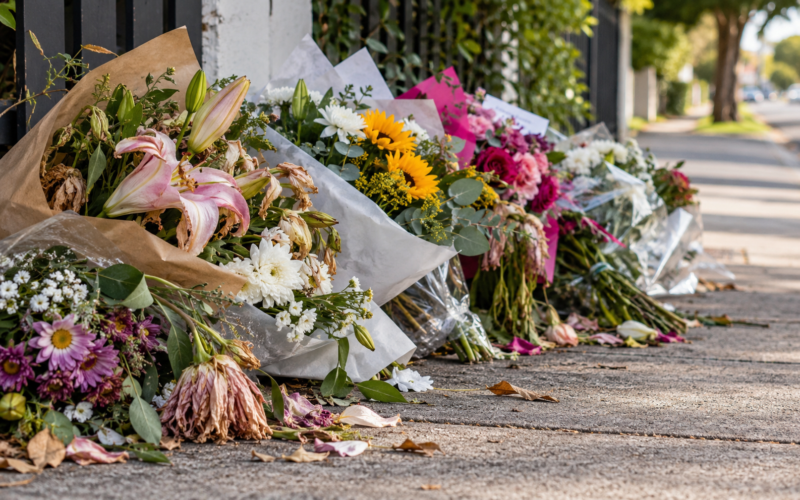
The ritual that follows each death is by now familiar. Flowers appear on a suburban footpath under a photograph that was taken at a barbecue or a wedding. A minister finds a microphone. There is a candlelight vigil, sometimes a march. And then, almost before the flowers have gone brown, the conversation turns back toward women: how women can stay safer, how they can leave earlier, how they might read the warning signs sooner, how they should get through the systems that were supposed to protect them.
Australia has become fluent in women’s survival strategies, but
has very little to say about the men.
The men we make
Tom Meagher noticed this more than a decade ago. His wife Jill was raped and murdered in Melbourne suburb Brunswick in September 2012 by Adrian Bayley, a man on parole with a long record of sexual violence that the system had chosen not to act on.
Meagher wrote about it in The Danger of the Monster Myth. The argument was that if we treat men like Bayley as monsters, as freak events, we let everything around them off the hook. The violence becomes inexplicable, and things that are inexplicable cannot be prevented. They can only be mourned.
It is hard to find evidence, all these years later, that anyone in government read it.
Rowan Baxter doused Hannah Clarke and their three children in petrol in a Brisbane suburb in February 2020 and set them alight. Paul Thijssen beat Lilie James to death with a hammer in a Sydney school bathroom in October 2023. A 28-year-old man is charged with murdering Molly Ticehurst in Forbes in April 2024 while on bail for raping her.
None of these men was a monster in the way the word is usually meant. They had jobs. They had mates. They had reputations that the people around them trusted, and their behaviour in the months and years before the killings was visible to nearly everyone in their lives.
The killings did not come out of nowhere.
They were where the pattern had been heading.
Coercive control
After Hannah Clarke’s death, her parents, Sue and Lloyd Clarke, spent four years pressing Queensland to recognise what their daughter had lived inside. The result was Hannah’s Law, in force since May 2025, which criminalised the pattern Baxter had built around her over years.
He tracked her location. He controlled her money and chose her clothes, cut her off from her friends, demanded her passwords and punished what he took to be defiance. Lloyd Clarke has since described every one of those behaviours in public, and every one of them was read at the time as protectiveness, or intensity, or devotion.
Coercive control, financial abuse. How domestic violence begins
This is not an unusual pattern. It is what the coronial files describe in most intimate partner homicides in this country. The men who produce it are not aberrations, and the conditions that make them are not mysterious either.
They are simply uncomfortable to discuss.
Boys’ permitted emotions
Most Australian boys are still raised with a very short list of permitted emotions. Anger is on it. A certain kind of jokey affection is on it, if the boy is lucky. Sadness is not. Fear is regarded as something girls feel. Vulnerability gets ridiculed by other boys long before it gets sympathy from anyone, and by fifteen most boys have learned that emotional pain is something to hide, drink through, joke away or convert into something more socially acceptable, which usually means rage.
Into that culture, over the past five or six years, has come the phone.
Dr Stephanie Wescott and Professor Steven Roberts at Monash University have been interviewing teachers about what they see in classrooms. Their research, published in 2024, describes boys in primary school refusing to be taught by women. Animal noises made at female students. Andrew Tate cited in Year 9 essays as the greatest of all time.
Women teachers are leaving the profession because the harassment has become something they can no longer absorb. The behaviour Wescott’s interviewees describe is more pervasive, more perverse, more targeted and more brazen than anything teachers were reporting five years earlier.
Polling reported in March put the share of Australian teenage boys who agree that women lie about domestic and sexual violence at around 40%. At that size it is no longer useful to call it a fringe.
Those boys are the men in the police statements of the 2030s.
What the manfluencers offer is a story about who these boys are and who has taken something from them. It is poisonous, but it is coherent, and it is delivered every day with total confidence to small screens everywhere. The story Australian parents, schools and politicians offer in reply has none of those qualities.
Where is the funding?
None of this is a mystery to the people who work in the field. What works is known. What is missing is money.
Men’s Behaviour Change Programs exist in every state and are the only intervention for adult perpetrators with an evidence base behind them. They are chronically underfunded. Most jurisdictions run waiting lists.
The workforce cannot be recruited fast enough because the pay is poor and the work is gruelling, and No to Violence, the national peak body, has spent years asking for the funding to clear the queues. It has not come.
The Respectful Relationships curriculum, the only national framework for teaching boys about consent and emotional regulation inside schools, has been gutted or quietly shelved by conservative state governments who regard it as ideological provocation rather than violence prevention.
Where is the legislation?
Coercive control is a standalone criminal offence in two states. New South Wales legislated it from July 2024, and Queensland followed in May 2025. South Australia passed its law last year and then set commencement two years into the future. Victoria, which likes to describe itself as the national leader on family violence after the Royal Commission Daniel Andrews called and Jacinta Allan inherited, put a Bill up in 2025 and let it stall. Western Australia is taking what it calls a phased approach. The Territory and Tasmania rely on older and broader family violence laws.
The Men’s Project at Jesuit Social Services has been working with boys and men since 1977. Its model has evidence behind it. Its reach is limited entirely by funding.
Sherele Moody is now petitioning the federal government for a Royal Commission into the killing of Australian women and girls. More than 1300 have been killed since the year 2000.
There has never been a national examination of why.
The federal budget is more than $800B a year. The government found room in it for tax cuts at the top end. It has not found room to clear the men’s behaviour change waiting lists. That is a decision about priorities. It has never been a shortage of money.
Real change is possible
So what would it actually take? It would take the country giving up the pretence that male violence is mysterious, when the pattern is documented, replicated, predictable and observable from about kindergarten.
It would take treating prevention as a men’s issue,
since women already know.
It would take funding the programs that change male behaviour at scale, making coercive control a national offence rather than one that exists in two states, restoring the Respectful Relationships curriculum and protecting it from political vandalism, and regulating the manfluencer platforms with the seriousness Australia once brought to tobacco.
It would take giving the women who run this country’s only national death toll a permanent budget line. And it would take giving Sherele Moody the Royal Commission she has spent ten years earning the right to ask for.
It would also take ministers not going to the same microphone every February to perform sorrow about a crisis they had every authority, and no will, to prevent.
Australia keeps asking why women stay. The harder question is why this country keeps protecting the conditions that produce the men they cannot safely leave.
Until that changes, the flowers will keep appearing on the footpaths.
Dead certain. The ledger showing how Australia fails its women

Andrew Brown is a Sydney businessman in the health products sector, former Deputy Mayor of Mosman and Palestine peace activist