

A rash of European countries have cut contracts with surveillance group Palantir. Australia has had no inquiry, nor explained the risks. Claudia Weisenberger reports.
In April 2026, Palantir posted a 22-point manifesto on Elon Musk’s X platform. It drew from CEO Alex Karp’s book ‘The Technological Republic’ — that had triggered an immediate international backlash.
Within ten weeks, five European countries had moved against Palantir contracts.
The UK’s Parliamentary Science Committee called the company’s presence ‘an unacceptable point of weakness’. France, the Netherlands, Spain, Denmark and Germany’s military all moved to reduce or refuse business with Palantir.
Switzerland had already been refusing for years.
Australia did none of this. No review. No audit.
No parliamentary question. No ethics assessments. And nobody has been required to explain why.
The manifesto called for the ‘rearmament’ of Germany and Japan and declared that some cultures are ‘dysfunctional and regressive’. It was posted by Alex Karp, CEO of Palantir — a company that has held contracts with Australian government agencies since 2012, holds top-secret security clearance, and has never been asked to explain its ideology to an Australian parliamentary committee.
The Karp Doctrine
Five countries moved against Palantir within ten weeks. Australia did not respond.
Karp has since defined ‘enemies’ to include not just foreign adversaries but critics of US defence and surveillance policy at home — protesters, academics and civil society organisations critical of Palantir’s work with ICE and the military.
Karp’s co-founder Peter Thiel has gone further, funding litigation that destroyed a media outlet critical of his interests. The company that builds the surveillance infrastructure also decides who it is pointed at.
In Australia, nobody has asked Palantir which cultures it considers dysfunctional, which Australians it considers enemies, or whether those definitions influence how its systems operate inside Australian government agencies.
The Palantir strategy
Palantir Technologies was founded in 2003 with CIA seed funding. Its strategy — described by campaigners as ‘land and expand’ — is consistent: enter through a government’s defence or health sector, demonstrate value, expand across agencies, make exit prohibitively expensive.
In the United Kingdom, Palantir landed in the NHS during COVID in 2020. By 2026 it had expanded to police, the military, the financial regulator and more than 34 state contracts worth at least £900 million.
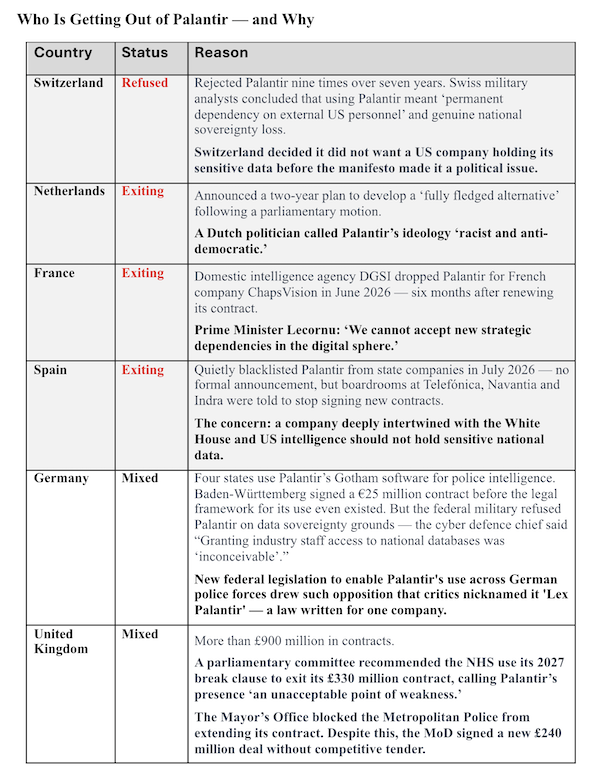 In every country that has examined its Palantir relationship, the same concerns emerged: data sovereignty, foreign legal jurisdiction, vendor lock-in, and the question of what a US company subject to US law can be compelled to hand over.
The response has been consistent too. Build sovereign systems.
France is building Arcadia, a national battlefield AI system designed to replace Palantir’s platforms. Germany is backing Helsing, a Munich-based defence AI company. Both are investing in sovereign alternatives — reducing dependency on a single US vendor and building national capability that cannot be compelled by a foreign court.
Cellebrite also under the scope
Cellebrite, the Israeli phone extraction company, now holds contracts with more than 60,000 agencies in 150 countries. Both companies market themselves as tools for justice. The question of what oversight exists is being asked by governments and parliaments everywhere.
In Australia, it has not been asked by either.
Cellebrite’s technology has been used to target journalists, activists and political opponents in Serbia, Bangladesh, Myanmar and Hong Kong.
In each case, Cellebrite withdrew — not because governments banned them, but because exposure made the relationship untenable. In Australia, the same company holds 128 active federal government contracts worth more than $15 million.
No parliamentary committee has examined it. No minister has been required to explain it.
What ‘Hosted in Australia’ actually means
Switzerland refused Palantir on sovereignty grounds. France dropped it six months after renewing its contract. Spain blacklisted it through boardrooms. Germany’s military said granting Palantir access to national databases was inconceivable. Each of these governments looked at its Palantir relationship and found reasons to act. Not one Australian minister has been required to explain why Australia has not looked at all.
Palantir assures Australian agencies that their data is hosted on Australian servers. It is. But the US CLOUD Act gives American authorities the power to compel any US company to hand over data stored anywhere in the world.
Palantir is incorporated in Delaware, United States. The server location does not matter. For Australians whose health records, financial transactions and disability information sit inside Palantir-connected systems, this means a US court could compel access to their most sensitive personal data — without their knowledge, without their consent, and without any Australian minister ever having been required to acknowledge that risk exists.
Palantir staff are now embedded inside the Department of Defence, AUSTRAC, the Australian Criminal Intelligence Commission and the Australian Signals Directorate.
Services Australia — which co-leads the Fraud Fusion Taskforce — has held its own discussions with Palantir about implementing its platforms. The UK has learned what exit actually costs — a separate NHS department paid Palantir £25 million specifically to manage a transition away from its systems.
Australia has never asked what leaving would cost. It has never been required to.
Customer. Shareholder. Bystander.
The Future Fund is Australia’s sovereign wealth fund — a government-owned body managing more than $289 billion on behalf of Australian taxpayers. Nobody in Australia chose to invest in Palantir. When Palantir joined the S&P 500 in September 2024, the Future Fund’s passive index managers were required to buy shares automatically.
The Australian government became a Palantir shareholder by default. It now holds $103.6 million worth of stock. The company is intimately linked to war crimes.
When Senator David Pocock asked the Future Fund to divest, it declined.
For Australian taxpayers, the picture is this: your government pays Palantir to handle your most sensitive data. Your sovereign wealth fund profits when those contracts generate revenue that grows Palantir’s share price.
The more the Australian government buys, the more the fund grows. You are simultaneously the subject of the surveillance and a shareholder in the company conducting it. Nobody has explained this conflict of interest. Nobody has been asked to.
Senator Shoebridge has called for a full audit and an exit plan. Neither major party has taken it up.
Australia is consulting on new privacy protections that would require organisations to prove their data handling is ‘fair and reasonable.’ The consultation closes 18 September 2026. None of the proposed reforms address the governance framework governing the Fraud Fusion Taskforce, the vendors processing participant data, or the consent notices that don’t mention Palantir.
Switzerland looked. France looked. The Netherlands looked. Germany looked. Every one of them found something worth acting on.
Australia has not looked. Not because there is nothing to find. Because nobody in power has chosen to look.
The ministers who signed the contracts chose not to ask. The parliament that passed the Bill chose not to investigate. The two major parties that ignored Senator Shoebridge’s call for a full audit chose not to answer.
That is not an oversight. It is a decision. The Albanese Government has not explained it. It has not been required to.

Claudia Weisenberger is a management consultant with deep experience in pharmaceuticals, hospital transformations, and strategic due diligence across four continents. She combines sharp analysis with hands-on execution.