
Real wages are down, and the RBA is afraid to change that. Recovery may be unachievable unless real wages grow or profits and wages are redistributed. Economist Greg Jericho explains.
Prior to the pandemic, governments drove the decline in nominal and real wage growth through public sector wage caps of no more than 2.5% annual growth. Such caps demonstrated the strong role the public sector plays in setting the overall level of wage growth across the entire economy, including the private sector.
While in the decade before the pandemic and the inflation surge of 2022 and 2023, the public sector depressed wage growth, now the public sector can lead the way by providing a guide to stronger wages.
Meanwhile, the RBA seems to be obsessed with keeping wages down.
The fall of real wages
Over the 25 years prior to the inflation rise in 2022 and 2023, Australian real wages rose steadily, if at differing rates. During the mining boom of the mid 2000s, real wages rose annually at an average of nearly 1%. By contrast, in the seven years prior to the COVID pandemic in 2020, the average annual growth was a much more pedestrian 0.35%.
Yet the growth persisted. Even as nominal wage growth in the 2010s fell to a record low of 1.8%, real wages continued to rise. In March 2021, the value of real wages had risen 5.8% in the preceding 11 years. And then in the next two years,
the entirety of those gains was wiped out.
In other words, in March 2023, the value of real wages was essentially the same they were 13 years earlier.
By June 2026, the level of real wages has risen a mere 1% since March 2023 – slower than even the pre-pandemic period. The path ahead, as suggested by the forecasts in the Reserve Bank’s August Statement of Monetary Policy reveal no sign of a quick return to 2021 levels, let alone a return to the pre-pandemic path.
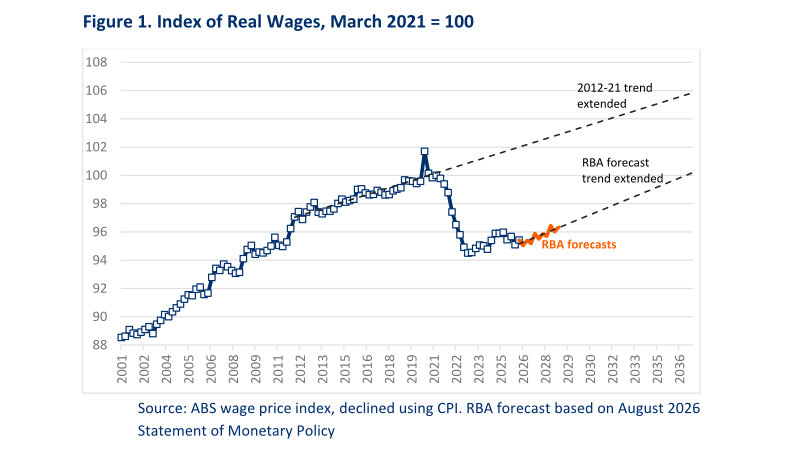
Should the trend of the Reserve Bank’s forecast out to 2028 continue, it would take until 2037 to recover the losses accrued from 2021 to 2023.
Reserve Bank barrier
While the slow recovery the Reserve Bank predicted is possible, any effort to hasten the return to March 2021 levels, let alone back to the trend path of the pre-pandemic period, may very well be limited by the Reserve Bank itself. This is because the Reserve Bank appears determined to limit both wage growth and wage growth expectations to avoid a “wage-price spiral”.
In May this year, during her post-decision media conference, the Governor of the Reserve Bank, Michele Bullock, told reporters that one reason the Reserve Bank had chosen to raise the cash rate for the third straight meeting was that “with a tight labour market it’s possible that … you will end up with higher wage increases and that will feed through into businesses and businesses think, well, that’s now the norm.
“That’s the inflation worry that – inflation expectations worry that I have. I’m not saying that’s happening. But that is a risk.”
The governor argued this during a quarter in which nominal private-sector wages rose just 0.7% – the slowest quarterly growth for four and a half years, and in which real annual private-sector wages fell 0.8%. And yet despite such woeful wage growth, the head of Australia’s central bank was still concerned that some time in the near future wage expectations would make workers feel confident enough to bargain for real annual wage growth of more than 1% and thus
decided a rate rise was required to dampen expectations.
Under such circumstances, it appears unlikely that monetary policy will allow real wages to grow at the rate which would put worker salaries back on the trend path of 2010-2020, and employers will use the views of the Reserve Bank when holding fast against calls from unions and employees for stronger wage growth.
The role of profits
The cruelty of this situation is that, as The Australia Institute research at the time noted, the overarching cause of the rise in inflation in 2022 and 2023 and thus the fall in real wages was a rise in profits.
The research, which disaggregated the national accounts, was confirmed by the OECD despite strong criticism by the Reserve Bank. Importantly, the research contradicted the arguments of the Reserve Bank at the time that interest rates needed to rise to curb wage growth.
When the Reserve Bank first increased the cash rate in May 2020, the Governor’s statement noted “the Bank’s business liaison suggests that wage growth has been picking up. In a tight labour market, an increasing number of firms are paying higher wages to attract and retain staff, especially in an environment where the cost of living is rising.
While aggregate wage growth was subdued during 2021 and no higher than it was prior to the pandemic, the more timely evidence from liaison and business surveys is that larger wage increases are now occurring in many private-sector firms. ”And yet at this point when the Reserve Bank was worried about “larger wage increases” that needed to be curbed, real wages had already fallen for four straight quarters and would fall again for the following four quarters.
Nevertheless, the Reserve Bank continued to consider inflation was related to a “tight labour market” and the prospect of faster-growing wages.
Our research revealed the folly of this approach. Unfortunately,
the Reserve Bank appears to have failed to learn from past mistakes.
In its 2026 employment outlook, the OECD again noted the impact of profits on inflation in 2022-23, as well as more recently in 2025-26. This research supported our recent analysis that profit has again been the overarching cause of the rise in inflation in the latter half of 2025 and the beginning of 2026.
And yet, despite profits being the major driver, once again the Reserve Bank has sought to raise interest rates in order to slow growth and has raised concerns about the possibility of wage rises above inflation.
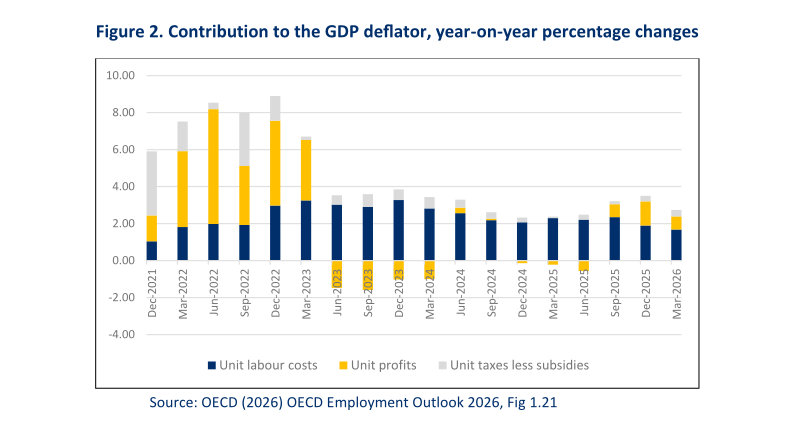
This highlights the difficulty of achieving an increase in real wages via a redistribution of national income from profits to wages. The structural organisation of the economic institutions, especially the central bank, remains one in which corporate profit growth is viewed as mostly an unalloyed good, and certainly
not something to be contained.
Public sector workers
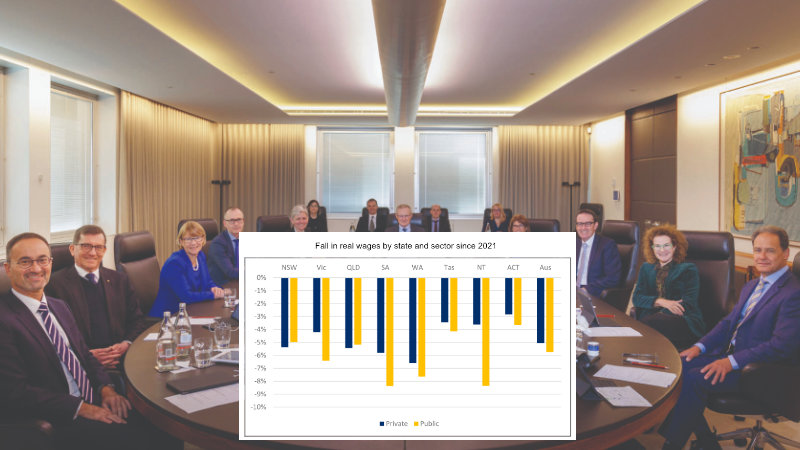
For public-sector workers the decline in real wages has, for the most part, been larger than for those in the private sector. Only in New South Wales and Queensland have private-sector workers experienced a greater fall in the value of their real wages since March 2021.
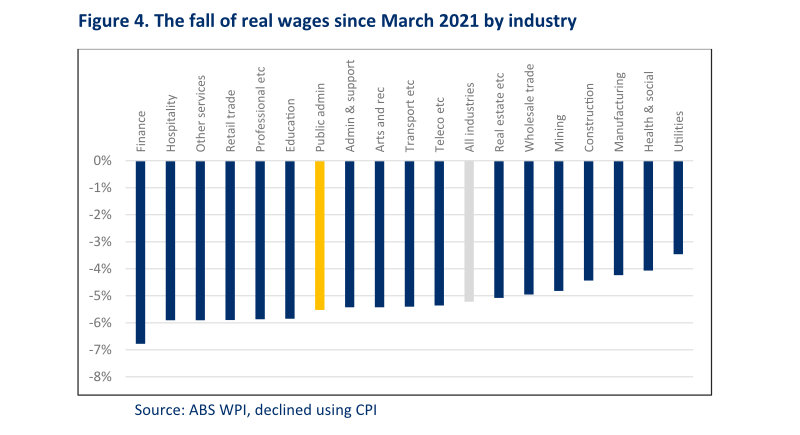
The increased falls in the real wages of public sector workers are largely due to the above-average falls for employees in education and also those in public administration and safety.
Unfortunately for public sector workers, the falls in real wages of 2022 and 2023 came at the end of just over a decade where several state governments and the Commonwealth government had instituted public-sector wage caps.
The suggestion that the caps were needed to restrain inflation was also found to be spurious given the caps remained in place even when inflation was below the Reserve Bank’s inflation target range of 2% to 3%. During this period, the Reserve Bank cut the cash rate seven times to stimulate the economy and improve wage outcomes, and yet the wage caps remained in place.
These caps not only directly affected public-sector workers, but also provided a guide for the private sector that led to falling nominal wage growth throughout the decade prior to the COVID pandemic.
The consequence of that slow growth meant that when those workers were affected by rising prices in 2022 and 2023, they had fewer gains from the preceding decade to act as a buffer. While the fall in overall Australian real wages meant that in March 2023 real wages were equivalent to levels observed in 2009 and 2010, for NSW public sector workers the fall took their value back to 2007 levels.
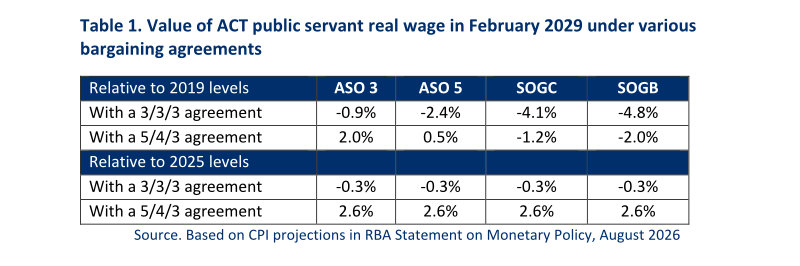
Currently, ACT public servants are engaged in an enterprise bargaining agreement negotiation. The CPSU proposed a 5%/4%/3% wage growth across the three years beginning with the current year. The ACT government has countered with a proposal for 3%/3%/3%. The impact on real wages in their proposal is significant.
Industry impact
The collapse of real wages in 2022 and 2023 has had an ongoing impact on all industries in the three years since the notional bottom had been reached. The recovery has proceeded at a slower pace than even the period before the pandemic.
While nominal wage growth is now higher, real wage growth continues to stagnate.
The difficulty for workers is that the Reserve Bank appears determined to keep wage growth and wage growth expectations down through higher interest rates, even as nominal and real wage growth slows.
As such, governments can have a key role by leading the charge for higher wage growth and a stronger recovery of the lost wages.
The concern of state and government budget balances will always be a factor. However, governments continuing to pursue low-wage growth agreements with their public servants and public-sector employees compounds the difficulty for workers to recover the losses of 2022 and 2023, as once again they are forced to carry the burden of rising inflation driven by profits and supply-side issues.
The ACT government’s current negotiations are a prime opportunity for a government to show leadership instead of punishing workers with falling real wages out of a misguided belief that it would limit wage growth and guard against inflation.
Republished extract by permission of The Australia Institute, original here.

Greg Jericho is the Chief Economist at The Australia Institute.