
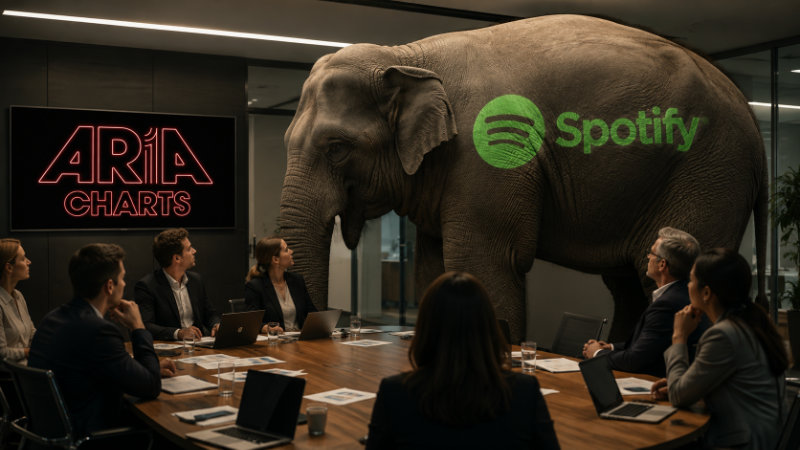

ARIA has decided to remove AI-generated tracks from its charts, while the streaming platforms have not and will still profit from it. Joshua Barnett reports.
The Australian Recording Industry Association (ARIA) has updated its Charts Code of Practice to exclude music made wholly or mostly by generative AI. It applies to charts published from this Friday.
A recording using AI can still chart if it is “substantially human made”, complies with “applicable laws, including those relating to copyright and related rights”, and raises no stream or chart manipulation concerns. ARIA can refuse a recording entry to the chart survey, remove it retrospectively, adjust positions, withdraw accreditations, recall a No. 1 Award and bar a track from the ARIA Awards. Rights holders can escalate a decision to ARIA’s Chart and Marketing Committee, then to the board.
ARIA chief executive Annabelle Herd told ABC radio the charts “are about tracking consumption and sales of music in Australia, but they’re also about celebrating human artistry and success”. ARIA called on everyone with a say in what gets played here, “particularly radio”, to change their own codes.
Gold Coast DJ Josh Fawaz’s cover of Like A Prayer spent four weeks atop the national radio airplay chart, peaked at No. 2 in May and has passed 38 million Spotify streams. Spotify updated its credits to acknowledge AI vocals and drums only after an ABC investigation. Fawaz later posted a video showing his use of Suno, an AI tool for music creators.
The elephant (track) in the room
Spotify replaced named artists with anonymous, cheap content on its playlists years before generative AI could hold a tune.
Journalist Liz Pelly documented how Spotify talks of it internally as “perfect fit content”. Spotify holds arrangements with a web of production companies, among them Epidemic Sound, Firefly Entertainment, Hush Hush, Catfarm Music, Queenstreet Content and Industria Works, that supply library tracks under invented artist names.
Spotify also has staff whose job is to seed those tracks into the ambient, sleep, focus and chill playlists carrying the most passive listening. A former employee described this to Pelly as “music we benefited from financially”. The composers are typically paid a flat fee and sign away the per-stream royalties a normal release would earn.
In 2022, Sweden’s Dagens Nyheter found that 830 invented artists were operating on the platform, 495 of them were placed on Spotify’s own curated playlists, with a single composer credited on more than 2,700 songs. Music Business Worldwide counted 50 such acts sharing 520 million streams back in 2017.
Spotify has denied this for years: “We do not and have never created ‘fake’ artists and put them on Spotify playlists.” But it has never denied playlisting music from companies it has commercial arrangements with.
The composer takes a flat fee. The listener hears a name that belongs to nobody. The royalty a working musician would have earned never enters the pool.
Generative AI did not invent that machine. It just removed the costs.
Perfect fit content still needed humans willing to write library music cheaply. Suno and Udio don’t require payment, which is why Deezer now receives 90,000 fully AI-generated tracks a day.
MWM’s Soundcheck investigation in June 2025 followed the pattern into the AI era, from ghost artists and royalty-free fakery to AI tracks surfacing on real musicians’ pages.
Spotify’s Dark Secret: AI Music Is Stealing from Real Artists | The Soundcheck
Spotify’s answer arrived earlier this month: a badge for “AI Persona” profiles, identities that “may be AI-generated” and do not “represent a real person”, which Spotify says it will keep out of editorial and algorithmic recommendations by default.
The badge describes who an artist claims to be. It says nothing about who got paid, or how little.
Artists brace as AI, the greatest theft in history, swamps us now
Where did the money go?
In May, MWM reported that three AI-generated tracks appeared on the Spotify artist page of The Sweet Enoughs, a project of Hiatus Kaiyote bassist Paul Bender, carrying different Spotify codes that routed the revenue elsewhere. Spotify blamed a “mapping” problem. Bender called that explanation laughable.
Spotify pays no recording royalties at all on a track with fewer than 1,000 streams in a rolling year.
APRA AMCOS and Goldmedia estimated in August 2024 that 23% of Australian and New Zealand music creators’ revenue would be at risk by 2028, a cumulative A$519m. They found 82% of creators worried AI would end their ability to make a living from music.
An Australia Institute report for APRA AMCOS found Australian artists’ share of domestic streams fell from 12% in 2021 to 8% in 2024. Australian acts in the 10,000 most-streamed dropped from 932 in 2021 to 773 in 2025. Holding 12% would have sent another US$40 m to Australian artists over three years.
APRA AMCOS chief Dean Ormston stated: “Major tech platforms have not come to the table. Not once. Instead, they have lobbied governments, circulated policy papers,
and proposed solutions designed to extinguish any obligation to pay.
Attorney-General Michelle Rowland ruled out a text and data mining exception on 27 October 2025, saying the government “will not be entertaining” one. Ten months later, the Copyright and Artificial Intelligence Reference Group is still considering whether a paid licensing scheme should exist. Nothing has been legislated. No date has been set.
The IFPI – representing the recorded music industry worldwide – issued chart principles in July, and is rolling them out in Latin America, the Middle East, Africa and Southeast Asia, and has put them to more than 20 other chart programs.

Josh is a journalist, musician and cameraman who is working with Michael West Media to develop The West Report and other visual content across major social media channels, as well as researching and writing articles.