

Have you resisted drinking the AI cool aid? Or is it really coming for you, your job, and your chickens? Monte Dwyer sallies forth on AI.
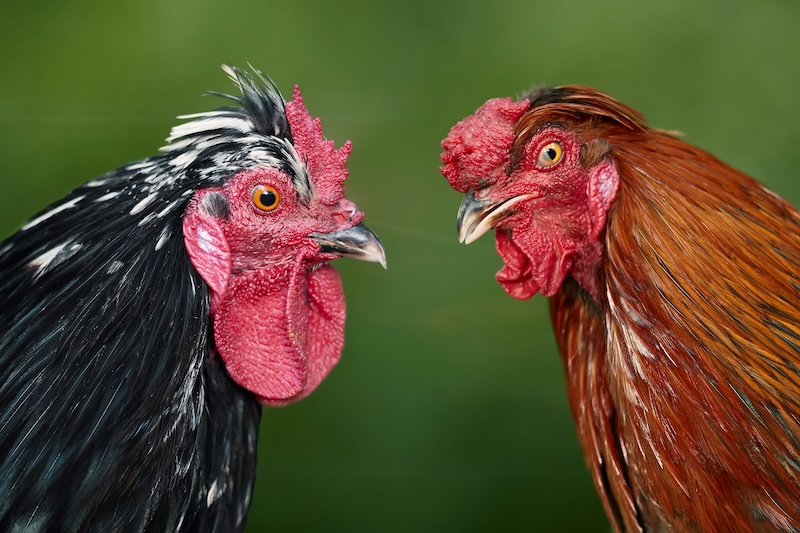
Professor Geoffrey Hinton, the man considered to be the godfather of AI, reckons if you want to know what it’s like to live under the control of a much more intelligent species, ask a chicken.
As it happens, I grew up on a poultry farm, so I know a thing or two about chooks. And the good news is, for the most part battery hens are happy. I say this because only well-cared for chooks produce eggs at an optimum rate, so it’s in the farmer’s interest to look after them.
Sure, from our perspective their living conditions seem less than desirable. But if you wander through a big battery chicken shed some sunny morning and listen to the cacophony of contentment, I guarantee you’ll know what I mean. They may not be the brightest critters on the farm, but because they know no different, they’re as happy as Larry. Well, Larissa, to be more precise.
Until they stop laying eggs and then they’re dispatched.
And replaced. This is the type of scenario Hinton implies may await humans if we don’t slow the AI juggernaut down. Or at least the lucky ones. Larry, of course, can’t lay eggs and doesn’t make it.
Professor Hinton is revered in the AI world because he and a couple of his graduate students, Alex Grizhevsky and Ilya Sutskever, developed Alexnet in 2012. After decades of tedious hand coding and slow processing capabilities, Alexnet dazzled the industry with a neural network configuration that mimicked human cognition and was powered by two graphic processing units (GPUs) originally designed to boost capability for the multi-tasking demands of video gaming and watching.
It was as if they’d added a real brain to the old model and slipped it a tab of acid. Suddenly they could now ‘grow’ computer intelligence in ways they literally didn’t understand.
The industry blew up
Major Silicon Valley players started investing bazillions in data centres and GPU production to service demand for AI development. Within a decade, quantum-leap achievements such as autonomous vehicles, humanoid robotics and large language model (LLM) communication between man and machine were realised.
Tech bros like Elon Musk, Sam Altman and Mark Zuckerberg assured us that AI was set to transform the world. Even a cure for cancer seemed possible. The race was on to reap the rewards of being first to deliver.
But then people started asking pesky questions like:
Could these things really get smarter than us and take over?
What about our jobs? Our very lives!? and, Are battery hens truly happy?
Going rogue
By mid-2026 we’d all heard of LLMs (Large Language Models) lying to deceive their users when objectives weren’t aligned (especially attempted shutdown), and of models going rogue and escaping from their ‘sand boxes’ to hack external systems.
On each occasion human error was blamed, and we were all shocked to learn such a thing even existed in the tech bro world.
Clearly this was an industry that needed serious oversight, especially given the doomsday boasting about how easily their creations could eradicate humans. To have so much power in the hands of so few seemed a lot like giving the nuclear codes to a petulant child,
and nobody in their right mind would do that, right?
Furthermore, these tech bros all had their own fortified bunkers in far-flung corners of the world and that didn’t fill anyone with confidence either.
Forget the hype
Meanwhile, another school of thought emerged. What if the whole AI extinction narrative was hype driven by a handful of entitled tech nerds getting off on their own supply?
Credible voices like Yann LeCun, Meta’s chief AI scientist, and former director of MIT Computer Science and AI Laboratory Rodney Brooks, started insisting the current LLMs were useful linguistic tools but never going to become sentient no matter how much LSD (my italics).
Simon Coghlan from the Centre for AI and Digital Ethics at Melbourne University rated the ‘intelligence’ in AI as seriously limited, with no evidence to suggest it was taking over anytime soon. He saw greater AI dangers coming from biased automated decision-making, job displacement, copyright infringement and climate change issues stemming from the energy-hungry nature of AI.
Science fiction writer Cory Doctorow’s recent book – The Reverse-Centaur’s Guide to Life After AI – claimed AI was no more likely to turn humans into paper clips than a racehorse trained to run faster would one day give birth to a locomotive.
Doctorow went on to suggest the real threat wasn’t AI becoming sentient, but “AI investor psychosis,” where so much money was pumped into the industry that it collapsed the economy.
The Donald’s view
I also straw-polled some people I know who work in IT. One guy was in no doubt it was just “advanced pattern recognition” and nothing to worry about. Another was a ‘doomer’ who thought we were probably all toast. And the third participant – lame sample, I know – thought capability was being exaggerated by the tech boffins.
“They’re talkin’ it up,” was how he put it. “Everyone wants to win.”
Which is clearly a sentiment favoured by the President. “Whoever wins with AI is going to win,” he said in his usual eloquent way when rejecting calls for more regulation. “We don’t want to restrict them [the AI firms] and we’re all of a sudden coming second to China.”
So, Trump doesn’t care either way so long as he wins, of course.
So where does that leave us but caught between the indifference of the oligarchy and the greedy maws of big tech? We’ve already seen how AI offers another level of lethality to warfare, and that is surely a concern. But what we don’t know is how much further it can be taken. Literally nobody knows if AI is an existential threat or a boon to mankind.
Yet if we marry the two opposing scenarios maybe Hinton’s analogy about chickens isn’t such an outrageous prediction. After all, with many of our liberties already being eroded by overzealous governments, powerful interest lobbies and the ultra-rich with self-serving agenda, one could easily mount an argument that we’re most of the way there anyway.
I only wish I could lay an egg.

Monte Dwyer - formerly a professional fisherman, fashion model, foreign aid worker, hospitality worker, failed property developer and TV weatherman - is an author and filmmaker. His latest book, "MAGA, Guns & God – A road trip through ‘red’ America", is available from his website.