

Private health insurers are making their way into your doctor’s office and the specialists they refer you to. It may not be to your benefit, Claudia Weisenberger reports.
Correction: an earlier version of this article stated that HCF operates residential and aged care accommodation. It has been brought to our attention that this is incorrect and the error has been corrected.
A private health insurer makes more money the less it spends on your healthcare. Increasingly, they own the GP clinic you visit — and the specialist it refers you to. Stay inside that network, and part of your gap fee disappears. Leave it, and you pay the difference yourself. The insurer isn’t paying more. You are.
America has already gone much further down this path — it’s called a managed care system, and this is their reality. A New York woman’s insurer denied her MRI for 40 days; by the time it happened, her cancer had progressed from treatable with chemotherapy alone to requiring amputation of her leg, hip and pelvis.
A teenager died hours after her insurer reversed a transplant denial it should never have made.
An insurer’s employee decided her care. Not her doctor.
Australia is next in line for a managed healthcare system. Two of the country’s five biggest health funds already own the GP clinics their members walk into — the first piece of the same machine.
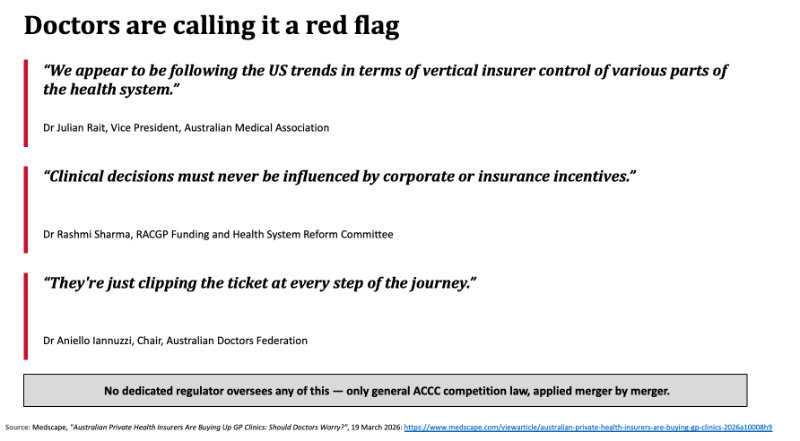
The AMA has flagged the exact risk: a doctor employed by an insurer directing patients toward that insurer’s own specialists and hospitals — not necessarily whoever is best placed to treat them.
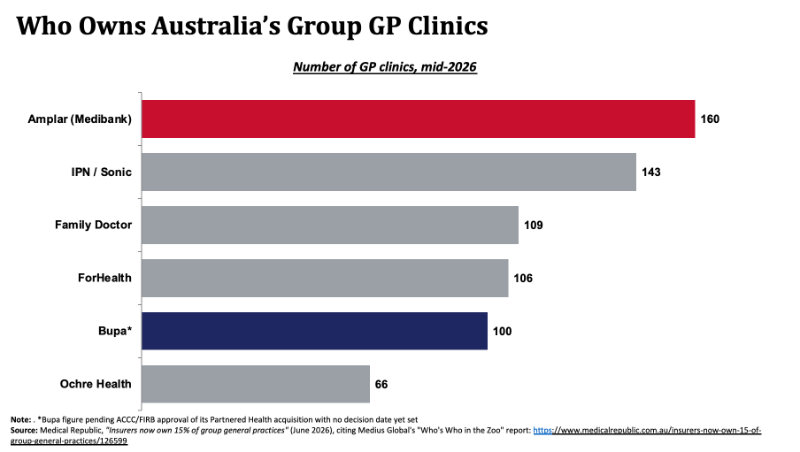
The number bears that out: Medibank and Bupa now own or control roughly 15% of Australia’s group general practices.
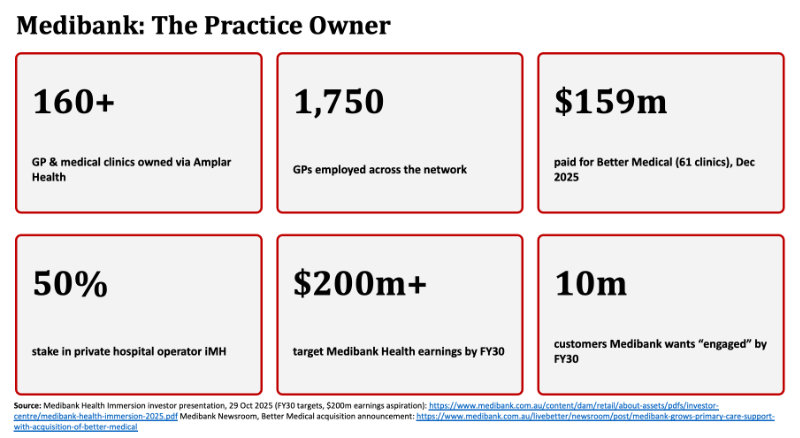
Medibank: the practice owner
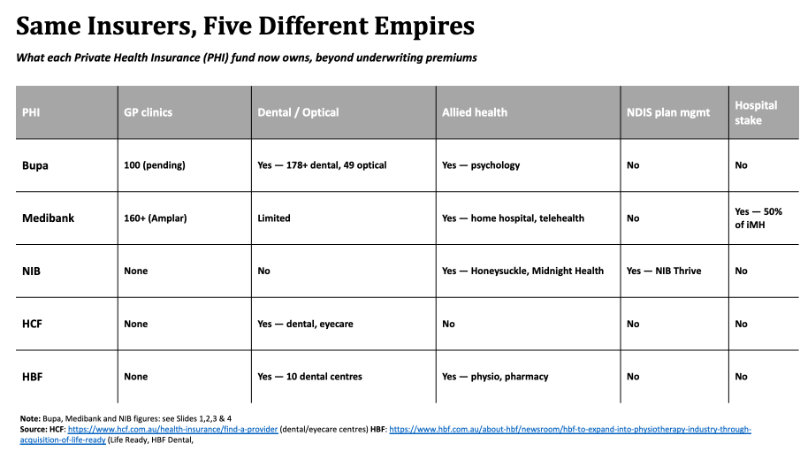
Medibank’s primary care arm, Amplar Health, now owns more than 160 GP and medical clinics. It’s the country’s second-largest network, behind only Sonic Healthcare’s IPN. Its latest acquisition, Better Medical, was completed in December 2025. Medibank also holds a stake in private hospital operator iMH and runs a “hospital in the home” service, part of a division it’s told investors will be worth significantly more by 2030.
Amplar’s chief executive, Robert Read, frames it as continuity, not takeover: “GPs will continue to have full clinical autonomy, and the clinics remain open to everyone.”
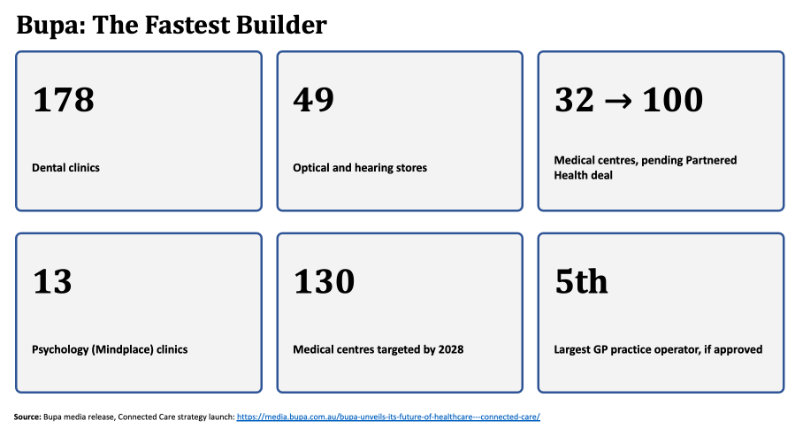
BUPA building fast
Bupa is moving faster than anyone. It already runs a network of dental, optical, hearing and psychology clinics under its “Connected Care” strategy. It’s now acquiring GP chain Partnered Health — a deal that, if cleared by the ACCC, would make Bupa Australia’s fifth-largest general practice operator overnight.
Bupa says its clinics are “open to all, both Bupa customers and non-Bupa customers” — the same claim the ACCC is now testing directly, in its review of the Partnered Health acquisition.
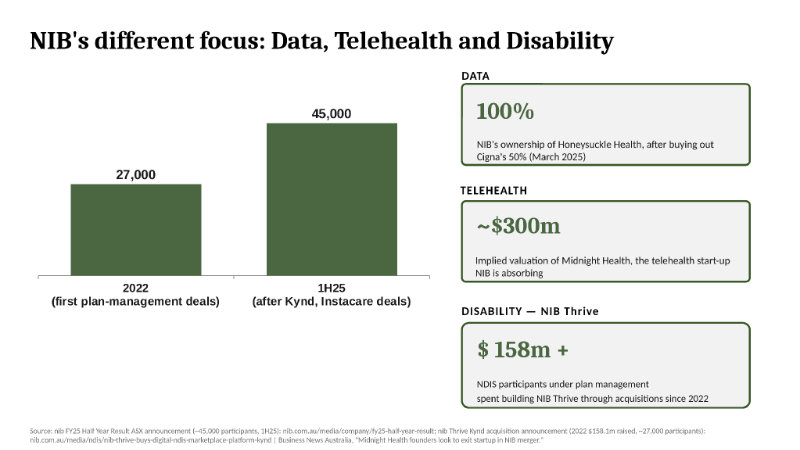
NIB with different focus
NIB hasn’t bought a single GP clinic. Its play is data and disability. It’s taken full ownership of Honeysuckle Health, buying out Cigna’s stake, and is merging it with Midnight Health, the telehealth start-up that it has been steadily acquiring.
Separately, NIB Thrive, its NDIS plan-management arm, has grown fast through acquisitions since 2022. It’s a smaller bet than Medibank’s or Bupa’s — but the logic is the same: don’t just fund the system, own a piece of how it operates.
Honeysuckle is fighting to keep its market power too. The ACCC first authorised its “buying group” — negotiating hospital and specialist contracts on NIB’s behalf — in 2021, deliberately capped and time-limited.
That cap is now up for review: Honeysuckle wants another decade. The Australian Private Hospitals Association is opposing it, calling the bid “an attempt by NIB to gain market dominance through a buyer bloc” that would “skew an already unequal playing field” against hospitals already under financial pressure.
HCF and HBF
HCF and HBF are run as not-for-profit, but are in the same business, just at a fraction of the scale.
HCF runs its own dental and eyecare centres, and HBF operates ten dental centres and 23 physiotherapy and pilates locations, alongside pharmacy partnerships with TerryWhite Chemmart and Pharmacy 777.
Neither is chasing GP ownership at Medibank’s or Bupa’s scale — and that distinction matters: dental, eyecare and physio are extras a member chooses, not the GP relationship deciding where they’re referred next. The referral-steering concern here is mostly about the two biggest for-profit funds.
Insurers empire building
The appeal for the insurers is obvious. “Vertical integration is a way to spread fixed costs,” says IBISWorld analyst Aishni Singh — and for a health insurer, owning the provider means costs can be cut before they’re paid out.
Rachel David, chief executive of Private Healthcare Australia — the insurers’ peak lobby body — argues health funds are already “investing in primary care, dental care, and programs to help people stay well and prevent illness,” and would do more “if private health funds were legally permitted to”.
Yet, private health insurers are companies, not charities.
Prevention is only worth funding if it’s profitable too.
The logic doesn’t stop at GP clinics. The next target is already visible: NIB and Medibank have run no-gap contractual deals with pathology and imaging providers for years. A contract today, an acquisition tomorrow? What’s to stop it?
Doctors worried
The medical profession isn’t neutral on this — and it isn’t only the AMA making the case. The RACGP and the Australian Doctors Federation have reached the same conclusion independently, both calling for statutory safeguards rather than industry self-regulation, in language that leaves little room to read this as mere convenience.
Three professional bodies that don’t always agree on much have converged on the same warning, independently — and on the same fix.
The regulatory gap
Nothing in current law stops any of this. Insurers are free to set up, acquire or own health-service delivery businesses; the only check is general competition law, weighed case by case by the ACCC.
There’s no dedicated regulator for the private health system, and no rule requiring insurers to disclose how much of their own network their members are being referred into. The AMA wants a standalone private health system authority with power to standardise the contracts already steering your referrals. So far, no government has built one.
Even in the US, the backlash has reached Congress: a Republican co-chair of the Congressional Doctors Caucus, Greg Murphy, has called for the country’s largest for-profit insurers to be broken up.
That fight hasn’t reached Australia yet. But the economics already have. Two of the country’s biggest health funds no longer just fund your surgery — they’re building the network that decides where you go next.
A managed-care system serves shareholders first.
Everything else — prevention included — is secondary. America already shows the cost: less choice, and decisions made by administrators. Not doctors.
Show me the money! How top five health funds spend your premiums

Claudia Weisenberger is a management consultant with deep experience in pharmaceuticals, hospital transformations, and strategic due diligence across four continents. She combines sharp analysis with hands-on execution.