
Are Australian environmental protection charities being funded, and silenced, by a foundation that heavily promotes controversial carbon credits? Stephanie Tran investigates.
Several of New South Wales’ leading environmental organisations have declined to disclose whether they have received funding from the Australian Climate and Biodiversity Foundation (ACBF), a charity lobbying for a controversial carbon credit scheme.
The issue has raised questions about transparency within the conservation movement after the National Parks Association of NSW (NPA) acknowledged in an advisory note to members, seen by MWM, that it had received funding from ACBF for campaigns related to the Great Koala National Park and its “30 x 30” conservation initiative.
The advisory note, sent to members on 26 July, states that the NPA “has received funding from the Australian Climate and Biodiversity Foundation (ACBF) for part of its GKNP campaign, and more recently for its 30 x 30 campaign”.
It also notes that “ACBF is not opposed to INFM”, referring to the Improved Native Forest Management carbon credit methodology.
Despite the disclosure to members, the NPA declined to comment on the funding they received from the ACBF when contacted.
Australian Climate and Biodiversity Foundation
The Australian Climate and Biodiversity Foundation was established in 2021 and describes itself as a not-for-profit organisation bringing together “governments, businesses, and communities to protect and restore nature across Australia”. It is chaired by former Treasury secretary Dr Ken Henry.
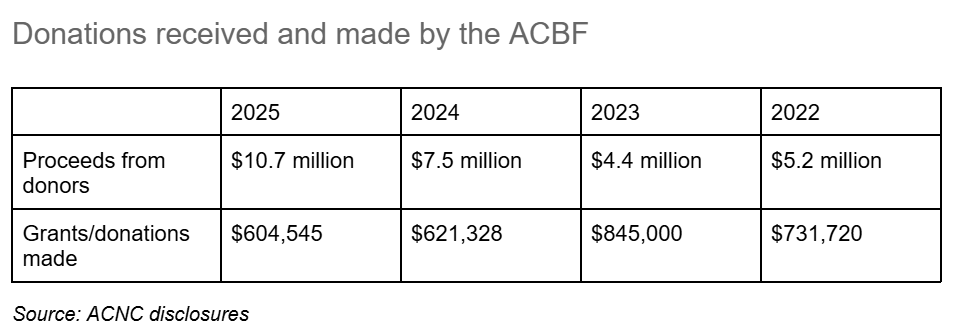
Financial statements show the Foundation has received $27.8m in donations since it was established. During the same period, it distributed $2.8m in grants to other organisations.
The ACBF has been one of the strongest advocates for the INFM method, which allows state governments to generate Australian Carbon Credit Units (ACCUs) by permanently ending logging in eligible public native forests.
ACBF told MWM it “strongly supports” the INFM method as “an economically responsible way to secure the long-term protection and management of biodiversity and carbon-rich native forests threatened by logging” and argued the scheme embodied the “polluter pays” principle by requiring industries responsible for emissions to contribute to environmental restoration.
Hiding donations received
Several organisations contacted by MWM declined to confirm whether they had received funding from ACBF.
The North East Forest Alliance and National Parks Association of NSW declined to comment.
The Nature Conservation Council of NSW (NCC) said it does not disclose its donors for privacy reasons.
“In line with our privacy policy, NCC respects the privacy of our donors and doesn’t disclose their details or comment on individual funders or foundations,” a spokesperson said. “NCC values its credibility as an independent charity, and our policy positions are carefully developed through member, staff, and board consultation and not influenced by donors.”
WWF-Australia did not confirm or deny whether it had received ACBF funding, instead stating that it supports “high-integrity carbon credits that cannot be sold to fossil fuel companies” and has campaigned for an end to native forest logging.
Greenpeace likewise did not confirm whether it had received funding, saying it was “not working on INFM” and maintained a longstanding position that fossil fuel companies should not have access to carbon credits.
The Biodiversity Council said it had “not received any funding, grants or other financial support from the Australian Climate and Biodiversity Foundation.”
The funding questions arise as several environmental organisations that have allegedly received funding from the ACBF have publicly supported INFM.
In the briefing note, the NPA suggested adopting a position of support for INFM stating that “while NPA acknowledges the flawed history of land-based carbon offsets, the strict 100 year permanence and full logging cessation rules built into INFM represent a fundamental break from previous models.”
The North East Forest Alliance has expressed support for INFM, submitting that carbon credits should only be granted where the forest is permanently protected from logging. The Nature Conservation Council of NSW also supports INFM arguing that it “has the potential to provide a significant financial incentive to end native forest logging in our public native forests and to limit expansion of private native forestry”.
More than 50 conservation groups have opposed the use of NSW’s native forests to generate carbon credits.
Calls for greater transparency
Ecologist Mark Graham says the issue lies in the lack of transparency from the organisations regarding funding they’ve received from the ACBF.
“I think that the most credible and appropriate way to deal with this is to have the integrity of declaring and disclosing all funding sources openly and publicly,” Graham said.
“If there is an unwillingness to fully publicly and openly and transparently declare the receipt of funding, then there cannot be trust.”
INFM opposition
The INFM method remains contentious among conservationists and carbon market experts, with debate extending beyond the integrity of carbon credits to the future of the Great Koala National Park (GKNP).
The legislation underpinning INFM is currently the subject of a disallowance motion in the Senate.
David McEwen, co-founder of Adaptive Capability, has argued there is “no evidence that land sector ACCUs can achieve satisfactory permanence to be considered a reliable offset for fossil-based emissions. Yet under the Safeguard Mechanism, these same credits can be used without limit to meet compliance obligations. That contradiction is becoming increasingly difficult for the government to defend.”
Climate policy. Is the era of unlimited emissions offsets ending?
The Australia Institute’s chief economist Richard Denniss has also questioned the government’s reliance on offsets, arguing that “every billion spent buying dodgy carbon offsets is a billion dollars that wasn’t spent on our low-carbon economy needs.”
Last week, the NSW government banned coal and gas companies from buying carbon credits generated by the Great Koala National Park.
The Bob Brown Foundation, has criticised the NSW government’s decision to make the development of GKNP contingent on the generating carbon offsets arguing that the Minns government was breaking an election promise.
While they welcomed the decision to prevent carbon credits generated from the GKNP from being sold to coal and gas projects, they said the decision “does not rule out making those credits available to facilitate NSW’s biggest industrial emitters such as Port Kembla Steel and Tomago Aluminium”.
Mark Graham expressed frustration about the continued logging of forests earmarked for protection,
We’re being shafted left, right, and centre on the Great Koala National Park,
“At the moment, the habitat of the largest coastal koala population in New South Wales, at the very heart of the Great Koala National Park, is being clear-fell logged. Last week, a koala had its jaw broken and massive internal injuries because of the loggers. It had to be euthanised.”
ACBF funding
Questions have also been raised about the origins of ACBF itself.
MWM asked ACBF to respond to reports that it was established following a multi-million-dollar donation from Angela Wright Bennett, the daughter of mining magnate Peter Wright. The foundation did not respond specifically to that question.
MWM also put the allegation to Ms Wright Bennett. Her spokesperson said she declined to comment.
In a statement, ACBF said it is a registered charity that complies with all obligations under the Australian Charities and Not-for-profits Commission and “respects the confidentiality of its donors and grant recipients and does not publicly disclose their information except where required by law or with their consent.”
The foundation rejected suggestions that it funds political campaigning.
“While we encourage governments to adopt policies which increase environmental protection and restoration and lower carbon emissions, the ACBF does not fund election campaigns or electoral activity,” it said.

Stephanie is a journalist with a background in both law and journalism. She has worked at The Guardian and as a paralegal, where she assisted Crikey’s defence team in the high-profile defamation case brought by Lachlan Murdoch. Her reporting has been recognised nationally, earning her the 2021 Democracy’s Watchdogs Award for Student Investigative Reporting and a nomination for the 2021 Walkley Student Journalist of the Year Award.