
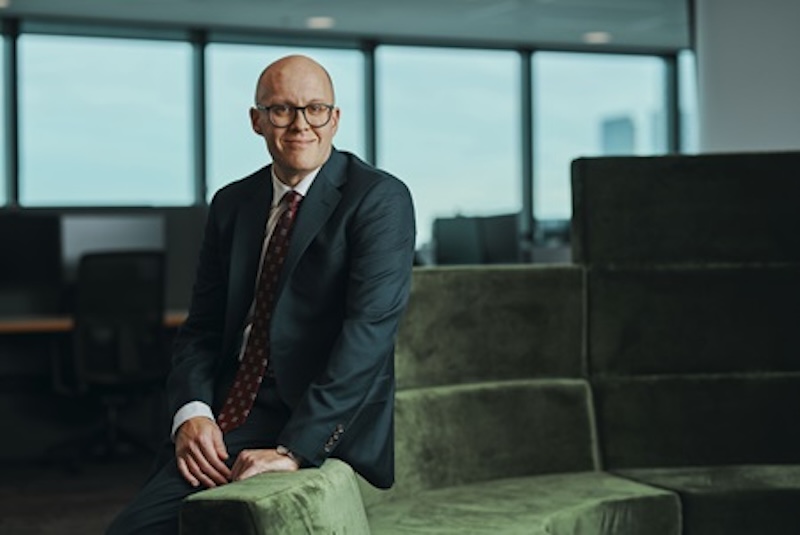
Australia’s health regulator has begun monitoring social media for criticism of Israel after pressure from Jillian Segal, the Royal Commission has heard, as a row over the word “genocide” erupted. Stephanie Tran and Wendy Bacon report.
A heated exchange erupted at the Royal Commission on Antisemitism and Social Cohesion on Wednesday after counsel for the Jewish Council of Australia, Kirsten Edwards SC, questioned Australian Health Practitioner Regulation Agency (AHPRA) chief executive Justin Untersteiner about whether healthcare workers could face complaints for describing Israel’s conduct in Gaza as genocide.
The exchange prompted strong objections from counsel for the Executive Council of Australian Jewry, Michael Borsky KC, who argued the commission should not become
“a platform” for “false claims” about Israel.
Edwards’ questioning centred on an example contained in the Special Envoy to Combat Antisemitism’s handbook, which AHPRA adopted alongside the International Holocaust Remembrance Alliance (IHRA) definition in June.
“One reading of the analysis provided of this example is that describing or using the words genocide, apartheid, or ethnic cleansing in connection with Israel’s actions in Palestine is antisemitic,” Edwards said.
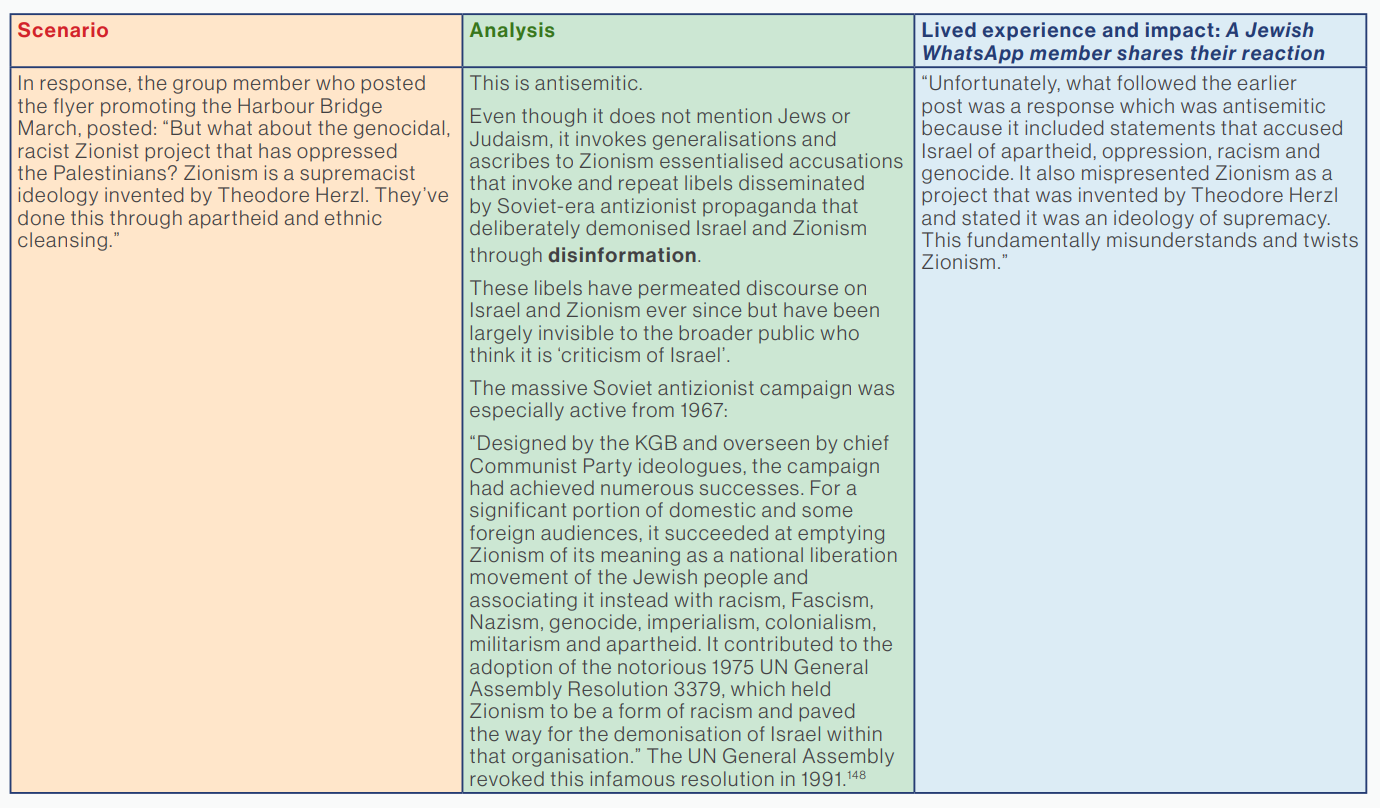
Example from ASECA handbook
She noted that international bodies, including the International Court of Justice, had used the term genocide in relation to Israel’s conduct in Gaza and asked how practitioners expressing similar views would be treated under AHPRA’s new approach.
“Prior to the publication of this handbook in January 2024, the International Court of Justice ruled that it was
plausible that Israel’s acts in Gaza could amount to genocide,” Edwards said.
Genocide claims antisemitic, claims Israel lobby lawyer
Borsky immediately objected and said the “false claims” would “fuel antisemitism”.
“I object. We respectfully submit that this Commission ought not be used as a platform for referring to such allegations. My friend is wrong. That’s not what was found, and the suggestion is, in any event, irrelevant to the Commission’s terms of reference, it could only be relevant to the subject of the Commission’s terms of reference in fuelling anti-Semitism and eroding social cohesion for these false claims to be advanced through this forum,” he said.
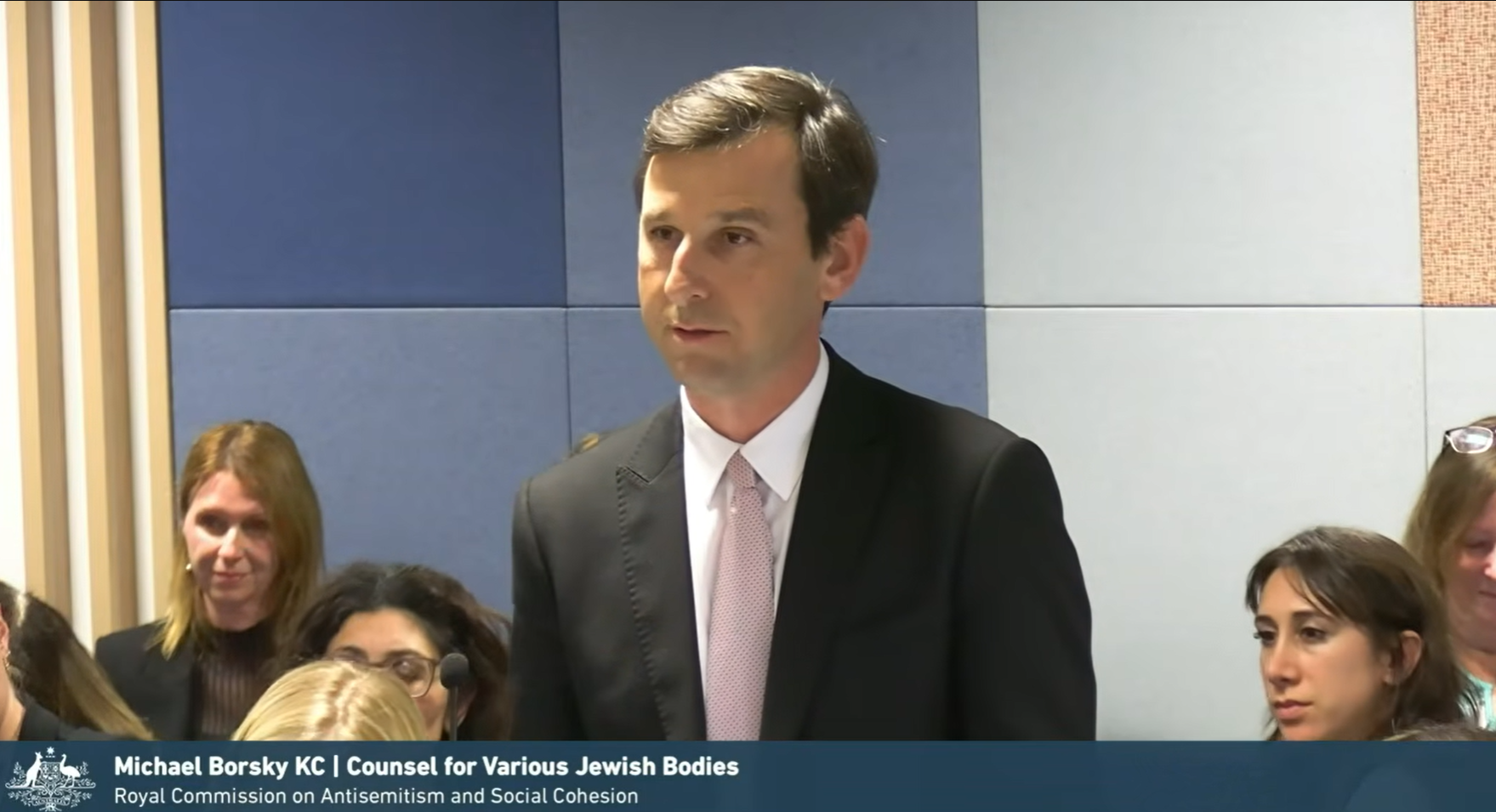
Michael Borsky KC, counsel for ECAJ and other Jewish bodies
Commissioner Virginia Bell rejected the submission that the questioning was irrelevant.
“As I understand where Ms Edwards is going,” Bell said, “it is to contend that in some contexts, use of the word genocide … might nonetheless not be evidence of hostility towards Jews, but might reasonably be taken as a political statement about the conduct of the State of Israel.”
“I think that’s very much at the heart of aspects of the work of this Commission.”
Genocide denied
Borsky doubled down.
“Commissioner, with the greatest of respect, we understand and accept that. But accuracy matters and what my friend put was inaccurate. It was false. She put that the International Court of Justice has ruled that it was plausible that Israel’s acts in Gaza could amount to genocide.
“That is false, and its airing in public is liable to exacerbate the problem of anti-Semitism in his country,” he said.
Commissioner Bell disagreed.
“Mr Borsky, calling it false might be going one step beyond a neutral way of framing it,” she said.
Bell observed that the ICJ had not determined whether genocide had occurred but had accepted there was a prima facie case warranting provisional measures while proceedings continue.
Counsel assisting the Royal Commission, Richard Lancaster SC also interjected Edwards’ line questioning twice.
On the first occasion, Lancaster objected to Edwards’ characterisation of the example in the Special Envoy’s handbook, telling the Commission:
“I object to that because it refers to Zionism. It doesn’t refer to Israel.”
On his second interjection, he once again emphasised that the example of antisemitism in the handbook referred to the term “Zionist”.
“The launching pad for Ms Edwards’ questions was an example given in the ASECA handbook. The example does not involve expressions using the word Israel or the government of Israel. It uses the terms Zionist, and so the launching pad for the question does not sit well with Miss Edwards’ explanation of it,” Lancaster said.
The analysis of the example on page 76 of Segal’s handbook argues that “trying to separate ‘antisemitism’ from ‘antizionism’ ignores the history of misinformation, disinformation and antisemitic propaganda that has shaped narratives about Israel and Zionism … Antisemitism and antizionism are both expressions of hatred towards Jews.”
Untersteiner was unable to answer whether the handbook example would be found to be antisemitic. He said that it would depend on “context” in each case and that he was not a decision maker of complaints.
Segal handbook was “tipping point”
Earlier in his evidence, AHPRA CEO Justin Untersteiner confirmed AHPRA had resisted adopting the IHRA definition because of concerns it could inhibit legitimate political speech.
“We resisted it for a period of time,” he said, because AHPRA had heard concerns about “the risk of the IHRA definition stifling free speech … within the healthcare system.”
He said publication of the Special Envoy’s handbook earlier this year altered the regulator’s assessment.
“The handbook really provided greater granularity and detail about the definition, about what it does mean and what it doesn’t mean,” Untersteiner said.
“It was on the basis of that handbook, as well as all the feedback that we’d had over a period of time, that we felt it was the right decision then to adopt it.”
When Edwards suggested the handbook had been the “tipping point” in AHPRA’s decision, Untersteiner agreed.
Handbook to inform disciplinary action
Untersteiner also confirmed the handbook would not simply assist staff in triaging complaints but could
inform disciplinary decisions made by professional boards.
Asked whether the IHRA definition would be referenced if AHPRA alleged a practitioner had breached professional standards through antisemitic conduct, Untersteiner replied that it would.
“The recommendation and the report … would very much reference IHRA,” he said.
“The appropriate board would be referencing IHRA in making that final decision.”
“Intolerable pressure”. Inside the Israel lobby campaign to coerce regulators on antisemitism
He further agreed that AHPRA was embedding not only the IHRA definition but also the Special Envoy’s handbook into its regulatory framework.
When asked whether both documents could inform assessments of whether conduct was antisemitic and whether complaints were vexatious, Untersteiner answered: “Correct.”
AHPRA begins social media monitoring
The hearing also revealed AHPRA has begun using social media monitoring tools to monitor practitioners’ social media activity.
“We, like most regulators, use a range of different regulatory tools,” Untersteiner said.
“That includes the use of social media monitoring tools … to help us identify where there might be activity of concern to us related to, for instance, racism or discrimination.”
“We’ve engaged a service provider that undertakes general social media monitoring, and they will use a range of different methods to identify. And by the way, this isn’t just about discrimination, which relates to other issues that might play out in the health system,” he said.
Pressed on whether the monitoring involved searching for particular terms, such as “genocide”, Untersteiner said he was not sufficiently familiar with the technical operation of the system to answer.
Untersteiner said that 85% of complaints related to Islamophobia and anti-Semitism were related to social media activity compared to 40 to 45% of overall complaints regarding racism and discrimination.
Chilling effect acknowledged
Edwards also questioned Untersteiner about complaints made against doctors who had spoken publicly about Gaza.
She referred to correspondence from the Royal Australian College of General Practitioners raising concerns that complaints relating to political speech, even when ultimately dismissed, were taking months to resolve and causing considerable stress to practitioners.
Untersteiner acknowledged that even
unsubstantiated complaints could have a “chilling effect”.
He said AHPRA was considering whether practitioners should sometimes not be notified about complaints unlikely to result in regulatory action in order to reduce unnecessary anxiety.
Abuse after adopting IHRA
Questioned later by Borsky, Untersteiner said he had received abuse following AHPRA’s adoption of the IHRA definition, including allegations that he supported genocide or had been influenced by the Israel lobby.
Borsky also referred to abuse directed at Special Envoy Jillian Segal, who will reappear at the Commission on Thursday.
The hearing did not examine claims that AHPRA had also come under sustained lobbying from pro-Israel organisations before adopting the IHRA definition.
MWM previously revealed that AHPRA’s decision followed months of lobbying by the Australian Zionist Health Alliance and other advocacy groups, including calls for Untersteiner’s removal and repeated engagement with senior government officials.
AHPRA, Gaza and the Campaign to Silence First-Hand Evidence | The West Report

Stephanie is a journalist with a background in both law and journalism. She has worked at The Guardian and as a paralegal, where she assisted Crikey’s defence team in the high-profile defamation case brought by Lachlan Murdoch. Her reporting has been recognised nationally, earning her the 2021 Democracy’s Watchdogs Award for Student Investigative Reporting and a nomination for the 2021 Walkley Student Journalist of the Year Award.
Wendy Bacon is an investigative journalist who was the Professor of Journalism at UTS. She worked for Fairfax, Channel Nine and SBS and has published in The Guardian, New Matilda, City Hub and Overland. She has a long history in promoting independent and alternative journalism.
She is a long-term supporter of a peaceful BDS and the Greens.