
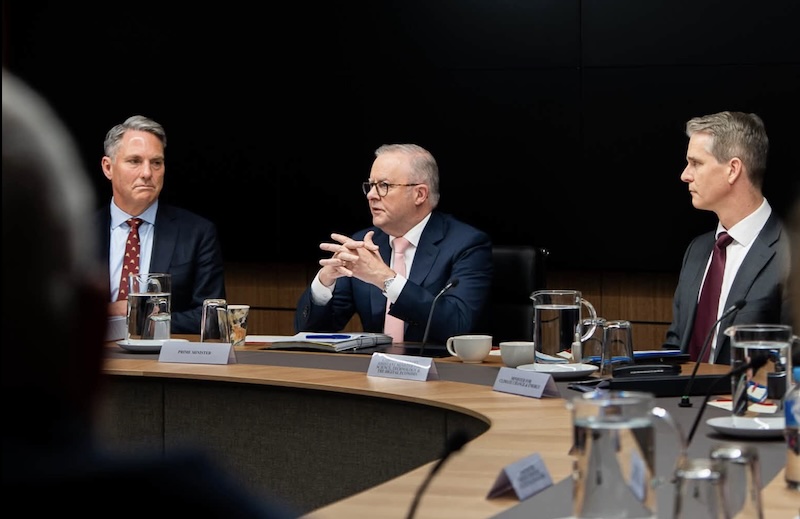
The Albanese machine’s biggest wheeze this month hasn’t been passing off Labor’s national conference as a success or displaying anosmia (the inability to smell) over the PM’s dinner with Joe Hockey’s little mate Felix Lee and friends, but the idea that it was up to speed on AI, reports Michael Pascoe.
Imagine the Victorian Government in 1859 was aware Thomas Austin was about to release 24 English wild rabbits for hunting on his property near Geelong.
Further imagine the Premier of the time, one John O’Shanassy, gave a speech titled “Rabbits in Australia’s Interests” that declared there would be rules about how many rabbits would be allowed to be taken by hunters on any one day, the dates of rabbit season and the types of weapons that could be used for hunting. (Snares would be considered unsporting.)
As monumentally silly and disastrous such a speech would prove to be, it’s about the same as Prime Minister Albanese’s “AI in Australian Interests” spiel delivered earlier this month in an effort to show the government was totes down with the amazing things being done with the electric light.
The defining characteristic of Australian government for many a long year now is lack of imagination, the inability to think beyond whatever was already the problem.
Thus Albo and bitcoin boy Andrew Charlton pushed out lines about controlling the building of data centres and looking to see there might be some pennies for copyright holders, plus something about it being great for Australia.
Feeding the chooks
In a sad example of successful media management, dropping parts of the speech ahead of its delivery ensured plenty of coverage of just what the government wanted people to read and the circus moved on without much thought about whether it really meant anything.
Yes, the rush to build massive data centres, Hoovering up electricity and water and construction workers, was and is a problem. It’s also a game, a little boom, that will see various potential sites played off against each other to extract the best deal for those spending the money.
Governments want to host the build, the short term economic boost of construction activity.
Already the electricity side is being fudged – no, Virginia, the data centres will not simply build their own renewable energy, they’re using the carbon credits ruse to push such concerns out to a time to be negotiated, when the flash money has gone elsewhere.
The game is moving faster than Albanese can hire people for the little AI desk within his office.
And the copyright? Sure creative types are concerned that their material will be used without payment to train machines that will then substantially replace creative types. Don’t worry – Albo will look into making sure you will be paid, albeit less than you get for a song played on Spotify i.e. SFA.
Bigger than data centres
But both issues are like rabbit bag limits and shotgun gauges. There’s no sign of the government having the imagination to assess the rabbits running riot, denuding the grasslands and bankrupting the land.
The data centres aren’t the real issue.
Nobody knows for sure how the AI revolution will play out, let alone the imminent AGI (artificial general intelligence), but it’s a fair guess our society, our tax system, is not structured to handle it. Heck, our tax system can’t handle the “old” technology megagiants and is struggling to catch up with mere multinationals.*
There’s a two-year-old line from somewhere on social media: “The underlying purpose of AI is to allow wealth to access skill while removing from the skilled the ability to access wealth.”
Jobs killer
The trillion-dollar investments in the AI rush only pay off if pretty much every business is prepared to pay a lot of money for AI to save them a lot of money by having fewer workers.
The optimists point to earlier technological advances not creating large scale unemployment – nobody misses the typing pool or the manual telephone exchange – but AGI promises to be much bigger, faster and broader than previous technological revolutions.
Should that promise be delivered, responsible government will need to be ready to capture a large share of the wealth generated at the top of the game to ease the pain of those tossed aside at the bottom.
There is zero sign of that. And with its habit of playing catchup, there is another complication for government: by the time it has the crisis, the AI companies are unlikely to be rich enough to be generous. Instead of this being a goldrush on the way to a diamond rush, providing AI now looks like becoming “a competitive, mediocre return industry, partly due to intense Chinese competition”.
That’s how international macroeconomist Gerard Minack summaries the present faltering Ai trade in his latest research note.
Fat returns really?
Minack has previously written about the firms selling shovels for the AI goldrush as the ones making the money, but if less money is to be expected from selling AI, “disappointing returns would point to lower investment and hence lower profits for the firms selling shovels”.
In other words, the boom mentality and promises of the data centre builders won’t last.
Getting the returns on investment the megascalers expect requires fat margins on massive sales, but China is demonstrating it will undercut them.
“Chinese models are not best-in-class. But the gap between Chinese models and those at the forefront is relatively close and doesn’t seem to be widening,” writes Minack.
“I continue to expect that AI providers will generate a mediocre, at best, return on their enormous investment spend. If that is what the market is now sniffing, the AI trade may have passed a major peak.”
Yet the changes wrought by AGI will remain. Profits will flow from the technological revolution while the world remains in the grip of powerful individuals and corporations forever pushing for lower corporate taxes. You know, the good ol’ trickle down effect.
How to support the changed labour force will make the little CGT and negative gearing fiddles look like, well, snaring rabbits. Dealing with the bigger challenges requires a lot more imagination than giving a desk in the PM’s office a name.
*An always handy example of tax failure: IKEA. The ATO is belatedly seeking $171 million IKEA dodged in the four years to 2020 – no mention of what it’s been doing since and IKEA reckons it won’t have to pay anyway.

Michael Pascoe is an independent journalist and commentator with five decades of experience here and abroad in print, broadcast and online journalism. His book, The Summertime of Our Dreams, is published by Ultimo Press.