
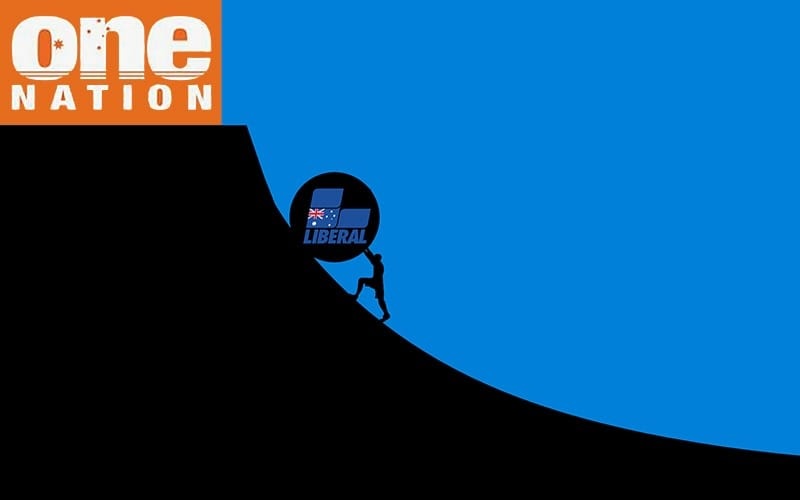
The Liberals have ruled out working with One Nation, but they’re taking on a menace of their own making. Andrew Gardiner reports.
Liberal leader Angus Taylor has spurned Pauline Hanson’s call for a united front against Labor, ruling out working with a One Nation party the Liberals belatedly see as an existential threat.
It’s an overdue reset from a man until recently content to echo One Nation’s positions on immigration and net zero, and from a party whose missteps in a ‘sliding doors moment’ following last year’s election may have doomed the Liberals – self-proclaimed “natural party of government” since World War II – to extinction at Hanson’s hands.
In a speech to the Sydney Institute last night, Taylor insisted One Nation was “long on rhetoric but short on substance, offering is a random grab bag of poorly defined, contradictory and constantly changing positions that leave no clear sense of who they are or what they stand for”.
Liberal shock treatment
Political operatives say Taylor’s newly combative stance is an attempt to shock voters who deserted the L-NP in recent months into realising Hanson is “not the solution” to their woes.
But it seems increasingly likely those voters won’t “come home” to the coalition at all. RedBridge pollster and strategist Kos Samaras has declared the LNP to be in a state of “structural decomposition”, having been abandoned by conservative voters “who no longer regard (them) as their natural home”.
“One Nation now has a viable path to becoming the dominant party of regional Australia” wrote Samaras, whose RedBridge consultants forecast LNP armageddon in 2028 (see map below). Observers say the coalition’s peril is of its own making, its blunders beginning when the Liberals narrowly chose as leader a moderate “place-holder” in Sussan Ley.
This gifted One Nation the chance to woo LNP voters looking for “an angrier, more culturally combative” alternative.
It was seized with alacrity.
Nats in danger
With the L-NP facing oblivion in the regions (and with the Liberals already reduced to just four seats in suburban Sydney, two in Brisbane, one each in Melbourne and Perth and none in Adelaide), it seems the “natural party of government” could indeed be facing extinction.
On an individual level, two of the biggest blunders came from media darlings Matt Canavan and Jacinta Price, who could have followed their well-known, opportunistic instincts by defecting One Nation, but instead dragged their feet, leaving them at real risk (along with dozens of others) of losing their seats in parliament.
In fact, Canavan – now leader of the Nationals – opted to meet Hanson head on (“in her 30 years in politics, she has never delivered a single dam, road or hospital”). Unless he can help turn the tsunami of public opinion around, Canavan (holder of the vulnerable second spot on the coalition’s Queensland Senate ticket) faces likely oblivion, with One Nation grabbing the lion’s share of conservative voters in that state.
Price is not alright
For her part, Price bought into the “Jacinta for The Lodge” hype, merely switching from the Nationals to the Liberals, the party from which coalition PMs hail historically. NT polling can be more art than science, but – with statistical models giving One Nation a strong chance in both its lower house seats – she could be doomed if she stays there.
She seems to have belatedly realised this blunder, amid reports Price may again jump ship, this time to One Nation, in what would be a remarkable second defection in the space of one parliamentary term.
Liberal and National MPs imperilled by One Nation include a who’s who of lower house opposition front benchers: Angus Taylor, Andrew Hastie, Dan Tehan, Ted O’Brien, Michael McCormack and Darren Chester are ‘in the gun’, Samaras and RedBridge conclude.
The parties of Menzies, McEwen and Howard have formed government for 51 of the past 77 years. These must seem like dizzy heights to the current crop: unless the reset works, those earlier missteps have likely ushered in catastrophe.
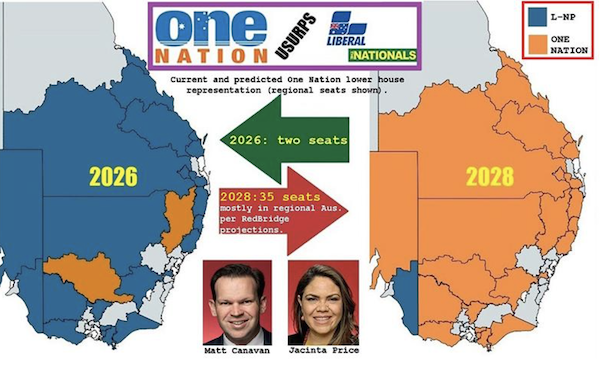
Kos Samaras and RedBridge say most of One Nation’s gains at the next election will come in regional Australia, at the LNP’s expense. Image: Andrew Gardiner, APH.gov.au
One Nation hit to Labor?
While some commentators speculate Hanson’s surge could also engulf Labor, Samaras thinks the Hanson surge won’t substantially damage them thanks to a “firewall” of multicultural constituencies in the outer suburban seats it holds and One Nation covets.
Hanson’s projected gains “cannot extend into the seats where most of Labor’s vote sits today, (a fact) some are trying very hard to misunderstand”, he wrote.
Another xenophobic fad?
Still other observers say One Nation’s prominence is a fad, brought about by Hanson’s regular use of angry, attention-grabbing sound bites which, they say, will lose their lustre as elections approach and actual policies come under the microscope.
With Hanson’s history as a guide, they say calls for the barring of visitors or immigrants from “incompatible” (read Third World) countries, coupled with the extreme push to abandon net zero and roll back late-term abortion laws, are wildly out of step with (respectively) multicultural communities, younger voters and women.
Such vulnerabilities dovetail with a growing perception that Hanson and others aren’t across policy, or details like budget office costings, views reinforced by Hanson’s flip-flopping implosion on paid parental leave, broadcast coast-to-coast late last month.
But these weaknesses aren’t all they seem.
While Labor, Greens and ‘Teals’ are more-than-happy to exploit them to hold onto the “firewalled” urban seats Samaras speaks of, the L-NP finds itself ‘wedged’, and unable to attack on many of the issues over which many of its voters have landed with One Nation.
The Angus Taylor assault
Taylor’s attacks on Hanson will focus on her incendiary rhetoric, deficiency in detail and issues where he calculates Hanson has gone “too far” for these voters to stomach. He’ll avoid attacks in areas on which he’s been happy to present as ‘One Nation lite’, in a hitherto futile attempt to win the base back.
Observers doubt this will work. While he’s opened up some lines of attack on One Nation, Taylor will still be fighting with one political hand tied behind his back, they say.
But the highest hurdle facing Taylor is the sizeable shift in support from right-wing donors and aligned groups away from the LNP and toward One Nation.
Driven by frustration with coalition poll numbers, internal chaos and policy “weakness”, this exodus is led by none other than Gina Rinehart, who’s throwing everything at the Hanson cause from cold hard cash to a $1.5 million private plane.
Who is financing?
Per court disclosures, the iron ore billionaire Rinehart once single-handedly endowed close to half the revenue of the Institute of Public Affairs (IPA), whose research fellow coincidentally penned an AFR opinion piece last month declaring One Nation “the only mainstream party” on the right, on the back of its strong polling numbers.
Prominent lobby group Advance followed suit, promoting speakers who accuse “the centre-right political establishment” of “betraying” its supporters by tacitly enabling “mass migration”.
While One Nation is well-placed to usurp the LNP as our major conservative force, it remains to be seen whether there’s enough votes in Australia – where 96 per cent of voters live in urban areas, and voting is compulsory – to elect into government a party with hair-raising screening processes for candidates, which wants SBS closed down and Australia out of the UN, the International Criminal Court, the World Health Organisation and the Paris Agreement.
“A hair-raising prospect indeed”, one ‘Teal’ operative told MWM.

An Adelaide-based graduate in Media Studies, with a Masters in Social Policy, I was an editor who covered current affairs, local government and sports for various publications before deciding on a change-of-vocation in 2002.